Showing posts with label Bradley Walsh. Show all posts

Tuesday, December 13, 2022

#30. The Power of the Doctor.

Ice cream in space: A final journey with the 13th Doctor and Yaz.

1 episode. Running Time: Approx. 87 minutes. Written by: Chris Chibnall. Directed by: Jamie Magnus Stone. Produced by: Nikki Wilson.


THE PLOT:

Siberia, 1916. Self-proclaimed monk Grigori Rasputin is summoned by the Romanovs to the Winter Palace. The desperate Tsarina tells him that her hemophiliac son's health is failing, and that the boy's condition began worsening with the appearance of a second moon in the sky...

London, present day. Kate Lethbridge-Stewart calls on the Doctor with a very peculiar problem. The world's leading seismologists have disappeared, even as famous paintings have been bizarrely altered. The Doctor is annoyed at being summoned for something so trivial. Until Kate introduces her two newest consultants: the Doctor's former companions, Tegan Jovanka (Janet Fielding) and Ace (Sophie Aldred). They show her the altered paintings, each changed so that the figure at the center is Grigori Rasputin.

Except the Doctor and Yaz instantly recognize that the man pictured is not really Rasputin, but rather the Master (Sacha Dhawan)! The Doctor's old enemy happily reveals his present-day location. When UNIT and the Doctor close in, he gleefully taunts her:

"This is the day you die!"
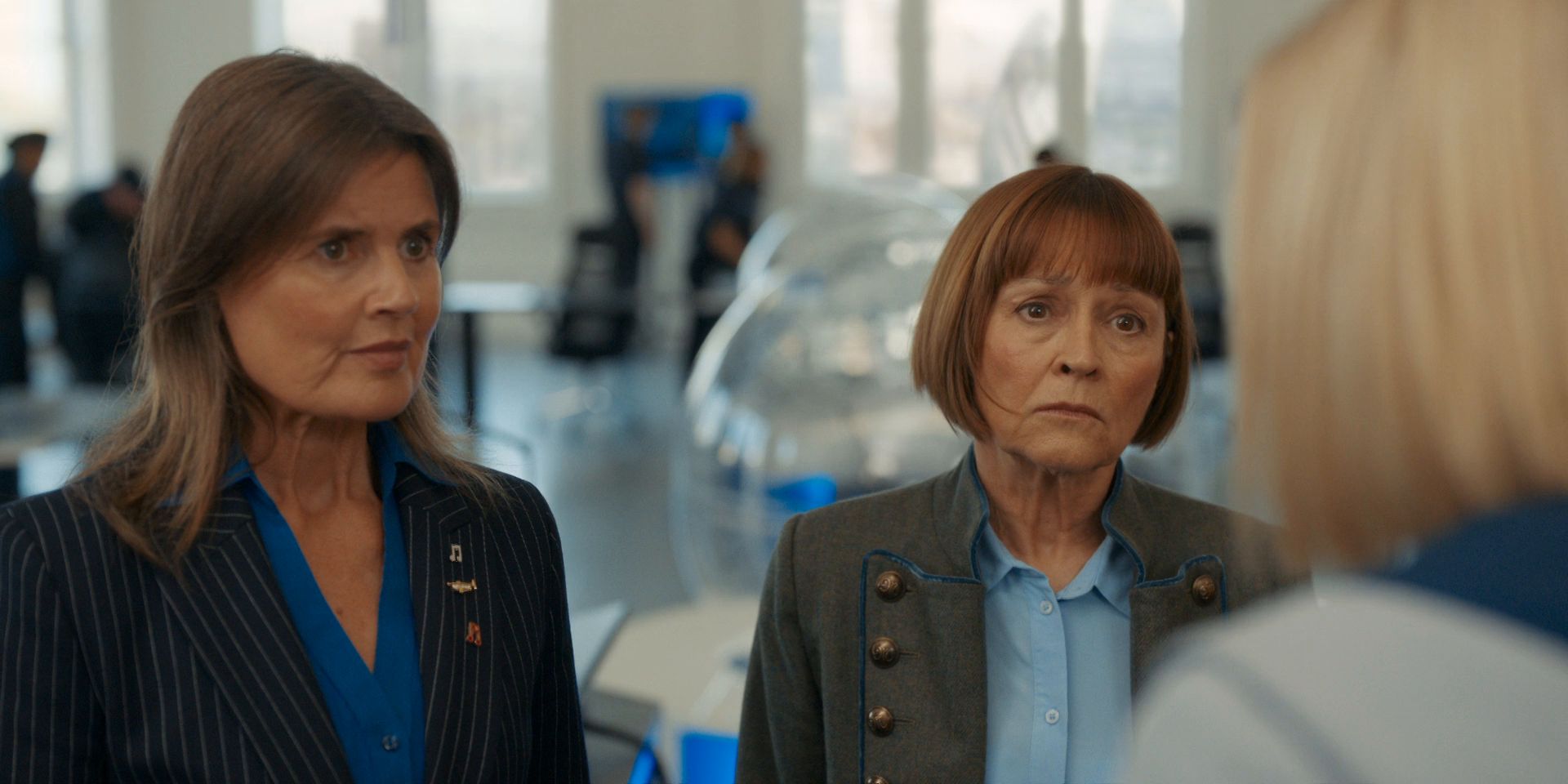
An unexpected reunion: The Doctor runs into past companions Ace (Sophie Aldred) and Tegan (Janet Fielding).

CHARACTERS:

The Doctor: Jodie Whittaker's final story, and it's a pretty good last outing for her. She is disturbed by the Master's "warning," and makes certain preparations before walking into his trap, which allows her to actively work with her friends even while she's technically incapacitated. I love the way she faces her regeneration at the end. It is neither mawkish nor protracted, but rather a look toward the future as she tells her incoming successor: "Tag, you're it."

Yaz: Sometime during the course of her travels, she has prepared a diagram and post-it notes for steering the TARDIS if the need arises. This speaks volumes about both her sense of preparation and her realism. For all of her love for (borderline worship of) the Doctor, she still realizes that her friend is not as invulnerable as she pretends. If something happens, Yaz doesn't want to end up stranded, and she has paid attention and taken steps for that eventuality. She also reacts with an absolute, forceful rejection to the idea of the Master smearing the Doctor's name, seeming to find that even more loathsome than if the Master had simply killed her.

Dan: After a particularly close brush with death, Dan re-evaluated his new lifestyle and opts to exit with his skin intact. This may have been for the best. This story is already juggling a lot with the Master, the regeneration, the returning Ace and Tegan, and giving good roles to both the Doctor and Yaz. Had Dan stuck around for the duration, he would almost certainly have been consigned (again) to the role of "spare part." At least this way, he gets a couple moments that are his own. John Bishop has been wonderful throughout his brief tenure, making the most of every scrap he's been given, and that continues to be the case here. In a way, though, that makes it all the more aggravating that we didn't get just one truly Dan-centric story some time over the past season-and-a-bit.

Tegan: Janet Fielding is one of two Classic Series regulars who return for this episode. Tegan remains as irritable as ever. She has not forgiven the Doctor for never contacting her again after she left. This is arguably unfair, as it's not as if she gave the Doctor any reason to believe that such contact would be welcome, but it is in character. Her reaction to seeing the Doctor's newest form is to sniff about how young she is. She eventually admits that she still misses the Doctor, and she gets emotional at a reference to Adric.

Ace: The other major Classic Series return comes in the form of Sophie Aldred's Ace. The original series' cancellation meant that we never saw her separation from the Doctor; other media has filled in the gaps, but knowledge of that isn't really needed. We are told enough to know that the 7th Doctor and Ace parted on even worse terms than the 5th Doctor and Tegan did. Despite this, she is openly enthusiastic at their reunion, and happily chirps that the current incarnation is "a good look." She even continues to refer to the Doctor as "Professor."

Graham: It's appropriate that one of the Thirteenth Doctor's own past companions makes an appearance. The final scenes of Revolution of the Daleks established that Graham and Ryan would continue investigating strange occurrences.  It is such an investigation that leads to Graham wandering into this story entirely on his own power. He ends up paired with Ace, and they make a surprisingly entertaining duo. Bradley Walsh works well with Sophie Aldred, and the two characters' contrasting personalities make for some enjoyable exchanges.

Kate Lethbridge-Stewart: The Power of the Doctor may just see Jemma Redgrave's best performance as Kate. What I appreciate most is how palpably frightened she of the Cybermen. When she confronts Ashad, she is shaking, knowing all too well what fate likely awaits her. She also gets to show a lighter side, with her genuine eagerness at the chance to enter the TARDIS. Her scientific background seems to be remembered in her reaction. Rather than simply express wonder at the TARDIS being bigger on the inside, she asks how it's bigger.

The Master: Sacha Dhawan's Master survived the events of The Timeless Children, though exactly how is never explained ("I'm indestructible; the whole universe knows that!"). He retains the same core of self-loathing. He doesn't want just to defeat the Doctor, or even just to take her remaining regenerations; he wants to be someone other than himself by claiming the Doctor's identity. When the Doctor and her companions thwart his plan, he pleads - as if to an uncaring universe - "Don't let me go back to being me." The irony of this plea being that there's no point in the story at which he behaves as anything other than The Master... which, if I'm honest, feels like a missed opportunity. It might have been interesting if, after taking the Doctor's identity, he had felt some "Doctorish" impulses, but the effect as portrayed isn't particularly different than if he'd snuck into the TARDIS and stolen her wardrobe.

Daleks: Are included because this is the big special celebrating the BBC's Centenary, because there was a chance that this would be the last Doctor Who story for a while, and because the New Series never misses an opportunity to overuse the Daleks. Within the confines of the story, however, they are mostly pointless. They fulfill the narrative demand of giving Ace something to do in the Final Act; but by and large, they could be removed entirely, and the story might actually be structurally cleaner for it. I guess it's nice that Ace's anti-Dalek baseball bat still works, though.

Cybermen: Unlike the Daleks, they actually seem like part and parcel of the narrative, and they work much better as a result. The Cyber-Master design looks just as silly here as it did in The Timeless Children. Thankfully, more is seen of Ashad and the regular New Series Cybermen. The scenes with the Cybermen invading UNIT develop a reasonable amount of tension, with Ashad's exchanges with Kate showing that he's still as vicious as ever. The Cybermen are a bit too easily defeated... but then, that's an issue hardly unique to this story, and the resolution to their subplot still beats "I blew them up with love!" By a lot.

Past Doctors: Chris Chibnall uses the Centenary to celebrate the Classic Series not just by bringing by Ace and Tegan, but also by bringing back Classic Series Doctors. Peter Davison and Sylvester McCoy get particularly good scenes opposite their prior companions. Jo Martin's Fugitive Doctor also receives a strong scene, which is appropriate since she's been a big part of the current era. Meanwhile, McGann, Colin Baker, and David Bradley's First Doctor show up for less than a minute each - though that's still long enough to enjoy their presence, and it's particularly nice to see Colin Baker giving such a relaxed and restrained performance. I suspect this will be their collective final bow for television Doctor Who, but the way in which this story uses the Past Doctors provides a ready, ongoing excuse for future showrunners to bring them back with no care for the actors' ages.

Band of Villains: The Master (Sacha Dhawan) makes a pact with the Daleks and the Cybermen.

THOUGHTS:

The Power of the Doctor hits the ground running with a set piece involving Cybermen attacking a bullet train in space. It never really slows down from there, as we're taken in rapid succession to: 1916 Siberia (Rasputin! And he's the Master!); UNIT HQ; a Cyber planet in Earth's orbit; and a Dalek dig site under an active volcano (did they have to exterminate Blofeld first?). We're zipped from location to location, and the high production values of this era and the large scale make this often feel less like a television special than a movie.

The benefit of this approach is that it's easy to get caught up in the rush. Writer Chris Chibnall and director Jamie Magnus Stone do a creditable job of keeping the scenes flowing nicely in and out of each other, so that it all feels like a unified narrative and not just a jumble of activity. As a celebration of 100 years of BBC history (of which Doctor Who's history is an integral part), it's also a joy to see the cameos by past Doctors and companions.

The downside? The story might be large-scale and fast-paced, but it doesn't really seem to be about much of anything. The plot mainly seems to be there to incorporate the fanservice. I've already mentioned how superfluous the Daleks seem. Add to that the Master's entire Rasputin disguise. As far as I can determine, he passes himself off as Rasputin so that he can taunt UNIT and the Doctor through altered art and then enjoy a dance number in the Winter Palace. This isn't entirely a complaint: The dance number is kind of brilliant, and none of this is even a tiny bit out of character. But on a pure plot level, it doesn't really do much.

The Thirteenth Doctor enjoys one last sunrise.

THE REGENERATION:

One aspect of this story that I cannot fault is the regeneration itself. After a brief protest that she wants more time, the Thirteenth Doctor stops and accepts what's happening - in part, I think, for Yaz's sake, but also because she recognizes the natural cycle of it. Her goodbye to Yaz, as they share ice cream atop the TARDIS while floating in space, is charming and acts as a sort of parallel to their date under the sea. Then she embraces the inevitability of the change in the light of a sunrise: the final dawn for this set of eyes, and the first for the next.

The story itself is far from my favorite New Series regeneration story. That said, I think this is my favorite New Series regeneration scene, and by a fairly substantial margin.


OVERALL:

Back in my Series Eleven Overview, I stated that Chibnall's best episodes tended to be the ones that were the most emotionally authentic, in contrast to Steven Moffat's big concepts and rapid spectacle. In that same overview, I expressed my hope that Chibnall could fix some of that season's issues with pacing and weak character interactions without throwing out those changes that had actually worked.

The Power of the Doctor mostly embraces style over substance. Yet its best moments are once again the ones that ring emotionally true: the Fifth and Seventh Doctor's brief reunions with their old companions; Thirteen standing at a very special crossroads; Kate's genuine terror of the Cybermen; and the Thirteenth Doctor's beautiful final moments. These are the scenes I will remember from this special, long after the bullet train action sequences, lethal skybeams, and dance numbers have slipped from my memory.

In the end, I enjoyed this special for what it was.  Still, it would have been nice if there had been something more substantial at the heart of it.


Overall Rating: 7/10.

Previous Story: Legend of the Sea Devils
Next Story: The Star Beast

13th Doctor Overview

Review Index

To receive new review updates, follow me:

On BlueSky:

On Threads:

Sunday, December 5, 2021

#21 (13.0): Revolution of the Daleks.

Prime Minister Jo Patterson (Harriet Walter) unveils her new security drones: The Daleks.

1 episode. Running Time: Approx. 71 minutes. Written by: Chris Chibnall. Directed by: Lee Haven Jones. Produced by: Alex Mercer.


THE PLOT:

The Doctor is in prison.

Captured by the Judoon and sentenced for the crimes of incarnations whose very existence she can't remember, she has now spent decades in a facility that is also home to Weeping Angels, Ood, and even a P'Ting. Fortunately, an old friend has come to rescue her: Captain Jack Harkness (John Barrowman), who uses his Time Vortex Manipulator to sweep her back to her TARDIS, so that she can rejoin her friends in Sheffield.

Unfortunately, the Doctor arrives ten months after her friends' return. The new Prime Minister is Jo Patterson (Harriet Walter), and courtesy of her connections with American businessman Jack Robertson (Chris Noth), she is introducing a new innovation - a security drone that she promises will ensure the country's security. The Doctor and her friends recognize these drones instantly: Daleks, reproduced from the wreckage of the Dalek recon scout the Doctor previously defeated!

The Dalek creature also survived.  It has used human DNA to supplement its genetic code and has cloned itself. With thousands of Daleks rolling off the assembly line, the Doctor has no choice but to call for help to the one force in the universe capable of destroying these mutated Daleks.

The pure-bred Daleks are coming to Earth. And it's the Doctor herself who invited them...


CHARACTERS:

The Doctor: When she discusses the Master's revelations about her hidden past, she reveals that she's angry. Unfortunately, this mostly doesn't show in the actual episode... or any other emotion, really. Part of this is the script, which has the Doctor say that she's angry in one scene and say that she's sad in another; there's very little less authentically emotional than hearing a character directly tell us their emotions. The rest, I'm sad to say, is Jodie Whittaker's performance. She's perfectly fine insofar as there are no badly played scenes or misjudged acting choices... but the spark that's carried so many episodes just isn't there this time. It feels like an "end of the production block" performance, and is adequate but no more than that.

Yaz: Was the most hurt by the Doctor's ten-month absence. Yaz has spent that time literally living inside the TARDIS that was the vessel for her and her friends' escape while searching for any information about the Doctor. When she hears the sound of the Doctor's timeship, she pleads aloud for it to be real... only to angrily shove the Doctor upon her appearance, snapping at her about how worried they were. Later, when the Doctor hatches her final plan, she pauses to assure a worried Yaz that she won't disappear; Yaz replies sadly that someday, the Doctor will do just that.

Jack Robertson: Chris Noth returns as business mogul Jack Robertson... unfortunately. Chris Noth has never been my favorite actor, and I pretty much hated both his performance and the character in Arachnids in the UK. This is a better episode, with a script that makes a reasonable effort to mold him into more of a character and less of a comedy sketch creation. He's cautious enough to try to talk the incoming Prime Minister out of rushing the Dalek rollout, and reacts with appropriate disgust when shown the first cloned creature. He's still an opportunist, and when he sees an opportunity to turn the crisis to his advantage he can't help but take it, but there are notes that a more nuanced actor might have played. If anything, however, Noth is even hammier than before, at one point actually growling at one of his associates. The door is again left open for Robertson to return, and dramatically speaking that's something that should happen... but I really hope it doesn't.

Capt. Jack Harkness: In what is all but certain to be his final appearance as Jack, John Barrowman delivers a "Capt. Jack's greatest hits" compilation: Quips about how good the Doctor looks in red, references to exactly how he stored his tech to smuggle it into prison; calling Graham as a "silver fox"; and blowing stuff up with a wink and a smile. More interesting is his conversation with Yaz. Jack understands how it feels to be left by the Doctor, and in one of the episode's best moments is able to both listen to Yaz's frustrations and respond to them in a mature and thoughtful manner.

Daleks: 2020's Resolution was essentially Chris Chibnall's take on Dalek, with a lone Daleks causing havoc.  This story has shades of The Power of the Daleks, with greedy humans eager to use the Dalek technology to further their own agendas while mainly just setting themselves up for destruction. There's not much new here. Chibnall recycles the Dalek possession bit from Resolution, and his climax draws in the "Dalek purity" idea that drove the plot of Remembrance of the Daleks. I actually like the redesign of the sleek black "Robertson Daleks," however, and wouldn't mind seeing it used again.


THE DEPARTURE OF GRAHAM AND RYAN:

This episode sees the departure of Graham and Ryan after two full seasons. The actual exit is done well enough, building on the restlessness Ryan expressed back in Can You Hear Me?, in which he wondered how much longer they (really meaning, he) could continue doing this. He's the one who really wants to leave, having come to the conclusion that it's time for him to return to his life to try to make a positive contribution to Earth in the present. Graham would as soon keep traveling... but if Ryan is staying, then he prefers to stay with the young man who's finally comfortable calling him "family."

I like that this is an entirely voluntary exit, the first Doctor Who has offered since Martha Jones in Series Three. I just wish it had come a year earlier. The Graham/Ryan arc was the strongest element of Series 11, but it came to a close in The Battle of Ranskoor av Kolos, with the return of Ryan's father in Resolution adding an effective button. Had they left at that time, I think the exit would have been more effective. Series 12 had little idea what to do with them, pushing them mostly to the background, and even this episode gives them little to do beyond leaving. Given that, it's hard to feel sorry to see them go.


THOUGHTS:

Resolution, Chris Chibnall's previous Dalek story, was surprisingly good. It re-energized the Daleks as a genuine threat, had some real tension and momentum to it, and overall felt fresh. A weak ending was all that kept it out of the upper ranks of Dalek tales.

The good news is: Revolution of the Daleks has a better ending. The bad news? It's not as good an episode. At 71 minutes, I think it needed to be trimmed closer to 60. There's little momentum here; large chunks feel downright sluggish. The means by which the Doctor defeats the Daleks is clever and fits the pieces that are established in the first part of the episode. But the beats feel slightly off, the humans lingering long enough for me to wonder why the Daleks haven't shot them yet.

The episode is entertaining overall, with well-staged action scenes and solid performances (well, except for Noth). It even offers up some decent social commentary, as the Prime Minister's promise to the voting public is that the Daleks will offer security. We then see them deployed, with the public either oblivious to them or snapping selfies - with not a single person seeming the slightest bit concerned.

As a basic Dalek runaround, Revolution of the Daleks does its job. But it feels oddly slack, multiple scenes feeling as if they should have been cut tighter; and despite getting better material, Chris Noth manages to be even worse than in his first appearance. All told, it's perfectly OK entertainment. But since it was billed as an "event," being merely "OK" feels a bit disappointing.


Overall Rating: 6/10.

Previous Story: The Timeless Children
Next Story: The Halloween Apocalypse

Review Index

To receive new review updates, follow me:

On BlueSky:

On Threads:

Tuesday, February 11, 2020

#17 (12.7): Can You Hear Me?

Yaz recalls the worst (and best?) day of her life...

1 episode. Running Time: Approx. 49 minutes. Written by: Charlene James, Chris Chibnall. Directed by: Emma Sullivan. Produced by: Alex Mercer.


THE PLOT:

The Doctor drops her companions off in present-day Sheffield to let them reconnect with friends and family, agreeing to pick them up the following day. Her companions' visits don't go smoothly. Graham plays cards with some old friends from his days as a bus driver, but soon has visions of a strange woman named Rakiya (Clare-Hope Ashitey) who is trapped and desperate for rescue. Ryan visits his friend Tibo (Buom Tihngang), who complains of nightmares that are starting to intrude on his reality. Yaz meets up with her sister, Sonya (Bhavnisha Parmar), for a peculiar type of anniversary celebration, only to see the mysterious Zellin (Ian Gelder) in her family's flat.

All three contact the Doctor, who has been drawn to a mental hospital in 14th century Aleppo - a hospital with only a single survivor, Tahira (Aruhan Galieva), who has somehow managed to avoid an attack by nightmare creatures. The Doctor realizes that she and her friends are being targeted, and uses the TARDIS' telepathic circuits to trace the incidents back to a space station orbiting two planets held at the edge of a collision - with a bizarre prison in the center of the suspended catastrophe.

The Doctor prepares to use the space station's technology to unlock the prison. But Zellin is waiting for them, ready to bring each member of the TARDIS team face-to-face with their deepest fears...


CHARACTERS:

The Doctor: When she is drawn to Aleppo, she starts to enthuse about a new adventure, filling her usual role of narrating interesting bits about the time period... only to deflate the instant she remembers that her companions aren't here, and that she is alone. When Zellin taunts her for her preoccupation with humanity, dubbing humans "endlessly pathetic," the Doctor is quick to respond with an impassioned speech about the human capacity for facing fear. But when Graham tries to confide his very real fears about his cancer returning, she has no idea what to say in response.

Yaz: Almost certainly the strongest episode for her thus far. In The Witchfinders, Yaz revealed that she had been bullied as a teen, and that she "took it" and endured "the year from hell." This episode's dream sequences and flashbacks reveal that Yaz was at the end of her rope, her grades dropping dramatically, feeling unable to confide in her family. A police officer (Nasreen Hussain) talked her out of desperate action, and it seems certain that this intervention led to Yaz's choice to join the police herself. Mandip Gill does well with this material, and Yaz feels instantly more complete as a character for this attention; it's just a shame it took so long to get to it.

Graham: His fears about his cancer returning are more than reasonable - as he says, cancer never really goes away - and so it is very fitting that his nightmare would combine his worry about that with his loss of Grace. In his vision, Grace becomes his doctor - a cold, uncaring doctor who blandly informs him that he is dying. Then she becomes the voice of Graham's guilt, coldly demanding to know why Graham didn't save her, leaving him only to beg for a chance to try again - which would almost certainly be his single greatest wish.

Ryan: His strained visit with Tibo reminds him that these travels come with consequences. The more time he and the others spend away from home, the more disconnected they become from the people in their lives. His nightmare is about exactly that, as he sees an old Tibo telling him accusingly that he waited for Ryan to return, and that Ryan never came back. At the end, he wonders to Yaz how much longer they can keep traveling with the Doctor. It seems apparent that he is seriously debating if he can continue.


THOUGHTS:

It seems as if every time Doctor Who airs a single-part story, there are people wishing it had been a two-parter. I rarely agree with that statement. Just looking at this season: the Tesla episode works very well as it is; Praxeus is perfectly solid filler; Fugitive of the Judoon's single biggest asset is that it's such a breathless, non-stop roller coaster ride; and the very last thing I would want from Doctor Who is more Orphan 55, thank you very much.

But in the case of Can You Hear Me?, I actually agree with the sentiment. I think it's a good episode as it stands; the character material for the regulars is extremely welcome, while the main plot gets a boost from some effectively moody imagery (director Emma Sullivan is a keeper). But the plot feels rushed, the conflict reduced to just a couple of conversations, while the resolution is far too easily achieved.

The reason for that is evident. The character material is what's most essential, so it is in those scenes that the pace slows down so that the moments can have impact. However, the plot suffers, effectively squeezed around those character moments. I would make the exact same choice, if forced to fit this story into 50 minutes. But if this had been a two-parter, with the Doctor falling into Zellin's trap acting as the cliffhanger, then the story would have room to breathe. There would be time for some complications - Maybe a less rushed, more difficult escape for the Doctor, perhaps a need to actually locate Zellin (I can see chasing him across various locations as a fun little set piece), and showcasing more damage done by Zellin when he begins absorbing nightmares.

Don't get me wrong; I enjoyed this episode, and it will definitely be one I rewatch. However, this is one case where a second part might have turned an already good installment into something truly special.


THE DOCTOR/GRAHAM MOMENT

The conversation between Graham and the Doctor is one that seems to have ignited a lot of debate, so it would be remiss of me to exclude it from this review.

For my part, I like the scene.  It's a messy interaction, born out of a messy situation, in which one very open person (Graham) confides in a very closed-off person (the Doctor).  The performances of Whittaker and Walsh are absolutely on-target, and they play well opposite each other; I strongly wish the show would provide more one-on-one interactions between these two.

Graham's fear of the cancer returning is entirely reasonable, and both of them know that. The Doctor has no words of comfort, has no idea what to say, and tries to let him know that without simply dismissing him. Whether he understands that or feels slighted is left up in the air, however - And I think it's significant that the Grace "Doctor" in his nightmare is an aloof figure, cold and detached. It raises the question of if that's how he ultimately views the Doctor.


In any case, the scene works for me... But as with many elements of this episode, I think it might have worked better if the story had been spread across two parts, to allow more groundwork to be laid.


Overall Rating: 7/10. Almost an "8." And if this had been a 2-parter, I'd have put it in with a chance of being a "9" or even a "10."

Previous Story: Praxeus
Next Story: The Haunting of Villa Diodati

Search Amazon.com for Doctor Who

Review Index

To receive new review updates, follow me:

On BlueSky:

On Threads:

Saturday, October 26, 2019

#10 (11.10): The Battle of Ranskoor Av Kolos.

Graham announces his intent to seek revenge on the alien who killed his wife.

1 episode. Approx. 50 minutes. Written by: Chris Chibnall. Directed by: Jamie Childs. Produced by: Nikki Wilson.


THE PLOT:

The time travelers come to Ranskoor av Kolos, a planet that is the origin point for several distress signals, and whose name roughly translates to "Disintegrator of the Soul." The planet is home to the Ux, a long-lived race that uses the power of its faith to bend reality - Which explains why the atmosphere is wracked with reality-distorting waves. The Doctor counters these waves by fitting her team with neural blockers that they must wear at all times. "Don't lose them," she admonishes.

They materialize on a ship, and are confronted at gunpoint by its captain, Paltraki (Mark Addy).  He has lost his memory, but starts to regain his faculties after the Doctor gives him a neural blocker. Looking around the ship, they discover a strange object - a rock of some type encased in a protective substance, which Paltraki recalls is important in some way.

The ship's communicator sounds, and a masked figure demands the captain return the object - killing a captive member of Paltraki's crew to demonstrate his seriousness. The voice is a familiar one: T'zim-Sha of the Stenza, the alien responsible for killing Grace. He is posing as The Creator, the Ux deity, manipulating and weaponizing their faith to serve his ends.

Hearing his voice, Graham becomes very still and reserved. As they move out to rescue Paltraki's surviving crew from the floating Ux shrine where they are imprisoned, Graham pulls the Doctor to one side and informs her of his intent: To kill T'zim-Sha if he gets the opportunity, to get justice for Grace. Even if that means the end of his time in the TARDIS.


CHARACTERS:

The Doctor: It's clear how serious she considers this situation to be when, before entering the Ux shrine, she produces grenades and bombs. When Ryan calls her out on her willingness to use these weapons after chastising him for shooting sniper bots, she blithely replies that her rules are "flexible... (They) change all the time." One consistent trait of this Doctor is a greater respect for faith than previous incarnations. We saw her join in with a vigil in The Tsuranga Conundrum, and preside over a wedding while freely talking about faith in Demons of the Punjab. Here, she meets Andinio (Phyllis Logan), the Ux leader, and remains not just respectful but downright impressed at the feats she and her kind can perform through faith - While at the same time showing naked scorn for T'zim-Sha, for manipulating and weaponizing their abilities.

She behaves differently with each character in this episode. With Paltraki, she is cautious but compassionate, patiently explaining that she is here to help even as he points a weapon at her. With Andinio, she acts as a voice of reason, asking questions to challenge her belief in T'zim-Sha as The Creator, particularly the question of how he can possibly know her. With Graham, she is very direct: If he takes revenge for Grace - assuming he survives the attempt - she will not allow him to travel with her anymore.

Graham: Is very direct in telling the Doctor that he will kill the Stenza if he gets the chance. The way he does it, pulling her aside to talk to her privately, feels like a mark of respect. He knows she won't approve, but he will not insult or betray her by trying to hide his intentions. When Ryan calls him on his revenge plan, demanding to know what Grace would have thought of such a course, he replies: "Your Nan would want to be alive. She actually liked being alive, and she was really good at it!" For all of his anger at the Stenza, however, he does not neglect the task of freeing the prisoners to try to hunt him down. He focuses fully on the job at hand, not compromising the safety of his charges at any point. It seems clear his intent is exactly as he says it is: If he gets the chance to kill T'zim-Sha, he'll take it, but he won't go so far as endangering others to get that chance.

Ryan: When the others wonder what happened to Paltraki's crew, Ryan jumps to the worst possible conclusion and wonders if the troubled captain killed them. This is consistent with the previous episode, when his first thought was that Hanne's father had abandoned her. In that episode, he was right; in this episode, he is wrong - But taken together, it seems clear that he instinctively looks for the worst in people, likely as a result of his abandonment. Graham is the one male authority figure who hasn't abandoned him, despite his early efforts to push him away. By this point, he has accepted Graham as family, and even tells the older man that he loves him and doesn't want to lose him... and at the end of the episode, Ryan goes back for him, almost certainly saving his life in the process.

Yaz: "I'm with you, whatever happens." Said flatly and firmly, when the Doctor tries to send her away in the closing stretch. She has developed an unswerving loyalty to the Doctor. When the Doctor hesitates to disconnect the Ux from a Stenza device, Yaz prods her with all that is in the balance - But she doesn't try to override the Doctor's judgment or enforce her own. Instead, she seems to trust that the Doctor will find a way to do what's necessary while still staying true to her own moral code.


THOUGHTS

The Battle of Ranskoor Av Kolos is the Series Eleven finale... sort of. Given that Resolution aired less than a month after this, and followed up directly on the Graham/Ryan character arc while also delivering a story that felt a bit "bigger" than the norm, I'd argue that it is the true finale in all but name. I'd also argue that this line of thinking helps the season as a whole. It certainly helps The Battle of Ranskoor Av Kolos, because while this isn't at all bad when judged simply as an episode, it does not do the job as a finale.


WHAT WENT WRONG: MORE TIME NEEDED

This episode really needed to be 60 or 65 minutes. It has many potentially interesting ideas and plot turns, but most of them don't get enough time to make a proper impression. The last part of the episode sees the Doctor and Yaz attempting to stop the Ux from destroying Earth while convincing them of T'zim-Sha's true nature. They remove their neural blockers, which the Doctor modifies to interrupt the Ux's mental signal - but at the cost of exposing them to the planet's disruptive mental effects.

This should be a fantastic way to ratchet up the tension at the climax... Except that the episode does nothing at all with it. We should see the Doctor and Yaz fighting to keep their focus and even their sanity while still solving the problem - perhaps with Yaz succumbing to the effects and the Doctor having to incapacitate her while still battling to finish the job. That would convey a sense of tension, conflict, and jeopardy. It would also require at least a few minutes of screen time to play out. Instead, we just get a line from the Doctor about feeling "fuzzy" and a few constipated expressions from Yaz in the background, turning what should have been a terrific complication into... Well, nothing really.

In the same scene, after fitting the Ux with the neural blockers, the Doctor still has to convince them that their "god" is nothing of the sort. This turns out to be remarkably easy to do. The Doctor just tells Andinio who T'zim-Sha really is, and Andinio instantly believes her. Far too easy, and utterly undramatic. With more time, the episode might have found a more convincing and interesting way to convince her, perhaps with T'zim-Sha himself accidentally revealing the truth when taunting the Doctor. As it stands, it takes the Doctor a little over ten seconds to talk around a woman who should be desperate to cling to her beliefs, if only so that she can continue believing that all she has done has been for some greater good.


WHAT WENT RIGHT: ATMOSPHERE AND STRUCTURE:

Director Jamie Childs has been the big find of this season. All four of his episodes have demonstrated an ability to create a strong visual atmosphere. Given a script that's too often guilty of telling instead of showing, Childs creates tension out of a wasteland of destroyed spaceships, or out of the artificial, yellow-hued lighting inside the Ux shrine. The visuals of T'zim-Sha, framed always in the darkness, lit indirectly from light that's anywhere but where he is, make the Stenza more formidable and threatening than in his earlier appearance, and the use of close-ups is particularly effective.

I will also credit Chibnall's story structure. The first Act raises mysteries: What happened to Paltraki's crew? What is the nature of the object Paltraki took from the Stenza? The first question is answered quickly, kicking off the rescue mission that drives the story. The answer to the second question is held back until near the end, but the script continually returns to it, with the Doctor asking it of both Andinio and T'zim-Sha.

An attempt to ratchet up the stakes by threatening Earth feels forced and doesn't quite land, but the resolution of Graham's revenge plot is more satisfying.  He ultimately does not kill his target, but takes a more poetic justice - As with the Doctor's freeing of the Ux, he finds a solution that fits within his moral code while still satisfying his need for justice.


OVERALL:

I will admit that, as an episode in itself, I find The Battle of Ranskoor Av Kolos quite entertaining. Even with the weaknesses, I strongly suspect it would have been much better-received had it aired in the mid-season, perhaps as a set up for a final confrontation with "Tim Shaw" later on.

That said, I will acknowledge that this episode is all surface. I was entertained, but I was never emotionally engaged, and I never felt like the stakes were as high as the script kept insisting they were.


Overall Rating: 6/10. Judged as an episode. But at least one point lower if judged as a finale.


Previous Story: It Takes You Away
Next Story: Resolution

Search Amazon.com for Doctor Who

Review Index

To receive new review updates, follow me:

On BlueSky:

On Threads:

Saturday, September 28, 2019

#6 (11.6): Demons of the Punjab.

The Doctor presides over a wedding on the eve of tragedy.

1 episode. Approx. 50 minutes. Written by: Vinay Patel. Directed by: Jamie Childs. Produced by: Nikki Wilson.


THE PLOT:

After celebrating her beloved grandmother Umbreen (Leena Dhingra)'s birthday, Yaz decides she wants to see her as a young woman, to get a sense of the stories she's not willing to share. The Doctor is hesitant, worried about the risks of Yaz interfering with her own timeline. She agrees, but only after extracting a promise that they will not get involved, not interfere, and will leave after one hour.

When they arrive, Yaz is startled to discover that the young Umbreen (Amita Suman) is preparing to be married - to Prem (Shane Zaza), a Hindu man who is decidedly not Yaz's grandfather. The families also disapprove; Umbreen's mother (Shaheen Khan) believes the union is cursed, while Prem's younger brother Manish (Hamza Jeetoa) does not want to see Prem marry a Muslim.

The Doctor is less concerned with the family drama and more concerned with the date of their arrival: August 14, 1947, the day before the Partition of India: The separation of the territory into the countries of India and Pakistan - which would lead to rising religious violence between Hindus and Muslims who had lived together for centuries. "It's not just the land that gets divided," the Doctor observes. "Tens of millions of people about to be displaced. More than a million about to die!"

The Doctor and her friends aren't the only aliens in the area. They discover two aliens standing over the body of the holy man who had agreed to perform the wedding ceremony. The Doctor identifies them as Thijarians, a race of legendary assassins. Prem has a revelation of his own: He has seen these demons before - In the war, standing over his older brother's dead body!


CHARACTERS:

The Doctor: The Doctor is hesitant when Yaz asks to travel back to see her grandmother. "The wrong word in the wrong moment, you could interfere yourself out of existence," she warns. "Tread softly - You're treading on your own history." She enjoys joining the women the night before the wedding, remarking that she "never did this when (she) was a man." Whittaker is positively radiant when the Doctor officiates the wedding, seeming to genuinely enjoy the scene while still maintaining a hint of the character's awkwardness.

We also get the reverse of these light moments. When she identifies the Thijarians as assassins, she demonstrates an icy fury as she warns them to leave Prem, Umbreen, and the rest alone. "They are under my protection!" she declares, her face practically a snarl. More of this, please! I actually think the friendly, happy Thirteenth Doctor could become downright frightening if something were to really set her off - and I would love to see an episode where that happens.

Yaz: Is stunned to discover that the young Umbreen's life is so different than what her grandmother has chosen to share. She is defiant when the Doctor tries to get her to leave, insisting that she needs answers. For the first half of the episode, she seems to jump at any excuse that might stop Umbreen's wedding. But as she comes to respect the young woman who will become her grandmother, she becomes more supportive, ultimately insisting on staying in a dangerous time and place just long enough to be sure Umbreen is safe.

Graham: Gets two excellent scenes. The first is a welcome conversation with Yaz. Seeing that she is upset at how little she knows of her grandmother's past, Graham reminds her that older people are under no obligation to tell their children and grandchildren everything. He reminds her that the young Umbreen is not Yaz's grandmother yet, and is busy living her life day by day; "It's only later she'll decide how to tell it." The second is a brief but heartfelt exchange with Prem. As the young man, about to be married, reflects on how inflamed his countrymen have become, Graham tells him, "All we can strive to be is good men. And you, Prem, are a good man."

Ryan: Gets a few nice interactions with Graham, particularly when he comments on the older man's singing. He is also the first to voice support for Yaz's decision to stay to make sure Umbreen is all right. Outside of that, he's mostly just present this week.

Thijarians: A part of me would have loved for this to have been a pure historical... But I have to admit, if given the chance I would not remove the Thijarians from the story. They work well within the narrative, their presence creating mystery and tension in the first two thirds, then supporting the theme and mood in the last third. The ending would simply not carry the same punch without their presence, particularly the last shot demonstrating just how many souls have already been claimed by this conflict. Also, the Thijarians are far and away the most interesting creation of Series 11, and very probably the best new alien race Doctor Who has introduced in years. They are well-designed, both visually and vocally, have a genuinely interesting backstory, and can inflict psychic pain on the Doctor - apparently, even when not actually trying to do so. Forget the Stenza - I want to see more of this race, perhaps a full story properly focused on them as assassins.


THOUGHTS

Vinay Patel, a playwright-turned-television writer, is probably best-known for his television film, Murdered by My Father, which tackled the subject of so-called "honor killings." In his first Doctor Who script, he again tackles themes of prejudice and fanaticism.  Heavy stuff for a family series... But his script not only connects - It hits it out of the proverbial park.

The Partition of India isn't exactly a well-known topic for Western viewers. Patel's script does a good job sketching in enough of the historical context for us to understand the time and place in which the regulars find themselves, and then studies the effects through the prism of one family. We're given enough context to appreciate the story, with viewers hopefully left with a drive to learn more - maybe even read a book (shock, horror), but if nothing else to at least do a Google search or two.

The guest characters are effective and well-performed, with Umbreen and Prem working both as a likable couple and as good one-shot characters in their own right. I'm most impressed, though, by the characterization of Manish, Prem's radicalized brother. Many scripts would have made him a cardboard villain; instead, he remains a fully-realized human being throughout.

Though he "spends too much time reading pamphlets, listening to angry men on the radio," he is introduced grinning with pleasure at Prem's return, and is genuinely welcoming to the regulars. At a certain point, his attitude becomes sullen and he grows angry and confrontational. Even then, it's clear that he's feeling genuine pain. In his confrontation with the Doctor, he is the one with gun; he is also the one who's afraid, and we can guess readily enough that this situation has slid very far from what he had originally envisioned or intended. At the end, he's as lost as the dead are - and probably soon to join them. It's good writing, well-acted by Hamza Jeetoa, and it makes the episode all the more effective that even its least sympathetic character is recognizably human.

In a season that's been visually strong throughout, Demons of the Punjab stands out as particularly beautiful, with excellent use of location filming. It's also interesting to compare this and Rosa to the rest of the season - Thus far, it's pretty much unmistakable that the episodes set in the past are working a lot better than the space tales and monster stories.


Rating: 10/10.

Previous Story: The Tsuranga Conundrum
Next Story: Kerblam!

Search Amazon.com for Doctor Who

Review Index

To receive new review updates, follow me:

On BlueSky:

On Threads:

Saturday, September 14, 2019

#4 (11.4): Arachnids in the UK.

The Doctor has a spider problem to deal with...

1 episode. Approx. 49 minutes. Written by: Chris Chibnall. Directed by: Sallie Aprahamian. Produced by: Nikki Wilson.


THE PLOT:

The Doctor finally manages to return Ryan, Graham, and Yaz to Sheffield - Getting them home just thirty minutes after they left. While Graham returns to his house to start dealing with the aftermath of Grace's death, Yaz invites the Doctor and Ryan to her apartment.

All is not well. A neighbor's apartment is covered in cobwebs, the woman herself suffocated in a cocoon spun by a giant spider. The Doctor contains the spider, then investigates with the help of arachnologist Dr. Jade McIntyre (Tanya Fear). Jade reveals that spiders have been behaving strangely, and the Doctor traces reported spider incidents to their epicenter - a soon-to-open luxury hotel, owned by American business mogul Jack Robertson (Chris Noth).

Robertson is in the hotel, having just fired the hotel's manager - Yaz's mother, Nadia (Shobna Gulati). He's incensed by the intrusion of the Doctor and her friends, and more than a little anxious about them discovering a secret he's trying to bury. When they discover giant spiders throughout the hotel, however, even Robertson agrees that it's time to run - Except that the entrance has been closed off with spider webs thick enough to stop a plane!

"They're trying to make the whole hotel their web... and we're the flies!"


THE DOCTOR:

I noted in my review of The Woman Who Fell to Earth that Jodie Whittaker seemed to struggle with moments that required her to switch rapidly between light comedy and heavy drama. I've since revised that opinion - She struggles with goofy comedy, whether she's shifting between modes or not. The Ghost Monument and particularly Rosa saw terrific performances from her, in no small part because the goofiness was dialed back. Arachnids in the UK dials the goofiness up to Thirteen, and much of Whittaker's performance falls flat as a direct result. Writers, please note - More of "Do you practice those lines in a mirror?" and "Go take one of your heroic naps," and less (better still, no) babbling about purple sofas or mistaking people for Ed Sheeran.

Whittaker still finds some good moments among the chaff. I enjoyed her moment of pleasant surprise that she actually managed to get her companions home - Followed by her quiet sadness as she realizes that she's gotten them home and will likely have to say goodbye. When investigating a cobwebbed apartment and discovering the body of a woman killed by a spider, she dismisses Ryan's "Do spiders do this?" as the wrong question. The right question? "Where is the spider that did this?" Best of all is the final scene, in which the Doctor makes sure she has absolute, informed consent by her new friends before letting them join her on a longer-term basis. "I can't guarantee that you're going to be safe... When I pull that lever, I'm never quite sure what's going to happen." Twelve's losses still resonate, and she wants to be certain her new friends know what they're signing on for.

It does beg the question: How did the same person who wrote that scene also write so much of the guff that comes before it?


CHARACTERS:

Graham: In what's ostensibly a Yaz spotlight episode, Graham still gets the best material. The scenes in which he returns to his now-empty house carry surprising weight, an authentic feel of grief. He sees Grace in every corner, hears her voice reminding him about vacuum cleaner bags and trash days, and you can physically see the life drain from him. When he rejoins the others, he's back to his usual cheerful self, but we're now aware that some of the cheer is a facade, and some is him distracting himself from his own grief.

Yaz: Is the first to notice how difficult it is for the Doctor to say goodbye, and delays their parting by inviting her for tea - Which the Doctor accepts even before Yaz has finished speaking the invitation. She regards her family with exasperation, which is fair enough given that her conspiracy-loving father (Ravin J. Ganatra) has actually toted bags of trash home with him as "evidence."  Yaz does seem to have a bit of hero worship going on with the Doctor, instantly ready to defer to her when she arrives on scene and declaring her to be "the best person I've ever met."

Ryan: Despite his insistence that he doesn't know Graham that well, he does seem to be bonding more than he might like. When Graham brings him a letter from his father, Ryan is reluctant to read it. When he does, and sees his father has invited him to live with him, his "proper family," he is bothered. "I don't like that he put that," he tells Graham, adding that his father is "not proper."

"Yaz's Mum": Shobna Gulati is instantly likable as Najia, Yaz's mother. Chris Chibnall's script is a broad one, and he sketches her in very broad strokes, particularly her grilling Yaz about whether she's dating first the Doctor, then Ryan. But she's an engaging presence, and meshes well with the regulars. I particularly enjoyed her frustration when Robertson's secret is discovered. She's not mad that he's shady; she's mad that he's effectively proved her husband right about a trash-connected conspiracy. "Do you have any idea how annoying it is when my husband's right?!" Definitely a character I would enjoy seeing again - Hopefully in a better episode.

Pompous Bureaucrat of the Week: Jack Robertson isn’t so much a villain as a pompous bureaucrat of the type regularly ignored and/or insulted by the Doctor during Jon Pertwee's run. He's an arrogant, neurotic, germ-phobic, none-too-bright business magnate who's running for President of the United States to satisfy his ego... So yes, basically Donald Trump. His role in the story is to alternate between being idiotic and reprehensible, save for when he's being both at the same time. Noth, never my favorite actor, yells most of his lines while overacting every reaction, letting the air right out of a few exchanges that might have been amusing with an actor capable of underplaying.


THOUGHTS

I'll start with the positive. Like most of this season, Arachnids in the UK is beautifully shot. It would have been easy for the opening of the episode to cut straight into Robertson talking with underlings in a darkened room. Instead, we get a series of establishing shots of the hotel, with the camera moving us closer and closer in, until we finally are brought to Robertson's clandestine meeting. The hotel is a good choice of setting, offering a confined (presumably budget-friendly) space while still allowing enough visual variety to avoid monotony.

I will also say that for most of its running time, this episode is a lot more fun to watch than it should be. It's a stupid episode, but it moves right along. Whittaker fumbles some of the goofy dialogue she's given - But most of the other actors do pretty well, and this is surprisingly funny for a story in which multiple people are suffocated by disturbingly convincing CGI spiders. And yes - Unlike previous Who attempts at giant insects, these spiders look good!

I also appreciate this season's tendency to actually fall back on real science. The Doctor and an arachnologist supply a number of facts about spiders. When the story requires spiders to behave in an abnormal way - such as by attacking humans - the characters comment on how uncharacteristic the behavior is. The fate of the mother spider is also tied to real science. This keeps the Giant Spider story fitting with the more grounded tone of the season, even if its B movie inspiration remains clear.

Unfortunately, this is the first story of Series 11 where the bad outweighs the good. Even allowing for my general dislike of his work, Chris Noth's performance here is utterly atrocious. Jodie Whittaker is fine when she's not being forced-goofy... But she is given a lot of overly quirky/goofball moments in this episode, and she's just not good at them. Chibnall's not particularly good at writing them, either.

Worst of all is the story's resolution. As the Doctor tries to find a humane way to deal with the dying mother spider, Robertson blows right past her, shoots the spider, and swans off, entirely dismissive of her. The Doctor basically just stands there, offering a few weak protests and nothing more. The scene makes the Doctor both weak and passive. Now, it's OK for the Doctor to have moments of weakness. It's OK for the Doctor to sometimes be passive. The Doctor should never be both weak and passive at the same time!

The first misfire of the new era. Enjoyable enough to rate above the series' worst - But definitely below par, and an episode that highlights all too well some of the limitations of both the lead writer and the lead actor.

Rating: 4/10.

Previous Story: Rosa
Next Story: The Tsuranga Conundrum


To receive new review updates, follow me:

On BlueSky:

On Threads:

Saturday, September 7, 2019

#3 (11.3): Rosa.

Rosa Parks (Vinette Robinson), the day before she makes history.

1 episode. Running Time: Approx. 49 minutes. Written by: Marjorie Blackman, Chris Chibnall. Directed by: Mark Tonderai. Produced by: Nikki Wilson.


THE PLOT:

The TARDIS materializes in Montgomery, Alabama on November 30, 1955, where the Doctor detects an unusual amount of artron energy. Investigating, she and her companions have an encounter with Rosa Parks (Vinette Robinson) - the future Civil Rights icon whose arrest for refusing to give up her bus seat for white passengers kicked off the Montgomery Bus Boycott. Or will do, at least; Rosa's arrest will occur the very next day.

The Doctor discovers that Rosa is being stalked by a mysterious man named Krasko (Joshua Bowman), a man also very much out of his time. Krasko is armed with time displacement technology, a vortex manipulator... And a determination to change history. "Tiny actions change the world," he sneers. He intends to prevent Rosa's arrest, thus preventing the bus boycott and changing the course of the American Civil Rights movement... Leaving it to the Doctor to make sure that history stays on course, even if it means she has to create the circumstances of a historical injustice to do it!


THE DOCTOR

This is the episode that sold me on Jodie Whittaker's Doctor. The Thirteenth Doctor has thus far been characterized by a fairly goofy, almost bubbly persona. As soon as she realizes where and when they are and what that means for two of her companions, that goofiness is dialed back significantly. She is immediately protective of her new friends, urging them to return to the safety of the TARDIS. "It's easy for me here," she tells them, "It's more dangerous for you." I suspect some still very recent losses are on her mind, and she's determined to be more careful of her friends moving forward... Though she is happy of their help when they insist on staying.

Whittaker gets to finally show some steel in the encounters with Krasko. I can take no credit for this observation - which I read from an online forum - but it seems to be valid that the Thirteenth Doctor only shows the harsher parts of her nature when her friends are not around, almost like she's trying to protect them from herself. Confronting Krasko alone in the bus depot he has made his lair, all the jokiness vanishes and the smiles become thin and grim. She addresses her adversary with open contempt, daring him to lose control, warning him to stay out of her way. It's just a glimpse - The scene only lasts a few minutes - But it's the first proof that "The Doctor of War" is still very much present, and not to be taken lightly.

On a lighter note, I absolutely love the look she gives Graham when, while posing as her husband, he lays a hand on her shoulder. You can practically hear, "Yeah, don't do that" in her expression.


CHARACTERS:

Graham: Bradley Walsh cements his "season MVP" status. When Graham reflects on how Grace idolized Rosa Parks and how he wishes she could be with them now, you can see him deflate just a bit, a haunted look settling in the back of his eyes. He doesn't let his grief stop him, but it's still just beneath the surface. His interactions with, and manipulations of, bus driver James Blake (Trevor White) are enjoyable, showing the audience Graham's distaste for the man, while remaining subtle enough that we aren't wondering why Blake doesn't notice it. And his stricken expression at the end, as he realizes that he has a very unwanted role to play in this piece of history, is perfection, even before he speaks.

Ryan: Heedless of the realities of history, Ryan behaves exactly as he would in modern-day Sheffield. When a woman drops a handkerchief, he picks it up and taps her on the shoulder to return it - Only to be immediately struck by her husband for daring to touch a white woman. He doesn't initially connect the name "Rosa Parks" to historical events, having paid little attention in school because, "she's American." This gives a perfectly in-character opportunity for the script to deliver the needed historical context. Later, when he spends time with Rosa and Martin Luther King (Ray Sesay), he is suitably impressed, insisting on addressing the future icons by their full names, and pausing to grin at the wonder of where he is. This is all well-played by Tosin Cole, who delivers by far his best performance to date.

Yaz: Actually gets some good material! She is appalled when Ryan doesn't recognize who Rosa Parks is, and takes him to task for it. Later, they share a flirty moment while sneaking into the Doctor's hotel room through the window (the hotel is "whites only"). Hiding from a police officer, she and Ryan have a thoughtful conversation about the casual racism they encounter in the modern day, but Yaz stays determinedly positive in her outlook, pointing out how much better things are in the present vs. the past.

Rosa: Vinette Robinson gives a good performance as Rosa Parks. She carries herself with dignity, but it's clear in her interactions with white characters that she very much "knows the rules" of her society. Her ability to navigate within those rules allows her to defuse a potentially violent misunderstanding between a white pedestrian and Ryan, while her ramrod-straight posture points to the defiance that will lead to her famous moment. For the story's purposes, Rosa is more plot device than character; but there's enough characterization present for her to feel like a fully-rounded individual, which makes the ending all the more effective.

Villain of the Week: Giving credit where it's due, actor Joshua Bowman does a good job with his material. Krasko has just enough low cunning to be a legitimate adversary for the Doctor, even though she has him clearly outclassed. He radiates hostility in a nearly wordless encounter with Rosa, and in the confrontation with the Doctor we can sense the violence within him. Krasko remains the weakest element of a very good story - But Bowman gives his all, and puts a lot more into this carboard baddie than is there on the page.


THOUGHTS

I'll be honest - On first viewing, I dreaded this episode. "Time traveler meets famous Civil Rights icon so that we can learn the very important lesson that Racism Is Bad, mm'kay." It's the kind of episode that shows tend to do very, very badly - Usually served with a hefty side of condescension and self-righteousness.  It hardly increased my optimism that this is an episode of a British show centered around an incident in American history.

So it was with my guard up that I watched the opening scenes. My guard stayed up for a good 10 - 15 minutes on first watch. And then, I think around the hotel room scene, I felt myself relax as I realized that this actually, genuinely was going to be a good episode.

Props to writers Marjorie Blackman and Chris Chibnall for the expert story structure. This is the first episode of Series 11 that has no fat on it. Every scene advances either plot or character. Series 11 is not, on the whole, the fastest-paced season of new Who. But Rosa moves along briskly, one scene leading to the next, every scene and every exchange advancing the overall story.

While it's emotionally effective, it doesn't forget to be entertaining. Even in the early scenes, establishing Montgomery as hostile territory for Yaz and Ryan, we get bits of humor. Confronted by a waitress who informs him, "We don't serve Negroes," Ryan cribs from Muhammed Ali in replying, "I don't eat 'em." Yaz is referred to as a "Mexican," which becomes a minor running joke for the rest of the episode. Jodie Whittaker's small stature is used to amusing visual effect as the group makes plans in the hotel room, with her standing on the bed to stand (just barely) above the others. Oh, and Graham briefly becomes Steve Jobs. In short, the script remembers that even an "Issue Episode" needs to be entertaining.

The one misstep, for me, is in how Krasko is ultimately dealt with. He's dispatched in a way that feels cheap and lazy - "We're ready for our emotional climax, better get rid of the baddie now." The scene was jarring to me on first viewing, and remained so this time around. I'd have preferred the Doctor and company got him on the bus (perhaps incapacitated?), so that he would fill that last empty seat, prompting the driver to demand Rosa move. Almost anything would have felt less "off" than the resolution he receives here.

That one misstep is significant enough to keep me from giving this full marks - But it remains an excellent episode overall. I liked it on first viewing; I actually liked it even more on re-watch.


Overall Rating: 9/10.

Previous Episode: The Ghost Monument
Next Episode: Arachnids in the UK


To receive new review updates, follow me:

On BlueSky:

On Threads: