Showing posts with label Vinay Patel. Show all posts

Sunday, October 6, 2024

13th Doctor Overview.

The Thirteenth Doctor (Jodie Whittaker), with The Fam
The Thirteenth Doctor (Jodie Whittaker), with "The Fam."

I'm writing this just shy of two years from the end of the Thirteenth Doctor's era, just as I'm preparing to move on to viewing and reviewing Ncuti Gatwa's first season as the 15th Doctor. Before I move forward, I'm feeling a need to look back, because many of my thoughts about the tenure of showrunner Chris Chibnall and star Jodie Whittaker are not fully represented by my reviews of the individual episodes.

Fair warning: This is neither a hate post nor a love letter. If you're looking for relentless negativity, I suggest finding a YouTube video, probably one with googly eyes on the thumbnail that uses the word "woke" a lot. If you're looking for only positive comments, then do the same, only avoiding those particular search cues. I'm going to discuss both what worked for me (and a lot did) and my frustrations about elements that either didn't work or that I thought fell short of their potential.

As ever, this represents my own opinion, and other views are available.

The Doctor confronts a Cyberman.
The Doctor confronts a Cyberman - and Whittaker shines
with a script that lets her get properly angry for a change.

JODIE WHITTAKER AS THE DOCTOR:

The announcement of Jodie Whittaker's casting came during my burnout period, in which I was neither viewing nor reviewing Doctor Who or anything else. I will admit that the announcement caught my eye. Whittaker is an actress whose work I've generally enjoyed, and I found her to be particularly good in Chris Chibnall's Broadchurch. It took me another year to recover from my malaise, but her casting was one of the reasons I decided to return to Who when I was ready to start reviewing again.

My response to her first appearance was... well, mixed. She was fine in The Woman Who Fell to Earth, with excellent individual moments... but she also had several deliveries that struck me as either flat or just plain misjudged. It wasn't until Rosa that she won me over. Even then, Arachnids in the UK (in my opinion, her single worst performance in the role) made me doubtful all over again.

Her performance improves whenever a script avoids reducing her to "the nice Doctor." There are glimpses throughout Series 11: Her scenes with Krasko in Rosa, her interactions with both the Thijarians and Manish in Demons of the Punjab, her confrontation with King James in The Witchfinders, and her general grumpiness in Kerblam!  All of these moments saw Whittaker's performance noticeably improve.

Thankfully, that became explicit characterization in Series 12 and 13, as it became clear that this Doctor's friendly smile was a shield to protect her from getting too close to her companions. She may have labeled her first companion set "Fam," but she kept them at a distance, avoiding anything that resembled a meaningful personal question. If they pushed harder, as Yaz often did in Series 13, she became snappish and even hostile. The more these beats were played, the better both character and actor became.

Whittaker was excellent at showing the character's defensiveness, and I think she exceled in moments of frustration and anger. On the other hand, I don't think she ever quite got the handle of delivering sci-fi Technobabble. In her first season, her Technobabble scenes often reminded me of actors phonetically reciting foreign language dialogue. She got better (and the scripts wrote less of it for her), but it remained a weakness.

Her worst performances came whenever she was written as "Dr. Exposition." Her acting flattened in episodes like Praxeus, Revolution of the Daleks, and Survivors of the Flux, in which she was little more than a vessel for explanations. I got the impression she couldn't engage with reams of exposition, and I wasn't surprised when excessive exposition was one of the only complaints she voiced in interviews after her exit. 

The Doctor officiates a wedding between a Hindu and a Muslim during the Partition of India.
The Doctor officiates a wedding in Demons of the Punjab, easily my favorite episode of this era.

WHAT WORKS:

When the Chibnall era gets discussed, particularly after a couple years' distance, I see a lot of the sentiment: "Jodie was good, shame about the scripts." There is truth to that, but I think it's reductive.

There are a handful of fine scripts in these three-and-a-bit seasons. The stories from Vinay Patel and Maxine Alderton would stack up well in any era, and I hope both writers get a chance to submit for the series in the future. Chibnall's own stories include a solid new Doctor introduction in The Woman Who Fell to Earth; a terrific time-loop story in Eve of the Daleks; and, in War of the Sontarans, the best showing for the potato-headed warriors since their introduction during Jon Pertwee's tenure... though, as my review noted at the time, that doesn't clear the highest of bars; my pick for their previous second best story was the enjoyable but heavily flawed The Two Doctors.

In my Series Eleven overview, I stated some of my issues with that first season. Still, while I had quibbles with the execution, Series Eleven's attempt at a grounded and character-focused approach was something I had wanted to see from Doctor Who for a while. When the Doctor introduced herself as "just a traveler" who helps where she can, I wanted to applaud. I also love that all of Thirteen's companions are ordinary people - no dark secrets, no paradoxes, no alien plots. Just a group of average but highly decent human beings.
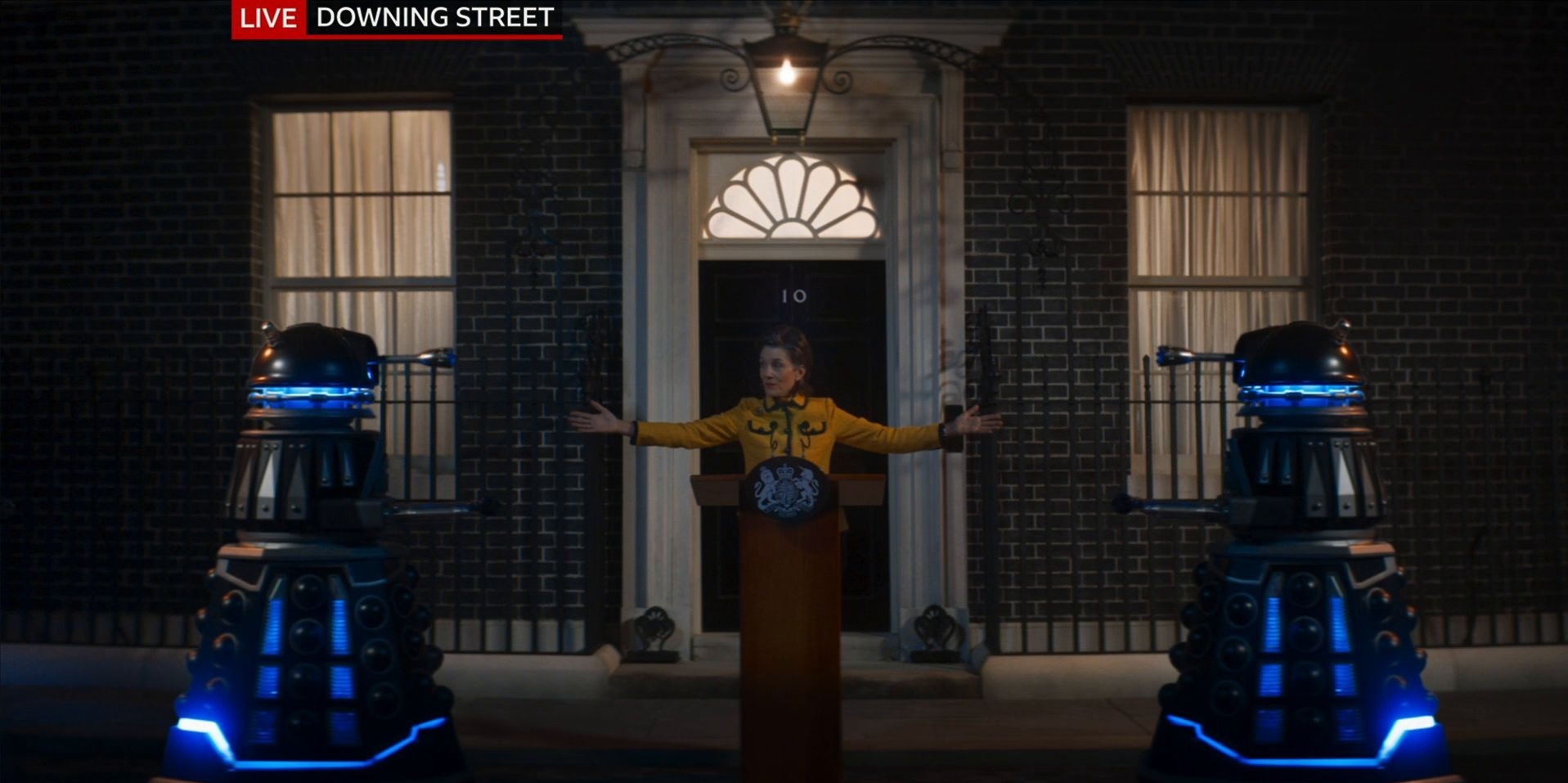
The Prime Minister introduces Daleks to the British public. It goes about as well as you'd expect.
Revolution of the Daleks. Like a lot of episodes, it's fine. Just... fine.

A LITTLE TOO CONSISTENT:

Chris Chibnall wrote a higher proportion of the scripts than his predecessors did, which results in an era that's very consistent in tone and quality. There are relatively few episodes that I think are truly bad. Even the worst don't approach the awfulness of other eras' stinkers. Gun to my head, I would choose to rewatch both Orphan 55 and Legend of the Sea Devils before I sat through either Victory of the Daleks or Fear Her again.

The flipside of this is that there are equally few standouts. The only "10/10" I awarded across three seasons was for Demons of the Punjab, while there are individual RTD and Moffat seasons that feature multiple episodes that I gave full marks. Most of the shows range from "okay" to "pretty good." That doesn't sound bad on the face of it, but a steady diet of "pretty good" becomes numbing in practice.

By the time Flux rolled around, I no longer felt excitement at the prospect of a new season. Ironically, and despite its flaws, that ended up becoming my favorite Chibnall season. But I came away from the era reflecting that the occasional ghastly dud was something I was willing to put up with, if it also meant that something truly brilliant might be around the corner.

Graham and Ryan in The Battle of Ravskor av Kolos.
Graham (Bradley Walsh) and Ryan (Tosin Cole) get Series 11's
character arc, leaving the Doctor and Yaz to just carry the plots.

CHARACTERS:

Up to this point, most of my thoughts tilt toward the positive, albeit with a side of, "This could have been better." Shifting to the regular characters, however, moves into an area that left me feeling frustrated.

I liked all three of the initial companions. As of Rosa, I thought this was a promising new set of regulars, just waiting for scripts that would bring out extra layers that would make them "pop." Sadly, at least for me, that "pop" never happened.

Some of the reasons are easy enough to determine. There's a lack of interaction, particularly among the "Fam" of Series Eleven and Twelve. Too many episodes fall into a familiar pattern of splitting them into teams - usually with the Doctor and Yaz working on the plot while Graham and Ryan received moments of character (in Series Eleven) or comedy relief (in Series Twelve).

The results tended to be good whenever an episode broke away from that pattern. Ryan and Yaz get some well-written exchanges in The Woman Who Fell to Earth and Rosa. Yaz and Graham share terrific moments in Demons of the Punjab and Ascension of the Cybermen. But Yaz is the only companion who gets significant one-on-one time with the Doctor. Even before the "Fam" leaves, it feels as if Yaz is her actual companion, with the other two just along for the ride.

Yaz also doesn't come properly into focus until Graham and Ryan leave. In those first two seasons, it often feels as if she's competing against them for screen time... and even in her supposed "spotlight" episodes, it tends to feel like she's losing that competition.

This improves with Flux and the specials, which see her interacting with new companion Dan in a way that feels a lot more authentic. It further helps that this shift happens at the same time that she starts really pushing back against the Doctor's secretiveness. At this point, the character starts to work... but by the time Flux starts, there are less than ten episodes remaining in her tenure.

The Doctor and Yaz.
Yaz falls hard for the Doctor, and it doesn't seem entirely unrequited. It also doesn't go anywhere.

BOLD IDEAS, TIMID EXECUTION:

And on to my single biggest frustration.

On paper, Chris Chibnall's ideas for Doctor Who are ambitious. These three seasons deliver: the series' first female Doctor; a massive retcon of the Doctor's origins; and the first same-sex romantic attachment between a Doctor and a companion. You can like or dislike any of these, but the ideas are unquestionably bold.

So why does it all feel so damn timid?

The first female Doctor spends too much of her first season being characterized as a blandly inoffensive "Doctor Fluffy." The Doctor, in all incarnations, has always been arrogant, more than a little judgmental, and often downright rude. In Series Eleven, she's rarely allowed to show any of these traits. She's so busy being "the nice Doctor" (right down to checking during a confrontation with a Dalek that she's nice, right?) that she too often doesn't feel properly like the Doctor.

As with other problems, this improves in her later seasons, as it becomes a major point that her surface niceness is a shield that keeps others at a distance far more effectively than the 12th Doctor's surface grumpiness ever did. But even then, she's rarely allowed to show the arrogance that the Doctor should possess.

The Doctor/Yaz relationship never actually comes to much. Yaz refers to the Doctor as "my person" in The Haunting of Villa Diodati, and her feelings for the Doctor are a character point in Flux and the first two 2022 specials... only for that to be cut off at the end of Legend of the Sea Devils when the Doctor tells her that relationships with short-lived humans end up hurting too much, something Yaz just... accepts.

Now, I've never been fond of the New Series phenomenon of Doctor/Companion romances, because they by definition can only go so far. Still, if you're going to go down that or any route, then do it! I don't think queerbaiting was the intent - but the refusal to commit to this as a direction made it come across that way. Either do a thing or don't; just half doing it will be enough to annoy those who don't like the direction while failing to satisfy those who do like it.

More than any other single element, this era's bizarre tentativeness is what holds it back. Chibnall seems to have conceived a fearless vision of Doctor Who - but instead of diving into the deep end, he keeps dipping a toe over and over before deciding the water's too cold, drying his feet off, and going back inside. Doubly frustrating for me was that I started watching this era on the heels of Broadchurch, a show from the same writer, showrunner, and actress that was emotionally fearless. His Doctor Who badly needed that same quality.

The 13th Doctor's last sunrise.
The Thirteenth Doctor's last sunrise.

OVERALL:

Given how critical the latter half of this post has been, I feel that I should emphasize that I enjoyed the 13th Doctor era on its own terms. I liked Jodie Whittaker's Doctor, particularly when she was allowed to be a little spiky and snappish later on. I loved seeing some historically based stories that were actually centered around history. I'm a Hartnell fan, and I can easily mentally transplant the original TARDIS team into stories like Demons of the Punjab and Nikola Tesla's Night of Terror.

Still, despite liking a lot more of the individual episodes than not, this is the most frustrated I've ever felt with an era of Doctor Who, including a couple that I think are qualitatively worse than this. What I said about Whittaker in Series Eleven equally applies to the era as a whole: I think there's a genuinely great take in here, if it had only been willing to commit to its own ideas.

It's been announced that Jodie Whittaker and Mandip Gill have joined Big Finish, so maybe some of their upcoming audios will redress this. Certainly, thanks in large part to COVID sending Whittaker's final season into disarray, there's a sense of an era that's only half-finished, so this was an extremely welcome announcement for me.

At its best, Big Finish has made some great Doctor Who. Fingers crossed for that, and for something of substance to be done with the 13th Doctor and Yaz, rather than them just battling Rutans and Krynoids to fill monthly slots.


Review Index

To receive new review updates, follow me:

On BlueSky:

On Threads:

Tuesday, January 28, 2020

#15 (12.5): Fugitive of the Judoon.

The Judoon leader and her mysterious employer, Gat (Ritu Arya)

1 episode. Running Time: Approx. 50 minutes. Written by: Vinay Patel, Chris Chibnall. Directed by: Nida Manzoor. Produced by: Nikki Wilson.


THE PLOT:

When the Doctor detects an alien signal, she quickly identifies it as the Judoon - who have erected a force field around the city of Gloucester, despite having no jurisdiction on Earth. The Judoon are searching the city for a fugitive, and have closed in on the apartment of Lee Clayton (Neil Stuke) and his wife, Ruth (Jo Martin). The Doctor impersonates an Imperial Regulator, which allows her to get into the apartment to question the couple.

It is immediately obvious that Lee is hiding something - But with the Judoon preparing to attack, there is no time to investigate. The Doctor agrees to smuggle Ruth out of the apartment and to keep her safe, while Lee surrenders. That's when Gat (Ritu Arya), the Judoon's employer, arrives. She knows Lee... and knows that he is not the fugitive. Their true target is Ruth, who is hiding secrets even from herself.

Meanwhile, the Doctor's companions are teleported to a distant spaceship, where an old friend has a message for the Doctor...


CHARACTERS:

The Doctor: The main action is bookended by two TARDIS scenes. The first establishes that the Doctor has been searching for the Master, certain that he'll have escaped from the Kasaavin. She again evades her companions' questions about her home and is openly irritable, complaining that they "ask too many questions." The end scene carries the opposite tone. The Doctor looks not just rattled, but outright defeated by the revelations of the episode. "Time is swirling around me... Something's coming for me." Her next words seem to confirm that she's been keeping her current companions at a distance to protect them. "I've lived for thousands of years, so long I've lost count... You don't know me, not even a little bit."

Ryan: As in The Ghost Monument, they don't let the Doctor wallow in self-defeat. I'll refer again to the Eleventh Doctor's words: "My friends have always been the best of me." Graham and Yaz back up Ryan as he tells her that they do know her: "You're the Doctor. Whoever you were in the past or are in the future, we know who you are right now." Earlier in the episode, the Doctor's old friend decides Ryan is his favorite of the three companions... largely because Ryan is the one who calls him "cheesy" to his face.

Yaz: The end scene is a stark counterpoint to the first TARDIS scene, in which the Doctor is actively trying to keep her companions from knowing her. In that scene, Yaz even snaps at her, "Don't lie to us" - with an unspoken again at the end of the sentence. Yaz was once the Doctor's strongest advocate, the one who bonded with her immediately. This season, perhaps because of that very connection, she is the most suspicious, sensing that something is going on that she refuses to share. Even at the end of the episode, the Doctor's only revealed a little bit more than before - And I would be very surprised, and disappointed, if her secret-keeping doesn't come back to bite all of them by the season's end.

Graham: Um, present. Again. After getting the best material in Series 11, Graham seems to have been largely shunted to the periphery this year, to the point that I'm starting to wonder if he should have left at the end of Resolution. It's actively frustrating, given that Series 11 so often showed how effective the character could be, that Series 12 seems content to just have him be "the funny one" in the Greek chorus of companions. Hopefully, this will be rectified in the back half of the season - Because at this point, use of the companions in general and Graham in particular is the only area in which Series 12 is not outshining Series 11.

Capt. Jack Harkness: Yes, Jack is back, at least as part of a subplot in this episode. "Did you miss me?" he asks as he teleports into the room, and the answer is a resounding "Yes!" John Barrowman is a delight, and his "B" plot accomplishes three important things: (1) Interacting with him gives the companions something to do that's actually fun and interesting; (2) His warnings about "the lone Cyberman" set up plot threads that I'm guessing will be followed up at the season's end; and (3) It is just a flat-out good time to spend a few scenes in Jack's company. It's fairly obvious that Barrowman had limited time on set - All of his scenes are in a single set, and likely were shot in a single, very packed day. But he's on form, the character writing is spot on, and he leaves with a promise that he will return - Maybe not soon (maybe not this season), but in due course.


THOUGHTS:

Writer Vinay Patel penned my favorite episode of Series 11, the emotionally charged historical drama, Demons of the Punjab. I'll admit, in the wake of Ed Hime's Orphan 55, I was nervous that Patel's episode would also disappoint.  But his sophomore Who story, co-written with Chris Chibnall, is almost as good as his first one - and has the benefit of being a lot more fun to watch.

Fugitive of the Judoon is a breathless rollercoaster ride of an episode. After a couple of sedate scenes that establish Ruth, Lee, and Ruth's life, the Judoon arrive - a nice, fan-pleasing inclusion that does not in itself mean an episode of any particular weight. But then we get that initial TARDIS scene, referencing both the Master and the Doctor's secretiveness, practically spelling out for us that This Is An Episode That Matters.

The following scenes, as the Doctor bluffs her way past the Judoon, have the staples of a good, fun Doctor Who runaround. Then the episode reveals Jack. And as the story progresses, it becomes apparent that Jack's return is the least of the surprises waiting for us.

By the end, the Doctor knows Ruth's secret... and in so doing, she is left knowing less than she did before the adventure started. "Everything that you think you know is a lie," the Master told her in Spyfall. We don't yet know where all this is heading (I could make a couple guesses... but they would probably be wrong). As of right now, however, I am excited to enjoy the journey, not least because thus far Series 12 is performing well above my expectations of it.


Overall Rating: 9/10.

Previous Story: Nikola Tesla's Night of Terror
Next Episode: Praxeus

Search Amazon.com for Doctor Who

Review Index

To receive new review updates, follow me:

On BlueSky:

On Threads:

Saturday, September 28, 2019

#6 (11.6): Demons of the Punjab.

The Doctor presides over a wedding on the eve of tragedy.

1 episode. Approx. 50 minutes. Written by: Vinay Patel. Directed by: Jamie Childs. Produced by: Nikki Wilson.


THE PLOT:

After celebrating her beloved grandmother Umbreen (Leena Dhingra)'s birthday, Yaz decides she wants to see her as a young woman, to get a sense of the stories she's not willing to share. The Doctor is hesitant, worried about the risks of Yaz interfering with her own timeline. She agrees, but only after extracting a promise that they will not get involved, not interfere, and will leave after one hour.

When they arrive, Yaz is startled to discover that the young Umbreen (Amita Suman) is preparing to be married - to Prem (Shane Zaza), a Hindu man who is decidedly not Yaz's grandfather. The families also disapprove; Umbreen's mother (Shaheen Khan) believes the union is cursed, while Prem's younger brother Manish (Hamza Jeetoa) does not want to see Prem marry a Muslim.

The Doctor is less concerned with the family drama and more concerned with the date of their arrival: August 14, 1947, the day before the Partition of India: The separation of the territory into the countries of India and Pakistan - which would lead to rising religious violence between Hindus and Muslims who had lived together for centuries. "It's not just the land that gets divided," the Doctor observes. "Tens of millions of people about to be displaced. More than a million about to die!"

The Doctor and her friends aren't the only aliens in the area. They discover two aliens standing over the body of the holy man who had agreed to perform the wedding ceremony. The Doctor identifies them as Thijarians, a race of legendary assassins. Prem has a revelation of his own: He has seen these demons before - In the war, standing over his older brother's dead body!


CHARACTERS:

The Doctor: The Doctor is hesitant when Yaz asks to travel back to see her grandmother. "The wrong word in the wrong moment, you could interfere yourself out of existence," she warns. "Tread softly - You're treading on your own history." She enjoys joining the women the night before the wedding, remarking that she "never did this when (she) was a man." Whittaker is positively radiant when the Doctor officiates the wedding, seeming to genuinely enjoy the scene while still maintaining a hint of the character's awkwardness.

We also get the reverse of these light moments. When she identifies the Thijarians as assassins, she demonstrates an icy fury as she warns them to leave Prem, Umbreen, and the rest alone. "They are under my protection!" she declares, her face practically a snarl. More of this, please! I actually think the friendly, happy Thirteenth Doctor could become downright frightening if something were to really set her off - and I would love to see an episode where that happens.

Yaz: Is stunned to discover that the young Umbreen's life is so different than what her grandmother has chosen to share. She is defiant when the Doctor tries to get her to leave, insisting that she needs answers. For the first half of the episode, she seems to jump at any excuse that might stop Umbreen's wedding. But as she comes to respect the young woman who will become her grandmother, she becomes more supportive, ultimately insisting on staying in a dangerous time and place just long enough to be sure Umbreen is safe.

Graham: Gets two excellent scenes. The first is a welcome conversation with Yaz. Seeing that she is upset at how little she knows of her grandmother's past, Graham reminds her that older people are under no obligation to tell their children and grandchildren everything. He reminds her that the young Umbreen is not Yaz's grandmother yet, and is busy living her life day by day; "It's only later she'll decide how to tell it." The second is a brief but heartfelt exchange with Prem. As the young man, about to be married, reflects on how inflamed his countrymen have become, Graham tells him, "All we can strive to be is good men. And you, Prem, are a good man."

Ryan: Gets a few nice interactions with Graham, particularly when he comments on the older man's singing. He is also the first to voice support for Yaz's decision to stay to make sure Umbreen is all right. Outside of that, he's mostly just present this week.

Thijarians: A part of me would have loved for this to have been a pure historical... But I have to admit, if given the chance I would not remove the Thijarians from the story. They work well within the narrative, their presence creating mystery and tension in the first two thirds, then supporting the theme and mood in the last third. The ending would simply not carry the same punch without their presence, particularly the last shot demonstrating just how many souls have already been claimed by this conflict. Also, the Thijarians are far and away the most interesting creation of Series 11, and very probably the best new alien race Doctor Who has introduced in years. They are well-designed, both visually and vocally, have a genuinely interesting backstory, and can inflict psychic pain on the Doctor - apparently, even when not actually trying to do so. Forget the Stenza - I want to see more of this race, perhaps a full story properly focused on them as assassins.


THOUGHTS

Vinay Patel, a playwright-turned-television writer, is probably best-known for his television film, Murdered by My Father, which tackled the subject of so-called "honor killings." In his first Doctor Who script, he again tackles themes of prejudice and fanaticism.  Heavy stuff for a family series... But his script not only connects - It hits it out of the proverbial park.

The Partition of India isn't exactly a well-known topic for Western viewers. Patel's script does a good job sketching in enough of the historical context for us to understand the time and place in which the regulars find themselves, and then studies the effects through the prism of one family. We're given enough context to appreciate the story, with viewers hopefully left with a drive to learn more - maybe even read a book (shock, horror), but if nothing else to at least do a Google search or two.

The guest characters are effective and well-performed, with Umbreen and Prem working both as a likable couple and as good one-shot characters in their own right. I'm most impressed, though, by the characterization of Manish, Prem's radicalized brother. Many scripts would have made him a cardboard villain; instead, he remains a fully-realized human being throughout.

Though he "spends too much time reading pamphlets, listening to angry men on the radio," he is introduced grinning with pleasure at Prem's return, and is genuinely welcoming to the regulars. At a certain point, his attitude becomes sullen and he grows angry and confrontational. Even then, it's clear that he's feeling genuine pain. In his confrontation with the Doctor, he is the one with gun; he is also the one who's afraid, and we can guess readily enough that this situation has slid very far from what he had originally envisioned or intended. At the end, he's as lost as the dead are - and probably soon to join them. It's good writing, well-acted by Hamza Jeetoa, and it makes the episode all the more effective that even its least sympathetic character is recognizably human.

In a season that's been visually strong throughout, Demons of the Punjab stands out as particularly beautiful, with excellent use of location filming. It's also interesting to compare this and Rosa to the rest of the season - Thus far, it's pretty much unmistakable that the episodes set in the past are working a lot better than the space tales and monster stories.


Rating: 10/10.

Previous Story: The Tsuranga Conundrum
Next Story: Kerblam!

Search Amazon.com for Doctor Who

Review Index

To receive new review updates, follow me:

On BlueSky:

On Threads: