Showing posts with label Graham. Show all posts

Sunday, October 6, 2024

13th Doctor Overview.

The Thirteenth Doctor (Jodie Whittaker), with The Fam
The Thirteenth Doctor (Jodie Whittaker), with "The Fam."

I'm writing this just shy of two years from the end of the Thirteenth Doctor's era, just as I'm preparing to move on to viewing and reviewing Ncuti Gatwa's first season as the 15th Doctor. Before I move forward, I'm feeling a need to look back, because many of my thoughts about the tenure of showrunner Chris Chibnall and star Jodie Whittaker are not fully represented by my reviews of the individual episodes.

Fair warning: This is neither a hate post nor a love letter. If you're looking for relentless negativity, I suggest finding a YouTube video, probably one with googly eyes on the thumbnail that uses the word "woke" a lot. If you're looking for only positive comments, then do the same, only avoiding those particular search cues. I'm going to discuss both what worked for me (and a lot did) and my frustrations about elements that either didn't work or that I thought fell short of their potential.

As ever, this represents my own opinion, and other views are available.

The Doctor confronts a Cyberman.
The Doctor confronts a Cyberman - and Whittaker shines
with a script that lets her get properly angry for a change.

JODIE WHITTAKER AS THE DOCTOR:

The announcement of Jodie Whittaker's casting came during my burnout period, in which I was neither viewing nor reviewing Doctor Who or anything else. I will admit that the announcement caught my eye. Whittaker is an actress whose work I've generally enjoyed, and I found her to be particularly good in Chris Chibnall's Broadchurch. It took me another year to recover from my malaise, but her casting was one of the reasons I decided to return to Who when I was ready to start reviewing again.

My response to her first appearance was... well, mixed. She was fine in The Woman Who Fell to Earth, with excellent individual moments... but she also had several deliveries that struck me as either flat or just plain misjudged. It wasn't until Rosa that she won me over. Even then, Arachnids in the UK (in my opinion, her single worst performance in the role) made me doubtful all over again.

Her performance improves whenever a script avoids reducing her to "the nice Doctor." There are glimpses throughout Series 11: Her scenes with Krasko in Rosa, her interactions with both the Thijarians and Manish in Demons of the Punjab, her confrontation with King James in The Witchfinders, and her general grumpiness in Kerblam!  All of these moments saw Whittaker's performance noticeably improve.

Thankfully, that became explicit characterization in Series 12 and 13, as it became clear that this Doctor's friendly smile was a shield to protect her from getting too close to her companions. She may have labeled her first companion set "Fam," but she kept them at a distance, avoiding anything that resembled a meaningful personal question. If they pushed harder, as Yaz often did in Series 13, she became snappish and even hostile. The more these beats were played, the better both character and actor became.

Whittaker was excellent at showing the character's defensiveness, and I think she exceled in moments of frustration and anger. On the other hand, I don't think she ever quite got the handle of delivering sci-fi Technobabble. In her first season, her Technobabble scenes often reminded me of actors phonetically reciting foreign language dialogue. She got better (and the scripts wrote less of it for her), but it remained a weakness.

Her worst performances came whenever she was written as "Dr. Exposition." Her acting flattened in episodes like Praxeus, Revolution of the Daleks, and Survivors of the Flux, in which she was little more than a vessel for explanations. I got the impression she couldn't engage with reams of exposition, and I wasn't surprised when excessive exposition was one of the only complaints she voiced in interviews after her exit. 

The Doctor officiates a wedding between a Hindu and a Muslim during the Partition of India.
The Doctor officiates a wedding in Demons of the Punjab, easily my favorite episode of this era.

WHAT WORKS:

When the Chibnall era gets discussed, particularly after a couple years' distance, I see a lot of the sentiment: "Jodie was good, shame about the scripts." There is truth to that, but I think it's reductive.

There are a handful of fine scripts in these three-and-a-bit seasons. The stories from Vinay Patel and Maxine Alderton would stack up well in any era, and I hope both writers get a chance to submit for the series in the future. Chibnall's own stories include a solid new Doctor introduction in The Woman Who Fell to Earth; a terrific time-loop story in Eve of the Daleks; and, in War of the Sontarans, the best showing for the potato-headed warriors since their introduction during Jon Pertwee's tenure... though, as my review noted at the time, that doesn't clear the highest of bars; my pick for their previous second best story was the enjoyable but heavily flawed The Two Doctors.

In my Series Eleven overview, I stated some of my issues with that first season. Still, while I had quibbles with the execution, Series Eleven's attempt at a grounded and character-focused approach was something I had wanted to see from Doctor Who for a while. When the Doctor introduced herself as "just a traveler" who helps where she can, I wanted to applaud. I also love that all of Thirteen's companions are ordinary people - no dark secrets, no paradoxes, no alien plots. Just a group of average but highly decent human beings.
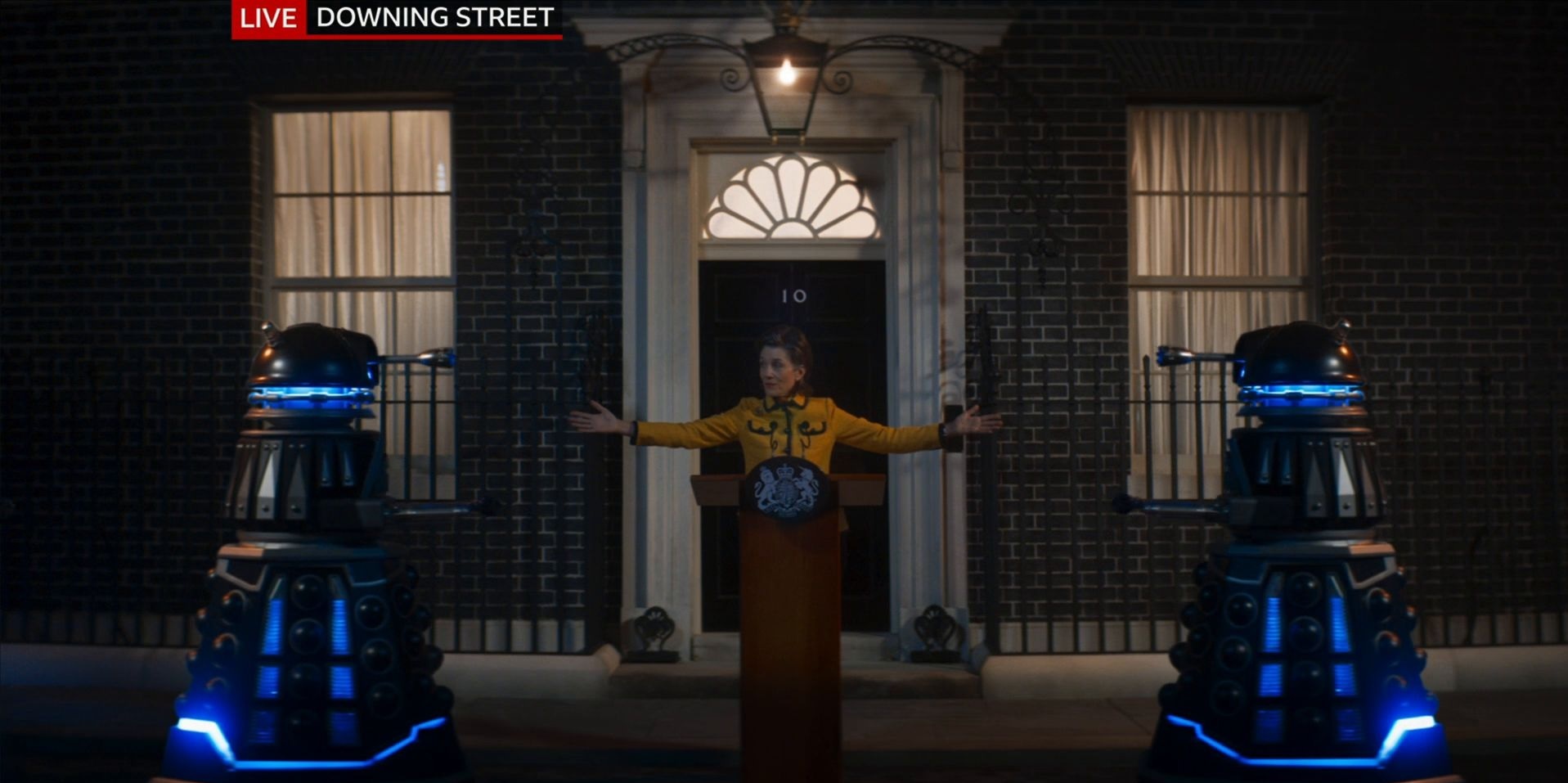
The Prime Minister introduces Daleks to the British public. It goes about as well as you'd expect.
Revolution of the Daleks. Like a lot of episodes, it's fine. Just... fine.

A LITTLE TOO CONSISTENT:

Chris Chibnall wrote a higher proportion of the scripts than his predecessors did, which results in an era that's very consistent in tone and quality. There are relatively few episodes that I think are truly bad. Even the worst don't approach the awfulness of other eras' stinkers. Gun to my head, I would choose to rewatch both Orphan 55 and Legend of the Sea Devils before I sat through either Victory of the Daleks or Fear Her again.

The flipside of this is that there are equally few standouts. The only "10/10" I awarded across three seasons was for Demons of the Punjab, while there are individual RTD and Moffat seasons that feature multiple episodes that I gave full marks. Most of the shows range from "okay" to "pretty good." That doesn't sound bad on the face of it, but a steady diet of "pretty good" becomes numbing in practice.

By the time Flux rolled around, I no longer felt excitement at the prospect of a new season. Ironically, and despite its flaws, that ended up becoming my favorite Chibnall season. But I came away from the era reflecting that the occasional ghastly dud was something I was willing to put up with, if it also meant that something truly brilliant might be around the corner.

Graham and Ryan in The Battle of Ravskor av Kolos.
Graham (Bradley Walsh) and Ryan (Tosin Cole) get Series 11's
character arc, leaving the Doctor and Yaz to just carry the plots.

CHARACTERS:

Up to this point, most of my thoughts tilt toward the positive, albeit with a side of, "This could have been better." Shifting to the regular characters, however, moves into an area that left me feeling frustrated.

I liked all three of the initial companions. As of Rosa, I thought this was a promising new set of regulars, just waiting for scripts that would bring out extra layers that would make them "pop." Sadly, at least for me, that "pop" never happened.

Some of the reasons are easy enough to determine. There's a lack of interaction, particularly among the "Fam" of Series Eleven and Twelve. Too many episodes fall into a familiar pattern of splitting them into teams - usually with the Doctor and Yaz working on the plot while Graham and Ryan received moments of character (in Series Eleven) or comedy relief (in Series Twelve).

The results tended to be good whenever an episode broke away from that pattern. Ryan and Yaz get some well-written exchanges in The Woman Who Fell to Earth and Rosa. Yaz and Graham share terrific moments in Demons of the Punjab and Ascension of the Cybermen. But Yaz is the only companion who gets significant one-on-one time with the Doctor. Even before the "Fam" leaves, it feels as if Yaz is her actual companion, with the other two just along for the ride.

Yaz also doesn't come properly into focus until Graham and Ryan leave. In those first two seasons, it often feels as if she's competing against them for screen time... and even in her supposed "spotlight" episodes, it tends to feel like she's losing that competition.

This improves with Flux and the specials, which see her interacting with new companion Dan in a way that feels a lot more authentic. It further helps that this shift happens at the same time that she starts really pushing back against the Doctor's secretiveness. At this point, the character starts to work... but by the time Flux starts, there are less than ten episodes remaining in her tenure.

The Doctor and Yaz.
Yaz falls hard for the Doctor, and it doesn't seem entirely unrequited. It also doesn't go anywhere.

BOLD IDEAS, TIMID EXECUTION:

And on to my single biggest frustration.

On paper, Chris Chibnall's ideas for Doctor Who are ambitious. These three seasons deliver: the series' first female Doctor; a massive retcon of the Doctor's origins; and the first same-sex romantic attachment between a Doctor and a companion. You can like or dislike any of these, but the ideas are unquestionably bold.

So why does it all feel so damn timid?

The first female Doctor spends too much of her first season being characterized as a blandly inoffensive "Doctor Fluffy." The Doctor, in all incarnations, has always been arrogant, more than a little judgmental, and often downright rude. In Series Eleven, she's rarely allowed to show any of these traits. She's so busy being "the nice Doctor" (right down to checking during a confrontation with a Dalek that she's nice, right?) that she too often doesn't feel properly like the Doctor.

As with other problems, this improves in her later seasons, as it becomes a major point that her surface niceness is a shield that keeps others at a distance far more effectively than the 12th Doctor's surface grumpiness ever did. But even then, she's rarely allowed to show the arrogance that the Doctor should possess.

The Doctor/Yaz relationship never actually comes to much. Yaz refers to the Doctor as "my person" in The Haunting of Villa Diodati, and her feelings for the Doctor are a character point in Flux and the first two 2022 specials... only for that to be cut off at the end of Legend of the Sea Devils when the Doctor tells her that relationships with short-lived humans end up hurting too much, something Yaz just... accepts.

Now, I've never been fond of the New Series phenomenon of Doctor/Companion romances, because they by definition can only go so far. Still, if you're going to go down that or any route, then do it! I don't think queerbaiting was the intent - but the refusal to commit to this as a direction made it come across that way. Either do a thing or don't; just half doing it will be enough to annoy those who don't like the direction while failing to satisfy those who do like it.

More than any other single element, this era's bizarre tentativeness is what holds it back. Chibnall seems to have conceived a fearless vision of Doctor Who - but instead of diving into the deep end, he keeps dipping a toe over and over before deciding the water's too cold, drying his feet off, and going back inside. Doubly frustrating for me was that I started watching this era on the heels of Broadchurch, a show from the same writer, showrunner, and actress that was emotionally fearless. His Doctor Who badly needed that same quality.

The 13th Doctor's last sunrise.
The Thirteenth Doctor's last sunrise.

OVERALL:

Given how critical the latter half of this post has been, I feel that I should emphasize that I enjoyed the 13th Doctor era on its own terms. I liked Jodie Whittaker's Doctor, particularly when she was allowed to be a little spiky and snappish later on. I loved seeing some historically based stories that were actually centered around history. I'm a Hartnell fan, and I can easily mentally transplant the original TARDIS team into stories like Demons of the Punjab and Nikola Tesla's Night of Terror.

Still, despite liking a lot more of the individual episodes than not, this is the most frustrated I've ever felt with an era of Doctor Who, including a couple that I think are qualitatively worse than this. What I said about Whittaker in Series Eleven equally applies to the era as a whole: I think there's a genuinely great take in here, if it had only been willing to commit to its own ideas.

It's been announced that Jodie Whittaker and Mandip Gill have joined Big Finish, so maybe some of their upcoming audios will redress this. Certainly, thanks in large part to COVID sending Whittaker's final season into disarray, there's a sense of an era that's only half-finished, so this was an extremely welcome announcement for me.

At its best, Big Finish has made some great Doctor Who. Fingers crossed for that, and for something of substance to be done with the 13th Doctor and Yaz, rather than them just battling Rutans and Krynoids to fill monthly slots.


Review Index

To receive new review updates, follow me:

On BlueSky:

On Threads:

Tuesday, December 13, 2022

#30. The Power of the Doctor.

Ice cream in space: A final journey with the 13th Doctor and Yaz.

1 episode. Running Time: Approx. 87 minutes. Written by: Chris Chibnall. Directed by: Jamie Magnus Stone. Produced by: Nikki Wilson.


THE PLOT:

Siberia, 1916. Self-proclaimed monk Grigori Rasputin is summoned by the Romanovs to the Winter Palace. The desperate Tsarina tells him that her hemophiliac son's health is failing, and that the boy's condition began worsening with the appearance of a second moon in the sky...

London, present day. Kate Lethbridge-Stewart calls on the Doctor with a very peculiar problem. The world's leading seismologists have disappeared, even as famous paintings have been bizarrely altered. The Doctor is annoyed at being summoned for something so trivial. Until Kate introduces her two newest consultants: the Doctor's former companions, Tegan Jovanka (Janet Fielding) and Ace (Sophie Aldred). They show her the altered paintings, each changed so that the figure at the center is Grigori Rasputin.

Except the Doctor and Yaz instantly recognize that the man pictured is not really Rasputin, but rather the Master (Sacha Dhawan)! The Doctor's old enemy happily reveals his present-day location. When UNIT and the Doctor close in, he gleefully taunts her:

"This is the day you die!"

An unexpected reunion: The Doctor runs into past companions Ace (Sophie Aldred) and Tegan (Janet Fielding).

CHARACTERS:

The Doctor: Jodie Whittaker's final story, and it's a pretty good last outing for her. She is disturbed by the Master's "warning," and makes certain preparations before walking into his trap, which allows her to actively work with her friends even while she's technically incapacitated. I love the way she faces her regeneration at the end. It is neither mawkish nor protracted, but rather a look toward the future as she tells her incoming successor: "Tag, you're it."

Yaz: Sometime during the course of her travels, she has prepared a diagram and post-it notes for steering the TARDIS if the need arises. This speaks volumes about both her sense of preparation and her realism. For all of her love for (borderline worship of) the Doctor, she still realizes that her friend is not as invulnerable as she pretends. If something happens, Yaz doesn't want to end up stranded, and she has paid attention and taken steps for that eventuality. She also reacts with an absolute, forceful rejection to the idea of the Master smearing the Doctor's name, seeming to find that even more loathsome than if the Master had simply killed her.

Dan: After a particularly close brush with death, Dan re-evaluated his new lifestyle and opts to exit with his skin intact. This may have been for the best. This story is already juggling a lot with the Master, the regeneration, the returning Ace and Tegan, and giving good roles to both the Doctor and Yaz. Had Dan stuck around for the duration, he would almost certainly have been consigned (again) to the role of "spare part." At least this way, he gets a couple moments that are his own. John Bishop has been wonderful throughout his brief tenure, making the most of every scrap he's been given, and that continues to be the case here. In a way, though, that makes it all the more aggravating that we didn't get just one truly Dan-centric story some time over the past season-and-a-bit.

Tegan: Janet Fielding is one of two Classic Series regulars who return for this episode. Tegan remains as irritable as ever. She has not forgiven the Doctor for never contacting her again after she left. This is arguably unfair, as it's not as if she gave the Doctor any reason to believe that such contact would be welcome, but it is in character. Her reaction to seeing the Doctor's newest form is to sniff about how young she is. She eventually admits that she still misses the Doctor, and she gets emotional at a reference to Adric.

Ace: The other major Classic Series return comes in the form of Sophie Aldred's Ace. The original series' cancellation meant that we never saw her separation from the Doctor; other media has filled in the gaps, but knowledge of that isn't really needed. We are told enough to know that the 7th Doctor and Ace parted on even worse terms than the 5th Doctor and Tegan did. Despite this, she is openly enthusiastic at their reunion, and happily chirps that the current incarnation is "a good look." She even continues to refer to the Doctor as "Professor."

Graham: It's appropriate that one of the Thirteenth Doctor's own past companions makes an appearance. The final scenes of Revolution of the Daleks established that Graham and Ryan would continue investigating strange occurrences.  It is such an investigation that leads to Graham wandering into this story entirely on his own power. He ends up paired with Ace, and they make a surprisingly entertaining duo. Bradley Walsh works well with Sophie Aldred, and the two characters' contrasting personalities make for some enjoyable exchanges.

Kate Lethbridge-Stewart: The Power of the Doctor may just see Jemma Redgrave's best performance as Kate. What I appreciate most is how palpably frightened she of the Cybermen. When she confronts Ashad, she is shaking, knowing all too well what fate likely awaits her. She also gets to show a lighter side, with her genuine eagerness at the chance to enter the TARDIS. Her scientific background seems to be remembered in her reaction. Rather than simply express wonder at the TARDIS being bigger on the inside, she asks how it's bigger.

The Master: Sacha Dhawan's Master survived the events of The Timeless Children, though exactly how is never explained ("I'm indestructible; the whole universe knows that!"). He retains the same core of self-loathing. He doesn't want just to defeat the Doctor, or even just to take her remaining regenerations; he wants to be someone other than himself by claiming the Doctor's identity. When the Doctor and her companions thwart his plan, he pleads - as if to an uncaring universe - "Don't let me go back to being me." The irony of this plea being that there's no point in the story at which he behaves as anything other than The Master... which, if I'm honest, feels like a missed opportunity. It might have been interesting if, after taking the Doctor's identity, he had felt some "Doctorish" impulses, but the effect as portrayed isn't particularly different than if he'd snuck into the TARDIS and stolen her wardrobe.

Daleks: Are included because this is the big special celebrating the BBC's Centenary, because there was a chance that this would be the last Doctor Who story for a while, and because the New Series never misses an opportunity to overuse the Daleks. Within the confines of the story, however, they are mostly pointless. They fulfill the narrative demand of giving Ace something to do in the Final Act; but by and large, they could be removed entirely, and the story might actually be structurally cleaner for it. I guess it's nice that Ace's anti-Dalek baseball bat still works, though.

Cybermen: Unlike the Daleks, they actually seem like part and parcel of the narrative, and they work much better as a result. The Cyber-Master design looks just as silly here as it did in The Timeless Children. Thankfully, more is seen of Ashad and the regular New Series Cybermen. The scenes with the Cybermen invading UNIT develop a reasonable amount of tension, with Ashad's exchanges with Kate showing that he's still as vicious as ever. The Cybermen are a bit too easily defeated... but then, that's an issue hardly unique to this story, and the resolution to their subplot still beats "I blew them up with love!" By a lot.

Past Doctors: Chris Chibnall uses the Centenary to celebrate the Classic Series not just by bringing by Ace and Tegan, but also by bringing back Classic Series Doctors. Peter Davison and Sylvester McCoy get particularly good scenes opposite their prior companions. Jo Martin's Fugitive Doctor also receives a strong scene, which is appropriate since she's been a big part of the current era. Meanwhile, McGann, Colin Baker, and David Bradley's First Doctor show up for less than a minute each - though that's still long enough to enjoy their presence, and it's particularly nice to see Colin Baker giving such a relaxed and restrained performance. I suspect this will be their collective final bow for television Doctor Who, but the way in which this story uses the Past Doctors provides a ready, ongoing excuse for future showrunners to bring them back with no care for the actors' ages.

Band of Villains: The Master (Sacha Dhawan) makes a pact with the Daleks and the Cybermen.

THOUGHTS:

The Power of the Doctor hits the ground running with a set piece involving Cybermen attacking a bullet train in space. It never really slows down from there, as we're taken in rapid succession to: 1916 Siberia (Rasputin! And he's the Master!); UNIT HQ; a Cyber planet in Earth's orbit; and a Dalek dig site under an active volcano (did they have to exterminate Blofeld first?). We're zipped from location to location, and the high production values of this era and the large scale make this often feel less like a television special than a movie.

The benefit of this approach is that it's easy to get caught up in the rush. Writer Chris Chibnall and director Jamie Magnus Stone do a creditable job of keeping the scenes flowing nicely in and out of each other, so that it all feels like a unified narrative and not just a jumble of activity. As a celebration of 100 years of BBC history (of which Doctor Who's history is an integral part), it's also a joy to see the cameos by past Doctors and companions.

The downside? The story might be large-scale and fast-paced, but it doesn't really seem to be about much of anything. The plot mainly seems to be there to incorporate the fanservice. I've already mentioned how superfluous the Daleks seem. Add to that the Master's entire Rasputin disguise. As far as I can determine, he passes himself off as Rasputin so that he can taunt UNIT and the Doctor through altered art and then enjoy a dance number in the Winter Palace. This isn't entirely a complaint: The dance number is kind of brilliant, and none of this is even a tiny bit out of character. But on a pure plot level, it doesn't really do much.

The Thirteenth Doctor enjoys one last sunrise.

THE REGENERATION:

One aspect of this story that I cannot fault is the regeneration itself. After a brief protest that she wants more time, the Thirteenth Doctor stops and accepts what's happening - in part, I think, for Yaz's sake, but also because she recognizes the natural cycle of it. Her goodbye to Yaz, as they share ice cream atop the TARDIS while floating in space, is charming and acts as a sort of parallel to their date under the sea. Then she embraces the inevitability of the change in the light of a sunrise: the final dawn for this set of eyes, and the first for the next.

The story itself is far from my favorite New Series regeneration story. That said, I think this is my favorite New Series regeneration scene, and by a fairly substantial margin.


OVERALL:

Back in my Series Eleven Overview, I stated that Chibnall's best episodes tended to be the ones that were the most emotionally authentic, in contrast to Steven Moffat's big concepts and rapid spectacle. In that same overview, I expressed my hope that Chibnall could fix some of that season's issues with pacing and weak character interactions without throwing out those changes that had actually worked.

The Power of the Doctor mostly embraces style over substance. Yet its best moments are once again the ones that ring emotionally true: the Fifth and Seventh Doctor's brief reunions with their old companions; Thirteen standing at a very special crossroads; Kate's genuine terror of the Cybermen; and the Thirteenth Doctor's beautiful final moments. These are the scenes I will remember from this special, long after the bullet train action sequences, lethal skybeams, and dance numbers have slipped from my memory.

In the end, I enjoyed this special for what it was.  Still, it would have been nice if there had been something more substantial at the heart of it.


Overall Rating: 7/10.

Previous Story: Legend of the Sea Devils
Next Story: The Star Beast

13th Doctor Overview

Review Index

To receive new review updates, follow me:

On BlueSky:

On Threads:

Sunday, December 5, 2021

#21 (13.0): Revolution of the Daleks.

Prime Minister Jo Patterson (Harriet Walter) unveils her new security drones: The Daleks.

1 episode. Running Time: Approx. 71 minutes. Written by: Chris Chibnall. Directed by: Lee Haven Jones. Produced by: Alex Mercer.


THE PLOT:

The Doctor is in prison.

Captured by the Judoon and sentenced for the crimes of incarnations whose very existence she can't remember, she has now spent decades in a facility that is also home to Weeping Angels, Ood, and even a P'Ting. Fortunately, an old friend has come to rescue her: Captain Jack Harkness (John Barrowman), who uses his Time Vortex Manipulator to sweep her back to her TARDIS, so that she can rejoin her friends in Sheffield.

Unfortunately, the Doctor arrives ten months after her friends' return. The new Prime Minister is Jo Patterson (Harriet Walter), and courtesy of her connections with American businessman Jack Robertson (Chris Noth), she is introducing a new innovation - a security drone that she promises will ensure the country's security. The Doctor and her friends recognize these drones instantly: Daleks, reproduced from the wreckage of the Dalek recon scout the Doctor previously defeated!

The Dalek creature also survived.  It has used human DNA to supplement its genetic code and has cloned itself. With thousands of Daleks rolling off the assembly line, the Doctor has no choice but to call for help to the one force in the universe capable of destroying these mutated Daleks.

The pure-bred Daleks are coming to Earth. And it's the Doctor herself who invited them...


CHARACTERS:

The Doctor: When she discusses the Master's revelations about her hidden past, she reveals that she's angry. Unfortunately, this mostly doesn't show in the actual episode... or any other emotion, really. Part of this is the script, which has the Doctor say that she's angry in one scene and say that she's sad in another; there's very little less authentically emotional than hearing a character directly tell us their emotions. The rest, I'm sad to say, is Jodie Whittaker's performance. She's perfectly fine insofar as there are no badly played scenes or misjudged acting choices... but the spark that's carried so many episodes just isn't there this time. It feels like an "end of the production block" performance, and is adequate but no more than that.

Yaz: Was the most hurt by the Doctor's ten-month absence. Yaz has spent that time literally living inside the TARDIS that was the vessel for her and her friends' escape while searching for any information about the Doctor. When she hears the sound of the Doctor's timeship, she pleads aloud for it to be real... only to angrily shove the Doctor upon her appearance, snapping at her about how worried they were. Later, when the Doctor hatches her final plan, she pauses to assure a worried Yaz that she won't disappear; Yaz replies sadly that someday, the Doctor will do just that.

Jack Robertson: Chris Noth returns as business mogul Jack Robertson... unfortunately. Chris Noth has never been my favorite actor, and I pretty much hated both his performance and the character in Arachnids in the UK. This is a better episode, with a script that makes a reasonable effort to mold him into more of a character and less of a comedy sketch creation. He's cautious enough to try to talk the incoming Prime Minister out of rushing the Dalek rollout, and reacts with appropriate disgust when shown the first cloned creature. He's still an opportunist, and when he sees an opportunity to turn the crisis to his advantage he can't help but take it, but there are notes that a more nuanced actor might have played. If anything, however, Noth is even hammier than before, at one point actually growling at one of his associates. The door is again left open for Robertson to return, and dramatically speaking that's something that should happen... but I really hope it doesn't.

Capt. Jack Harkness: In what is all but certain to be his final appearance as Jack, John Barrowman delivers a "Capt. Jack's greatest hits" compilation: Quips about how good the Doctor looks in red, references to exactly how he stored his tech to smuggle it into prison; calling Graham as a "silver fox"; and blowing stuff up with a wink and a smile. More interesting is his conversation with Yaz. Jack understands how it feels to be left by the Doctor, and in one of the episode's best moments is able to both listen to Yaz's frustrations and respond to them in a mature and thoughtful manner.

Daleks: 2020's Resolution was essentially Chris Chibnall's take on Dalek, with a lone Daleks causing havoc.  This story has shades of The Power of the Daleks, with greedy humans eager to use the Dalek technology to further their own agendas while mainly just setting themselves up for destruction. There's not much new here. Chibnall recycles the Dalek possession bit from Resolution, and his climax draws in the "Dalek purity" idea that drove the plot of Remembrance of the Daleks. I actually like the redesign of the sleek black "Robertson Daleks," however, and wouldn't mind seeing it used again.


THE DEPARTURE OF GRAHAM AND RYAN:

This episode sees the departure of Graham and Ryan after two full seasons. The actual exit is done well enough, building on the restlessness Ryan expressed back in Can You Hear Me?, in which he wondered how much longer they (really meaning, he) could continue doing this. He's the one who really wants to leave, having come to the conclusion that it's time for him to return to his life to try to make a positive contribution to Earth in the present. Graham would as soon keep traveling... but if Ryan is staying, then he prefers to stay with the young man who's finally comfortable calling him "family."

I like that this is an entirely voluntary exit, the first Doctor Who has offered since Martha Jones in Series Three. I just wish it had come a year earlier. The Graham/Ryan arc was the strongest element of Series 11, but it came to a close in The Battle of Ranskoor av Kolos, with the return of Ryan's father in Resolution adding an effective button. Had they left at that time, I think the exit would have been more effective. Series 12 had little idea what to do with them, pushing them mostly to the background, and even this episode gives them little to do beyond leaving. Given that, it's hard to feel sorry to see them go.


THOUGHTS:

Resolution, Chris Chibnall's previous Dalek story, was surprisingly good. It re-energized the Daleks as a genuine threat, had some real tension and momentum to it, and overall felt fresh. A weak ending was all that kept it out of the upper ranks of Dalek tales.

The good news is: Revolution of the Daleks has a better ending. The bad news? It's not as good an episode. At 71 minutes, I think it needed to be trimmed closer to 60. There's little momentum here; large chunks feel downright sluggish. The means by which the Doctor defeats the Daleks is clever and fits the pieces that are established in the first part of the episode. But the beats feel slightly off, the humans lingering long enough for me to wonder why the Daleks haven't shot them yet.

The episode is entertaining overall, with well-staged action scenes and solid performances (well, except for Noth). It even offers up some decent social commentary, as the Prime Minister's promise to the voting public is that the Daleks will offer security. We then see them deployed, with the public either oblivious to them or snapping selfies - with not a single person seeming the slightest bit concerned.

As a basic Dalek runaround, Revolution of the Daleks does its job. But it feels oddly slack, multiple scenes feeling as if they should have been cut tighter; and despite getting better material, Chris Noth manages to be even worse than in his first appearance. All told, it's perfectly OK entertainment. But since it was billed as an "event," being merely "OK" feels a bit disappointing.


Overall Rating: 6/10.

Previous Story: The Timeless Children
Next Story: The Halloween Apocalypse

Review Index

To receive new review updates, follow me:

On BlueSky:

On Threads:

Tuesday, November 23, 2021

#19: Ascension of the Cybermen.

The Lone Cyberman (Patrick O'Kane) interrogates a prisoner.

1 episode. Running Time: Approx. 49 minutes. Written by: Chris Chibnall. Directed by: Jamie Magnus Stone. Produced by: Nikki Wilson.


NOTE:

I previously reviewed Ascension of the Cybermen and The Timeless Children as a single story. Given how different the focus is for each episode, and my very different overall response to each installment, I have chosen to re-review these as individual episodes before moving forward with the latest season. You can find my original review here.


THE PLOT:

In the distant future, the Cyber-Wars have resulted in the near-eradication of both humanity and the Cybermen. A handful of human survivors, led by Ravio (Julie Graham) are trying to reach a place of safety known as "The Boundary" in a dilapidated shuttle. But the shuttle has broken down - and despite Ravio's best efforts to repair it quickly, the Cybermen have found them.

The Doctor and her friends arrive just as the Cybermen attack, led by Ashad (Patrick O'Kane), the Lone Cyberman who retrieved the Cyberium from 19th Century Earth. The Doctor stands her ground long enough to distract Ashad, allowing the others to escape. However, Ryan and a young survivor named Ethan (Matt Carver) become separated from the others. The Doctor rescues them - but becomes separated from Yaz, Graham, and the other survivors in the process.

That group manages to find shelter inside a dead Cyber-ship. They appear to be safe for the moment. But Ashad is not far behind - And this ghost ship is not as dead as it appears!


CHARACTERS:

The Doctor: As The Haunting of Villa Diodati made clear, the Doctor is still haunted by Bill's Cyber-conversion. The moment she realizes that her preparations have failed and that she won't be able to just fend off the Cybermen, she pushes her companions to flee and berates herself for being "reckless" by bringing them anywhere near Cybermen. The generally more ferocious Doctor of the last couple episodes is well-suited to Jodie Whittaker's acting strengths and she really holds the screen, particularly in a holographic confrontation with Ashad in the episode's second half.

Graham/Yaz: They are strong enough together to seize a leadership role when separated from the Doctor. Between Graham's experience and Yaz's inherent optimism, they push Ravio's group to keep trying, even when the weary survivors seem ready to give up just to end their perpetual running. Graham also enjoys an amusing flirtation with Ravio, Bradley Walsh and Julie Graham showing some pretty decent screen chemistry in their too-brief moments together.

Ryan: That this TARDIS team is too large is shown by how many episodes relegate at least one companion to the role of spare part. It's Ryan's turn to wear the dunce cap, not for the first time, his importance to this installment basically just being the excuse to separate the Doctor from the others so that the derelict ship subplot can happen.

The Cybermen: "We're carrying a Cyberman that makes other Cybermen scream!" Ashad, the Lone Cyberman, returns, this time as the head of an army. The Doctor's capitulation to him has left him in control of the Cyberium, and has made him more powerful than ever. He easily defeats the preparations against his attack, and the survivors are lucky to escape with their lives. The Doctor correctly guesses that Ashad despises himself for being too human - And the decidedly un-Cyberman-like anger he carries makes him more dangerous than most of the Cyber-leaders the Doctor has faced.


THOUGHTS:

Though the math changes when it's considered in combination with the next episode, when taken on its own merits Ascension of the Cybermen ranks among the best of the season. Momentum is built almost immediately, as Ashad's Cybermen make short work of the Doctor's defenses and three of the seven survivors fall in rapid succession. There's a sense of danger, and the situation feels legitimately high-stakes in a way that The Battle of Ranskoor av Kolos failed to achieve.

Meanwhile, a side story involving a young man named Brendan (Evan McCabe) is given no direct link to the main story, yet it feels of a piece and is intriguing on its own. Initially lyrical, this side story builds a gradual sense of dread after Brendan miraculously survives a gunshot wound and a fall from a cliff. Though he protests that he was "lucky," his family suddenly eyes him... not quite with suspicion, but certainly in a way that's less than loving. When we return to him near the episode's end, his story receives a shocking final note... But it never is tied into the main plot, its significance withheld until the following installment. This is not in itself a bad thing - It shows Chris Chibnall's confidence in his material, a confidence that was too often lacking in Series 11, with him certain the audience will wait for the next installment to tie it all together.

Ascension builds to strong endings to all three threads: The Brendan side plot, Graham and Ravio's group trapped on a ship with the Lone Cyberman, and the Doctor coming face-to-face with the story's true enemy, a being even more dangerous than Ashad. Pretty much every note works, guest performances and regulars alike are on strong form, and anticipation is left high for the final episode.


Overall Rating: 9/10.

Previous Story: The Haunting of Villa Diodati
Next Story: The Timeless Children

Review Index

To receive new review updates, follow me:

On BlueSky:

On Threads:

Tuesday, February 11, 2020

#17 (12.7): Can You Hear Me?

Yaz recalls the worst (and best?) day of her life...

1 episode. Running Time: Approx. 49 minutes. Written by: Charlene James, Chris Chibnall. Directed by: Emma Sullivan. Produced by: Alex Mercer.


THE PLOT:

The Doctor drops her companions off in present-day Sheffield to let them reconnect with friends and family, agreeing to pick them up the following day. Her companions' visits don't go smoothly. Graham plays cards with some old friends from his days as a bus driver, but soon has visions of a strange woman named Rakiya (Clare-Hope Ashitey) who is trapped and desperate for rescue. Ryan visits his friend Tibo (Buom Tihngang), who complains of nightmares that are starting to intrude on his reality. Yaz meets up with her sister, Sonya (Bhavnisha Parmar), for a peculiar type of anniversary celebration, only to see the mysterious Zellin (Ian Gelder) in her family's flat.

All three contact the Doctor, who has been drawn to a mental hospital in 14th century Aleppo - a hospital with only a single survivor, Tahira (Aruhan Galieva), who has somehow managed to avoid an attack by nightmare creatures. The Doctor realizes that she and her friends are being targeted, and uses the TARDIS' telepathic circuits to trace the incidents back to a space station orbiting two planets held at the edge of a collision - with a bizarre prison in the center of the suspended catastrophe.

The Doctor prepares to use the space station's technology to unlock the prison. But Zellin is waiting for them, ready to bring each member of the TARDIS team face-to-face with their deepest fears...


CHARACTERS:

The Doctor: When she is drawn to Aleppo, she starts to enthuse about a new adventure, filling her usual role of narrating interesting bits about the time period... only to deflate the instant she remembers that her companions aren't here, and that she is alone. When Zellin taunts her for her preoccupation with humanity, dubbing humans "endlessly pathetic," the Doctor is quick to respond with an impassioned speech about the human capacity for facing fear. But when Graham tries to confide his very real fears about his cancer returning, she has no idea what to say in response.

Yaz: Almost certainly the strongest episode for her thus far. In The Witchfinders, Yaz revealed that she had been bullied as a teen, and that she "took it" and endured "the year from hell." This episode's dream sequences and flashbacks reveal that Yaz was at the end of her rope, her grades dropping dramatically, feeling unable to confide in her family. A police officer (Nasreen Hussain) talked her out of desperate action, and it seems certain that this intervention led to Yaz's choice to join the police herself. Mandip Gill does well with this material, and Yaz feels instantly more complete as a character for this attention; it's just a shame it took so long to get to it.

Graham: His fears about his cancer returning are more than reasonable - as he says, cancer never really goes away - and so it is very fitting that his nightmare would combine his worry about that with his loss of Grace. In his vision, Grace becomes his doctor - a cold, uncaring doctor who blandly informs him that he is dying. Then she becomes the voice of Graham's guilt, coldly demanding to know why Graham didn't save her, leaving him only to beg for a chance to try again - which would almost certainly be his single greatest wish.

Ryan: His strained visit with Tibo reminds him that these travels come with consequences. The more time he and the others spend away from home, the more disconnected they become from the people in their lives. His nightmare is about exactly that, as he sees an old Tibo telling him accusingly that he waited for Ryan to return, and that Ryan never came back. At the end, he wonders to Yaz how much longer they can keep traveling with the Doctor. It seems apparent that he is seriously debating if he can continue.


THOUGHTS:

It seems as if every time Doctor Who airs a single-part story, there are people wishing it had been a two-parter. I rarely agree with that statement. Just looking at this season: the Tesla episode works very well as it is; Praxeus is perfectly solid filler; Fugitive of the Judoon's single biggest asset is that it's such a breathless, non-stop roller coaster ride; and the very last thing I would want from Doctor Who is more Orphan 55, thank you very much.

But in the case of Can You Hear Me?, I actually agree with the sentiment. I think it's a good episode as it stands; the character material for the regulars is extremely welcome, while the main plot gets a boost from some effectively moody imagery (director Emma Sullivan is a keeper). But the plot feels rushed, the conflict reduced to just a couple of conversations, while the resolution is far too easily achieved.

The reason for that is evident. The character material is what's most essential, so it is in those scenes that the pace slows down so that the moments can have impact. However, the plot suffers, effectively squeezed around those character moments. I would make the exact same choice, if forced to fit this story into 50 minutes. But if this had been a two-parter, with the Doctor falling into Zellin's trap acting as the cliffhanger, then the story would have room to breathe. There would be time for some complications - Maybe a less rushed, more difficult escape for the Doctor, perhaps a need to actually locate Zellin (I can see chasing him across various locations as a fun little set piece), and showcasing more damage done by Zellin when he begins absorbing nightmares.

Don't get me wrong; I enjoyed this episode, and it will definitely be one I rewatch. However, this is one case where a second part might have turned an already good installment into something truly special.


THE DOCTOR/GRAHAM MOMENT

The conversation between Graham and the Doctor is one that seems to have ignited a lot of debate, so it would be remiss of me to exclude it from this review.

For my part, I like the scene.  It's a messy interaction, born out of a messy situation, in which one very open person (Graham) confides in a very closed-off person (the Doctor).  The performances of Whittaker and Walsh are absolutely on-target, and they play well opposite each other; I strongly wish the show would provide more one-on-one interactions between these two.

Graham's fear of the cancer returning is entirely reasonable, and both of them know that. The Doctor has no words of comfort, has no idea what to say, and tries to let him know that without simply dismissing him. Whether he understands that or feels slighted is left up in the air, however - And I think it's significant that the Grace "Doctor" in his nightmare is an aloof figure, cold and detached. It raises the question of if that's how he ultimately views the Doctor.


In any case, the scene works for me... But as with many elements of this episode, I think it might have worked better if the story had been spread across two parts, to allow more groundwork to be laid.


Overall Rating: 7/10. Almost an "8." And if this had been a 2-parter, I'd have put it in with a chance of being a "9" or even a "10."

Previous Story: Praxeus
Next Story: The Haunting of Villa Diodati

Search Amazon.com for Doctor Who

Review Index

To receive new review updates, follow me:

On BlueSky:

On Threads:

Monday, January 13, 2020

#13 (12.3): Orphan 55.

The Dregs attack.

1 episode. Running Time: Approx. 46 minutes. Written by: Ed Hime. Directed by: Jamie Magnus Stone. Produced by: Alex Mercer.


THE PLOT:

The TARDIS Team win an unexpected trip to Tranquility Spa, an all-inclusive off-world resort. Graham intends to spend his time napping in as many chairs as possible; Yaz befriends elderly couple Benni (Col Farrell) and Vilma (Julia Foster); and Ryan strikes up a flirtation with Bella (Gia RĂ©), an attractive young woman who introduces herself as a resort critic before admitting that she's actually unemployed.

Meanwhile, the Doctor finds the control center of the spa - hidden away in an overly secure linen closet. The owner, Kane (Laura Fraser), is unimpressed by her intrusion. But when the spa comes under attack by alien Dregs, the Doctor manages to restore the shield that keeps them safe... though not quickly enough to avoid the deaths of several guests, and the disappearance of Benni.

Kane reveals that Tranquility Spa is a "Fakation," a spa that simulates an idyllic setting while in reality being located on an uninhabitable orphan planet. Kane's plan was to use proceeds from the spa to terraform the dead world. What she didn't realize was that the Dregs had survived the planet's death and adapted.

With Benni outside the spa, the Doctor and Kane lead the others on a rescue mission. When they are trapped by Dregs, however, what began as a rescue turns into a fight for survival - with one of their party being something other than what they seem...


CHARACTERS:

The Doctor: Though the script makes no reference to the events of the previous story, we see that she is not particularly interested in a relaxing holiday. She's already hunting for the resort's hidden control center before the Dregs attack. Once the attack starts, her outer silliness - only ever a thin veneer in this episode - drops away completely, replaced by a grim resolve. Throughout the episode, the Doctor is short-tempered, ruthlessly pragmatic, and occasionally downright rude, particularly to the profit-minded Kane (Laura Fraser)... and I absolutely love it; could we see the same characterization in a good episode next time?

Graham: "It ain't the aliens that are going to kill me - It's worrying about you!" Graham remains entirely relatable. While the team works on cleaning up the mess of an alien encounter in the console room, Graham cheerfully finds coupons for a free vacation. His vacation plan? Sit and do nothing in one spot for a few hours, then move to another spot and sit and do nothing over there. After the Dregs attack and Ryan is unaccounted for, Graham barely waits for the door to unlock before rushing out to find him, and his relief when he does find Ryan safe and alive is tangible.

Ryan: Quickly bonds with Bella, who appears to have much in common with him. She had a father she obviously loved who died, and a mother who was nowhere to be found when she needed her - Basically, Ryan's story in broad strokes with the genders flipped. He's quite pleased to find an attractive woman to flirt with, though not so much as to neglect his friends when they are genuinely in trouble.

Yaz: In a stunning plot twist, Yaz gets the least to do of all the regulars in this episode. That said, there are some good character beats. I actually love that Yaz is now the one who is most suspicous of the Doctor. At the end, she demands to know exactly when the Doctor realized the secret behind Orphan 55, clearly thinking that the Doctor had known for a while. She seems satisfied when the Doctor tells her that she found out only seconds before the rest of them did, but there's a wariness in that relationship that wasn't there before. If that carries forward, future scripts could build on that.

Kane: Laura Fraser is always a welcome presence. Kane could easily have been a one-dimensional bureaucrat, a paper tiger for the Doctor to verbally shred (see the various pompous bureaucrats of the Pertwee era). Fraser grounds the character, finds a strength and credibility that allows Kane to stand her ground even as the Doctor berates her. As a result, the Doctor/Kane scenes, of which there are far too few, are the highlights of a weak episode.


THOUGHTS:

Unfortunately, new Who has a bad track record of following up "big" stories with ones that are... well, kind of crappy. The Impossible Planet/Satan Pit two-parter leaves you breathless with its scale, pace, and ambition? Fear not - because Love and Monsters and Fear Her will crush all your excitement in a heartbeat. The Eleventh Hour kicks off the Eleventh Doctor's run with breathless excitement and a grab bag of endless clever reinvention?  Well, The Beast Below and Victory of the Daleks will smother that exhilaration with a pillow and leave you actively worried about the new Doctor's run in no time flat.

Chris Chibnall's era as showrunner is radically different from those of Russell T. Davies and Steven Moffat. However, one thing remains the same: The big, ambitious story that was almost entirely successful in its ambitions is followed by... a bit of a damp turd.

Orphan 55 actually starts off quite promisingly. The initial TARDIS scene quickly re-establishes the team in a post-Spyfall setting, and obliquely follows up on that story by mentioning the Doctor's "mood." We're then whisked off to the resort, where the companions split up to meet the various guest characters while the Doctor uncovers a mystery. So far, so good. The Dregs attack, the artificial nature of the resort is revealed, and the characters head out into a hostile alien landscape on a rescue mission. This is promising.

Then it all falls apart.

I'm not referring to the episode's overly on-the-nose message. For all that it seems almost calculated to draw an outcry from the usual sources, the message is actually fairly well-integrated into the story. No, the real problem is the pacing. The episode, which runs a scant 46 minutes, feels rushed, with obvious ADR taking us from one scene to the next. I can't say for certain, but it plays as if someone made an ill-advised attempt to "speed things up" by chopping out badly-needed scene transitions, leaving the end product feeling choppy and unfinished.

Orphan 55 is far from the worst episode of Doctor Who. The Dregs are well-realized, if fairly generic. The guest cast ranges from decent to very good. The regulars are on fine form, with Jodie Whittaker particularly strong - It's probably a good sign that she manages to be this good in an episode that's otherwise rather bad.

But after Spyfall started off the season with such a bang, it is a disappointment to follow it up with a misfire. All the more disappointing given that this was written by Ed Hime, who wrote last season's fearless, genre-hopping It Takes You Away. And though I would not rule out the possibility of some overly ruthless post-production edits (the run time is suspiciously short), in the end most of the issues with this episode come down to the script, which is simultaneously too formulaic and too busy.

I hope Hime writes for the series again next season - But I also hope he delivers something a little closer in quality to his Who debut, so that we can just put this one down to a bad day at the keyboard.


Overall Rating: 2/10.

Previous Story: Spyfall
Next Story: Nikola Tesla's Night of Terror

Search Amazon.com for Doctor Who

Review Index

To receive new review updates, follow me:

On BlueSky:

On Threads:

Thursday, January 9, 2020

#12 (12.1 - 12.2): Spyfall.

The Doctor confronts a corrupt Internet mogul (Lenny Henry) - But he's the least of her problems...

2 episodes. Running Time: Approx. 121 minutes. Written by: Chris Chibnall. Directed by: Jamie Magnus Stone, Lee Haven Jones. Produced by: Nikki Wilson, Alex Mercer.


THE PLOT:

Intelligence agents are being targeted - but apparently at random, the attacks claiming agents of every nationality. Every victim has suffered the same fate - Wiped clean, their DNA entirely rewritten by some unknown, alien force. "C" (Stephen Fry), the head of MI6, has the Doctor and her companions brought in and reveals that they have only one lead: Daniel Barton (Lenny Henry), founder of VOR, an in-no-way Google-like Internet company that "C" describes as "more powerful than most nations."

While the Doctor and Graham travel to Australia to meet Agent "O" (Sacha Dhawan), Yaz and Ryan go undercover in San Francisco as a reporter and photographer to interview Barton. They quickly find that Barton is in league with the aliens, known as the Kasaavins - who abduct Yaz, and somehow transport her to Australia.

The reunited TARDIS team, along with "O," crash Barton's birthday party to confront him about the aliens. Barton flees to his private jet, but not before the Doctor and her friends manage to stow away.

Whereupon "O" makes a startling revelation. Barton is not on the plane. "O" is not who he appears to be. And everything the Doctor thinks she knows is a lie...


CHARACTERS:

The Doctor: I said in my Series Eleven overview that I thought Jodie Whittaker had the potential to be a great Doctor, but was not one yet. In this story, she meets that potential. The Doctor has a lot to do, particularly in the second part, and Whittaker nails pretty much all of it. There's a scene in Part Two in which the villain of the piece threatens to murder innocents unless the Doctor kneels. She does so - But with an eyeroll, followed by a glare that would melt steel. Her final scenes opposite this villain showcase a more ruthless side, which reinforces my impression from Demons of the Punjab - that this is a Doctor who, for all her surface "niceness," has the potential to be a little frightening.

Graham: "Looking outside was actually quite low on my list!" Continues to be the voice of the everyday viewer's common sense - You don't run toward the alien, and when something spooky is happening outside you stay indoors. Which doesn't stop him from following after "the Doc" and "the Fam," because a part of him loves the excitement as much as Grace did, and the rest of him wishes she could be there to enjoy it with him. When they are separated from the Doctor, he is the one who insists that they will see her again - and firmly states that they will ask some questions about her once they do reunite.

Ryan/Yaz:: Though this is not a companion-centric story, they both get good moments. Yaz is properly scared - maybe for the first time since meeting the Doctor - when the aliens transport her to their home dimension (or whatever it is), and it takes her a few scenes to shake that off. When separated from the Doctor, once the group has settled on taking action, she is the one who pushes them to act. Meanwhile, Ryan recognizes the need to destroy their cell phones to hide from Barton. Both of them are experiencing pressure from their professional and social circles, thanks to the excuses they create to justify their time away with the Doctor; as with Rory and Amy so long ago, "Doctor life" and "real life" just aren't proving compatible.

Daniel Barton: Lenny Henry is Bill Gates... um, Steve Jobs... um, Daniel Barton, the apparent villain of the piece. For most of Part One, he is basically the face of the evil force behind the story. And in a story that gives more than a passing nod to the James Bond franchise, Henry's billionaire Internet industrialist fits the villain bill perfectly. He's a sneering, ultimately petty man whose main motivation seems to be resentment. He resents his mother (Blanche Williams) for not acknowleding his accomplishments, and he resents being socially ostracized at school for being non-white; a part of me wanted a Social Network moment in which someone told Barton the reason for his lack of friends wasn't because of race - It was because he was a ****. Henry manages to squeeze a few layers into a fairly cardboard villain, but it's not much of a surprise that he is mainly a stand-in, drawing our attention to catch us off-guard when the real bad guy is revealed...

"O":: The agent who is more than he seems, the reveal of his true identity effectively is the Episode One cliffhanger. For benefit of the three people who haven't found out (but who for some reason are reading this), I will not disclose it here. Suffice to say, Sacha Dhawan is terrific both before and after the mask drops. In retrospect, there are several clues to his true identity - But it was hidden well enough to be a genuine surprise. Dhawan and Whittaker bring out the best in each other's performances, and the scenes in which they verbally spar are the highlights of a generally excellent 2-parter.


THOUGHTS:

I love Chris Chibnall's writing and showrunning... When he's writing and showrunning Broadchurch. In Doctor Who, I have generally found that Chibnall's scripts tend to fall somewhere in the range of "pretty good" to "just okay." I've never dreaded Chibnall episodes the way I used to dread Mark Gatiss' annual offerings - Chibnall's very worst have still been consistently watchable. But there has always been something a little bit timid about his Doctor Who stories, as if he's too reverent a fan to really properly dig into his vision of what makes the character tick.

Spyfall is not timid. Chibnall sold it ahead of time as "the biggest episode of Doctor Who we've done." He promised stunts and action on the level of a motion picture, but without losing sight of the characters. I'll admit, I braced myself for disappointment - the idea of a Bond pastische did not particularly line up with my personal series wish list, and had the potential to go very wrong.

Fortunately, the Bond elements are largely there as window dressing, even forming part of the misdirection as to the nature of the story. Part Two maintains the "bigness" of the story, moving from globe-hopping to time-hopping with some breathless set pieces in a 19th century exhibition and in 1943 Paris.  Along the way, the Doctor teams up with computer pioneer Ada Lovelace (Sylvie Briggs) and World War II heroine Noor Inayat Khan (Aurora Marion), and the three make an engaging team.

But the heart of the piece lies with the character conflict between the Doctor and "O," and it is their exchanges that dominate the memory long after the episode itself has finished. I want to see these two spar again - And with so much left unresolved, I'm fairly certain I'm going to get my wish.

The two-parter does a good job of telling a story that is passably complete in itself, with an alien invasion thwarted and the world saved (all served with a sharp, all-too-accurate analysis of how blithely we serve ourselves up to the World Wide Web), while at the same time leaving plenty of threads dangling for the rest of the season.

Spyfall is a terrific story, the best solo script Chris Chibnall has written for Doctor Who. It's also a superb season premiere - in my opinion, the best season opener since Matt Smith's tenure.

Oh, and a final aside: The current TARDIS interior, which I've mostly disliked? It looks fantastic in blue! Can we keep the blue, please? No? Ah, well - Can't have everything.


Overall Rating: 9/10. I retroactively deducted a point for the dangling plot threads that were never tied up or even mentioned again. It's still a terrific opener... but too many elements never get addressed again, and that rubs me the wrong way in retrospect.

Previous Story: Resolution
Next Story: Orphan 55

Search Amazon.com for Doctor Who

Review Index

To receive new review updates, follow me:

On BlueSky:

On Threads: