Showing posts with label Mandip Gill. Show all posts

Sunday, October 6, 2024

13th Doctor Overview.

The Thirteenth Doctor (Jodie Whittaker), with The Fam
The Thirteenth Doctor (Jodie Whittaker), with "The Fam."

I'm writing this just shy of two years from the end of the Thirteenth Doctor's era, just as I'm preparing to move on to viewing and reviewing Ncuti Gatwa's first season as the 15th Doctor. Before I move forward, I'm feeling a need to look back, because many of my thoughts about the tenure of showrunner Chris Chibnall and star Jodie Whittaker are not fully represented by my reviews of the individual episodes.

Fair warning: This is neither a hate post nor a love letter. If you're looking for relentless negativity, I suggest finding a YouTube video, probably one with googly eyes on the thumbnail that uses the word "woke" a lot. If you're looking for only positive comments, then do the same, only avoiding those particular search cues. I'm going to discuss both what worked for me (and a lot did) and my frustrations about elements that either didn't work or that I thought fell short of their potential.

As ever, this represents my own opinion, and other views are available.

The Doctor confronts a Cyberman.
The Doctor confronts a Cyberman - and Whittaker shines
with a script that lets her get properly angry for a change.

JODIE WHITTAKER AS THE DOCTOR:

The announcement of Jodie Whittaker's casting came during my burnout period, in which I was neither viewing nor reviewing Doctor Who or anything else. I will admit that the announcement caught my eye. Whittaker is an actress whose work I've generally enjoyed, and I found her to be particularly good in Chris Chibnall's Broadchurch. It took me another year to recover from my malaise, but her casting was one of the reasons I decided to return to Who when I was ready to start reviewing again.

My response to her first appearance was... well, mixed. She was fine in The Woman Who Fell to Earth, with excellent individual moments... but she also had several deliveries that struck me as either flat or just plain misjudged. It wasn't until Rosa that she won me over. Even then, Arachnids in the UK (in my opinion, her single worst performance in the role) made me doubtful all over again.

Her performance improves whenever a script avoids reducing her to "the nice Doctor." There are glimpses throughout Series 11: Her scenes with Krasko in Rosa, her interactions with both the Thijarians and Manish in Demons of the Punjab, her confrontation with King James in The Witchfinders, and her general grumpiness in Kerblam!  All of these moments saw Whittaker's performance noticeably improve.

Thankfully, that became explicit characterization in Series 12 and 13, as it became clear that this Doctor's friendly smile was a shield to protect her from getting too close to her companions. She may have labeled her first companion set "Fam," but she kept them at a distance, avoiding anything that resembled a meaningful personal question. If they pushed harder, as Yaz often did in Series 13, she became snappish and even hostile. The more these beats were played, the better both character and actor became.

Whittaker was excellent at showing the character's defensiveness, and I think she exceled in moments of frustration and anger. On the other hand, I don't think she ever quite got the handle of delivering sci-fi Technobabble. In her first season, her Technobabble scenes often reminded me of actors phonetically reciting foreign language dialogue. She got better (and the scripts wrote less of it for her), but it remained a weakness.

Her worst performances came whenever she was written as "Dr. Exposition." Her acting flattened in episodes like Praxeus, Revolution of the Daleks, and Survivors of the Flux, in which she was little more than a vessel for explanations. I got the impression she couldn't engage with reams of exposition, and I wasn't surprised when excessive exposition was one of the only complaints she voiced in interviews after her exit. 

The Doctor officiates a wedding between a Hindu and a Muslim during the Partition of India.
The Doctor officiates a wedding in Demons of the Punjab, easily my favorite episode of this era.

WHAT WORKS:

When the Chibnall era gets discussed, particularly after a couple years' distance, I see a lot of the sentiment: "Jodie was good, shame about the scripts." There is truth to that, but I think it's reductive.

There are a handful of fine scripts in these three-and-a-bit seasons. The stories from Vinay Patel and Maxine Alderton would stack up well in any era, and I hope both writers get a chance to submit for the series in the future. Chibnall's own stories include a solid new Doctor introduction in The Woman Who Fell to Earth; a terrific time-loop story in Eve of the Daleks; and, in War of the Sontarans, the best showing for the potato-headed warriors since their introduction during Jon Pertwee's tenure... though, as my review noted at the time, that doesn't clear the highest of bars; my pick for their previous second best story was the enjoyable but heavily flawed The Two Doctors.

In my Series Eleven overview, I stated some of my issues with that first season. Still, while I had quibbles with the execution, Series Eleven's attempt at a grounded and character-focused approach was something I had wanted to see from Doctor Who for a while. When the Doctor introduced herself as "just a traveler" who helps where she can, I wanted to applaud. I also love that all of Thirteen's companions are ordinary people - no dark secrets, no paradoxes, no alien plots. Just a group of average but highly decent human beings.
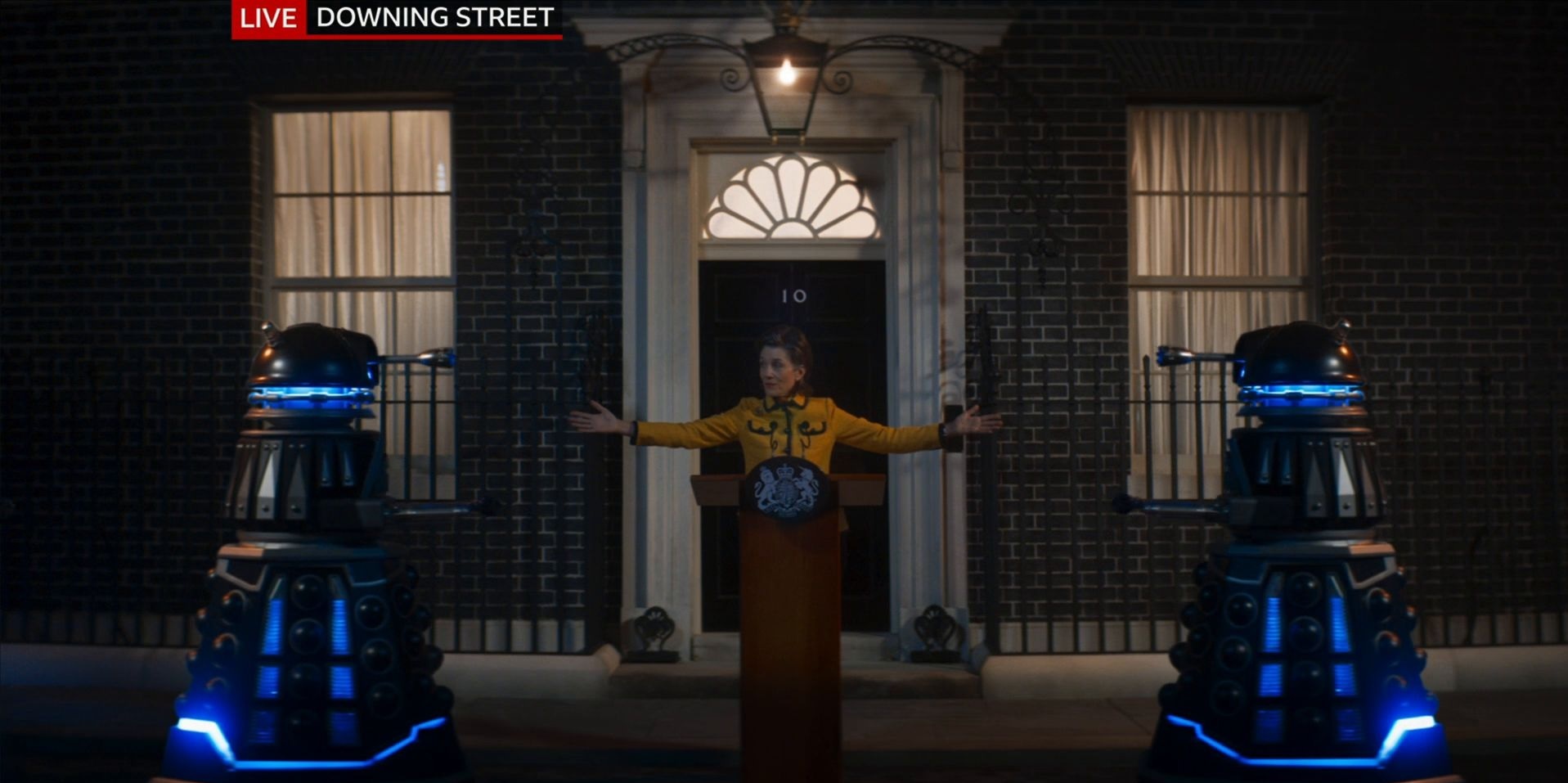
The Prime Minister introduces Daleks to the British public. It goes about as well as you'd expect.
Revolution of the Daleks. Like a lot of episodes, it's fine. Just... fine.

A LITTLE TOO CONSISTENT:

Chris Chibnall wrote a higher proportion of the scripts than his predecessors did, which results in an era that's very consistent in tone and quality. There are relatively few episodes that I think are truly bad. Even the worst don't approach the awfulness of other eras' stinkers. Gun to my head, I would choose to rewatch both Orphan 55 and Legend of the Sea Devils before I sat through either Victory of the Daleks or Fear Her again.

The flipside of this is that there are equally few standouts. The only "10/10" I awarded across three seasons was for Demons of the Punjab, while there are individual RTD and Moffat seasons that feature multiple episodes that I gave full marks. Most of the shows range from "okay" to "pretty good." That doesn't sound bad on the face of it, but a steady diet of "pretty good" becomes numbing in practice.

By the time Flux rolled around, I no longer felt excitement at the prospect of a new season. Ironically, and despite its flaws, that ended up becoming my favorite Chibnall season. But I came away from the era reflecting that the occasional ghastly dud was something I was willing to put up with, if it also meant that something truly brilliant might be around the corner.

Graham and Ryan in The Battle of Ravskor av Kolos.
Graham (Bradley Walsh) and Ryan (Tosin Cole) get Series 11's
character arc, leaving the Doctor and Yaz to just carry the plots.

CHARACTERS:

Up to this point, most of my thoughts tilt toward the positive, albeit with a side of, "This could have been better." Shifting to the regular characters, however, moves into an area that left me feeling frustrated.

I liked all three of the initial companions. As of Rosa, I thought this was a promising new set of regulars, just waiting for scripts that would bring out extra layers that would make them "pop." Sadly, at least for me, that "pop" never happened.

Some of the reasons are easy enough to determine. There's a lack of interaction, particularly among the "Fam" of Series Eleven and Twelve. Too many episodes fall into a familiar pattern of splitting them into teams - usually with the Doctor and Yaz working on the plot while Graham and Ryan received moments of character (in Series Eleven) or comedy relief (in Series Twelve).

The results tended to be good whenever an episode broke away from that pattern. Ryan and Yaz get some well-written exchanges in The Woman Who Fell to Earth and Rosa. Yaz and Graham share terrific moments in Demons of the Punjab and Ascension of the Cybermen. But Yaz is the only companion who gets significant one-on-one time with the Doctor. Even before the "Fam" leaves, it feels as if Yaz is her actual companion, with the other two just along for the ride.

Yaz also doesn't come properly into focus until Graham and Ryan leave. In those first two seasons, it often feels as if she's competing against them for screen time... and even in her supposed "spotlight" episodes, it tends to feel like she's losing that competition.

This improves with Flux and the specials, which see her interacting with new companion Dan in a way that feels a lot more authentic. It further helps that this shift happens at the same time that she starts really pushing back against the Doctor's secretiveness. At this point, the character starts to work... but by the time Flux starts, there are less than ten episodes remaining in her tenure.

The Doctor and Yaz.
Yaz falls hard for the Doctor, and it doesn't seem entirely unrequited. It also doesn't go anywhere.

BOLD IDEAS, TIMID EXECUTION:

And on to my single biggest frustration.

On paper, Chris Chibnall's ideas for Doctor Who are ambitious. These three seasons deliver: the series' first female Doctor; a massive retcon of the Doctor's origins; and the first same-sex romantic attachment between a Doctor and a companion. You can like or dislike any of these, but the ideas are unquestionably bold.

So why does it all feel so damn timid?

The first female Doctor spends too much of her first season being characterized as a blandly inoffensive "Doctor Fluffy." The Doctor, in all incarnations, has always been arrogant, more than a little judgmental, and often downright rude. In Series Eleven, she's rarely allowed to show any of these traits. She's so busy being "the nice Doctor" (right down to checking during a confrontation with a Dalek that she's nice, right?) that she too often doesn't feel properly like the Doctor.

As with other problems, this improves in her later seasons, as it becomes a major point that her surface niceness is a shield that keeps others at a distance far more effectively than the 12th Doctor's surface grumpiness ever did. But even then, she's rarely allowed to show the arrogance that the Doctor should possess.

The Doctor/Yaz relationship never actually comes to much. Yaz refers to the Doctor as "my person" in The Haunting of Villa Diodati, and her feelings for the Doctor are a character point in Flux and the first two 2022 specials... only for that to be cut off at the end of Legend of the Sea Devils when the Doctor tells her that relationships with short-lived humans end up hurting too much, something Yaz just... accepts.

Now, I've never been fond of the New Series phenomenon of Doctor/Companion romances, because they by definition can only go so far. Still, if you're going to go down that or any route, then do it! I don't think queerbaiting was the intent - but the refusal to commit to this as a direction made it come across that way. Either do a thing or don't; just half doing it will be enough to annoy those who don't like the direction while failing to satisfy those who do like it.

More than any other single element, this era's bizarre tentativeness is what holds it back. Chibnall seems to have conceived a fearless vision of Doctor Who - but instead of diving into the deep end, he keeps dipping a toe over and over before deciding the water's too cold, drying his feet off, and going back inside. Doubly frustrating for me was that I started watching this era on the heels of Broadchurch, a show from the same writer, showrunner, and actress that was emotionally fearless. His Doctor Who badly needed that same quality.

The 13th Doctor's last sunrise.
The Thirteenth Doctor's last sunrise.

OVERALL:

Given how critical the latter half of this post has been, I feel that I should emphasize that I enjoyed the 13th Doctor era on its own terms. I liked Jodie Whittaker's Doctor, particularly when she was allowed to be a little spiky and snappish later on. I loved seeing some historically based stories that were actually centered around history. I'm a Hartnell fan, and I can easily mentally transplant the original TARDIS team into stories like Demons of the Punjab and Nikola Tesla's Night of Terror.

Still, despite liking a lot more of the individual episodes than not, this is the most frustrated I've ever felt with an era of Doctor Who, including a couple that I think are qualitatively worse than this. What I said about Whittaker in Series Eleven equally applies to the era as a whole: I think there's a genuinely great take in here, if it had only been willing to commit to its own ideas.

It's been announced that Jodie Whittaker and Mandip Gill have joined Big Finish, so maybe some of their upcoming audios will redress this. Certainly, thanks in large part to COVID sending Whittaker's final season into disarray, there's a sense of an era that's only half-finished, so this was an extremely welcome announcement for me.

At its best, Big Finish has made some great Doctor Who. Fingers crossed for that, and for something of substance to be done with the 13th Doctor and Yaz, rather than them just battling Rutans and Krynoids to fill monthly slots.


Review Index

To receive new review updates, follow me:

On BlueSky:

On Threads:

Tuesday, December 13, 2022

#30. The Power of the Doctor.

Ice cream in space: A final journey with the 13th Doctor and Yaz.

1 episode. Running Time: Approx. 87 minutes. Written by: Chris Chibnall. Directed by: Jamie Magnus Stone. Produced by: Nikki Wilson.


THE PLOT:

Siberia, 1916. Self-proclaimed monk Grigori Rasputin is summoned by the Romanovs to the Winter Palace. The desperate Tsarina tells him that her hemophiliac son's health is failing, and that the boy's condition began worsening with the appearance of a second moon in the sky...

London, present day. Kate Lethbridge-Stewart calls on the Doctor with a very peculiar problem. The world's leading seismologists have disappeared, even as famous paintings have been bizarrely altered. The Doctor is annoyed at being summoned for something so trivial. Until Kate introduces her two newest consultants: the Doctor's former companions, Tegan Jovanka (Janet Fielding) and Ace (Sophie Aldred). They show her the altered paintings, each changed so that the figure at the center is Grigori Rasputin.

Except the Doctor and Yaz instantly recognize that the man pictured is not really Rasputin, but rather the Master (Sacha Dhawan)! The Doctor's old enemy happily reveals his present-day location. When UNIT and the Doctor close in, he gleefully taunts her:

"This is the day you die!"

An unexpected reunion: The Doctor runs into past companions Ace (Sophie Aldred) and Tegan (Janet Fielding).

CHARACTERS:

The Doctor: Jodie Whittaker's final story, and it's a pretty good last outing for her. She is disturbed by the Master's "warning," and makes certain preparations before walking into his trap, which allows her to actively work with her friends even while she's technically incapacitated. I love the way she faces her regeneration at the end. It is neither mawkish nor protracted, but rather a look toward the future as she tells her incoming successor: "Tag, you're it."

Yaz: Sometime during the course of her travels, she has prepared a diagram and post-it notes for steering the TARDIS if the need arises. This speaks volumes about both her sense of preparation and her realism. For all of her love for (borderline worship of) the Doctor, she still realizes that her friend is not as invulnerable as she pretends. If something happens, Yaz doesn't want to end up stranded, and she has paid attention and taken steps for that eventuality. She also reacts with an absolute, forceful rejection to the idea of the Master smearing the Doctor's name, seeming to find that even more loathsome than if the Master had simply killed her.

Dan: After a particularly close brush with death, Dan re-evaluated his new lifestyle and opts to exit with his skin intact. This may have been for the best. This story is already juggling a lot with the Master, the regeneration, the returning Ace and Tegan, and giving good roles to both the Doctor and Yaz. Had Dan stuck around for the duration, he would almost certainly have been consigned (again) to the role of "spare part." At least this way, he gets a couple moments that are his own. John Bishop has been wonderful throughout his brief tenure, making the most of every scrap he's been given, and that continues to be the case here. In a way, though, that makes it all the more aggravating that we didn't get just one truly Dan-centric story some time over the past season-and-a-bit.

Tegan: Janet Fielding is one of two Classic Series regulars who return for this episode. Tegan remains as irritable as ever. She has not forgiven the Doctor for never contacting her again after she left. This is arguably unfair, as it's not as if she gave the Doctor any reason to believe that such contact would be welcome, but it is in character. Her reaction to seeing the Doctor's newest form is to sniff about how young she is. She eventually admits that she still misses the Doctor, and she gets emotional at a reference to Adric.

Ace: The other major Classic Series return comes in the form of Sophie Aldred's Ace. The original series' cancellation meant that we never saw her separation from the Doctor; other media has filled in the gaps, but knowledge of that isn't really needed. We are told enough to know that the 7th Doctor and Ace parted on even worse terms than the 5th Doctor and Tegan did. Despite this, she is openly enthusiastic at their reunion, and happily chirps that the current incarnation is "a good look." She even continues to refer to the Doctor as "Professor."

Graham: It's appropriate that one of the Thirteenth Doctor's own past companions makes an appearance. The final scenes of Revolution of the Daleks established that Graham and Ryan would continue investigating strange occurrences.  It is such an investigation that leads to Graham wandering into this story entirely on his own power. He ends up paired with Ace, and they make a surprisingly entertaining duo. Bradley Walsh works well with Sophie Aldred, and the two characters' contrasting personalities make for some enjoyable exchanges.

Kate Lethbridge-Stewart: The Power of the Doctor may just see Jemma Redgrave's best performance as Kate. What I appreciate most is how palpably frightened she of the Cybermen. When she confronts Ashad, she is shaking, knowing all too well what fate likely awaits her. She also gets to show a lighter side, with her genuine eagerness at the chance to enter the TARDIS. Her scientific background seems to be remembered in her reaction. Rather than simply express wonder at the TARDIS being bigger on the inside, she asks how it's bigger.

The Master: Sacha Dhawan's Master survived the events of The Timeless Children, though exactly how is never explained ("I'm indestructible; the whole universe knows that!"). He retains the same core of self-loathing. He doesn't want just to defeat the Doctor, or even just to take her remaining regenerations; he wants to be someone other than himself by claiming the Doctor's identity. When the Doctor and her companions thwart his plan, he pleads - as if to an uncaring universe - "Don't let me go back to being me." The irony of this plea being that there's no point in the story at which he behaves as anything other than The Master... which, if I'm honest, feels like a missed opportunity. It might have been interesting if, after taking the Doctor's identity, he had felt some "Doctorish" impulses, but the effect as portrayed isn't particularly different than if he'd snuck into the TARDIS and stolen her wardrobe.

Daleks: Are included because this is the big special celebrating the BBC's Centenary, because there was a chance that this would be the last Doctor Who story for a while, and because the New Series never misses an opportunity to overuse the Daleks. Within the confines of the story, however, they are mostly pointless. They fulfill the narrative demand of giving Ace something to do in the Final Act; but by and large, they could be removed entirely, and the story might actually be structurally cleaner for it. I guess it's nice that Ace's anti-Dalek baseball bat still works, though.

Cybermen: Unlike the Daleks, they actually seem like part and parcel of the narrative, and they work much better as a result. The Cyber-Master design looks just as silly here as it did in The Timeless Children. Thankfully, more is seen of Ashad and the regular New Series Cybermen. The scenes with the Cybermen invading UNIT develop a reasonable amount of tension, with Ashad's exchanges with Kate showing that he's still as vicious as ever. The Cybermen are a bit too easily defeated... but then, that's an issue hardly unique to this story, and the resolution to their subplot still beats "I blew them up with love!" By a lot.

Past Doctors: Chris Chibnall uses the Centenary to celebrate the Classic Series not just by bringing by Ace and Tegan, but also by bringing back Classic Series Doctors. Peter Davison and Sylvester McCoy get particularly good scenes opposite their prior companions. Jo Martin's Fugitive Doctor also receives a strong scene, which is appropriate since she's been a big part of the current era. Meanwhile, McGann, Colin Baker, and David Bradley's First Doctor show up for less than a minute each - though that's still long enough to enjoy their presence, and it's particularly nice to see Colin Baker giving such a relaxed and restrained performance. I suspect this will be their collective final bow for television Doctor Who, but the way in which this story uses the Past Doctors provides a ready, ongoing excuse for future showrunners to bring them back with no care for the actors' ages.

Band of Villains: The Master (Sacha Dhawan) makes a pact with the Daleks and the Cybermen.

THOUGHTS:

The Power of the Doctor hits the ground running with a set piece involving Cybermen attacking a bullet train in space. It never really slows down from there, as we're taken in rapid succession to: 1916 Siberia (Rasputin! And he's the Master!); UNIT HQ; a Cyber planet in Earth's orbit; and a Dalek dig site under an active volcano (did they have to exterminate Blofeld first?). We're zipped from location to location, and the high production values of this era and the large scale make this often feel less like a television special than a movie.

The benefit of this approach is that it's easy to get caught up in the rush. Writer Chris Chibnall and director Jamie Magnus Stone do a creditable job of keeping the scenes flowing nicely in and out of each other, so that it all feels like a unified narrative and not just a jumble of activity. As a celebration of 100 years of BBC history (of which Doctor Who's history is an integral part), it's also a joy to see the cameos by past Doctors and companions.

The downside? The story might be large-scale and fast-paced, but it doesn't really seem to be about much of anything. The plot mainly seems to be there to incorporate the fanservice. I've already mentioned how superfluous the Daleks seem. Add to that the Master's entire Rasputin disguise. As far as I can determine, he passes himself off as Rasputin so that he can taunt UNIT and the Doctor through altered art and then enjoy a dance number in the Winter Palace. This isn't entirely a complaint: The dance number is kind of brilliant, and none of this is even a tiny bit out of character. But on a pure plot level, it doesn't really do much.

The Thirteenth Doctor enjoys one last sunrise.

THE REGENERATION:

One aspect of this story that I cannot fault is the regeneration itself. After a brief protest that she wants more time, the Thirteenth Doctor stops and accepts what's happening - in part, I think, for Yaz's sake, but also because she recognizes the natural cycle of it. Her goodbye to Yaz, as they share ice cream atop the TARDIS while floating in space, is charming and acts as a sort of parallel to their date under the sea. Then she embraces the inevitability of the change in the light of a sunrise: the final dawn for this set of eyes, and the first for the next.

The story itself is far from my favorite New Series regeneration story. That said, I think this is my favorite New Series regeneration scene, and by a fairly substantial margin.


OVERALL:

Back in my Series Eleven Overview, I stated that Chibnall's best episodes tended to be the ones that were the most emotionally authentic, in contrast to Steven Moffat's big concepts and rapid spectacle. In that same overview, I expressed my hope that Chibnall could fix some of that season's issues with pacing and weak character interactions without throwing out those changes that had actually worked.

The Power of the Doctor mostly embraces style over substance. Yet its best moments are once again the ones that ring emotionally true: the Fifth and Seventh Doctor's brief reunions with their old companions; Thirteen standing at a very special crossroads; Kate's genuine terror of the Cybermen; and the Thirteenth Doctor's beautiful final moments. These are the scenes I will remember from this special, long after the bullet train action sequences, lethal skybeams, and dance numbers have slipped from my memory.

In the end, I enjoyed this special for what it was.  Still, it would have been nice if there had been something more substantial at the heart of it.


Overall Rating: 7/10.

Previous Story: Legend of the Sea Devils
Next Story: The Star Beast

13th Doctor Overview

Review Index

To receive new review updates, follow me:

On BlueSky:

On Threads:

Tuesday, November 15, 2022

#29: Legend of the Sea Devils.

The Sea Devils return to television! After this story, it might take them another 40 years to try again.

1 episode. Running Time: Approx. 47 minutes. Written by: Ella Road, Chris Chibnall. Directed by: Haolu Wang. Produced by: Nikki Wilson.


THE PLOT:

The TARDIS finally brings the Doctor and her friends to a beach! That beach, however, is at a Chinese fishing village in the year 1807 - a village that has just been raided by the infamous pirate known as Madam Ching (Crystal Yu)!

Ching has come for a very specific target: a stone statue of a sea monster whose base holds the key to the location of the fabled treasure of the Flor de la Mar. What she doesn't realize is that the statue is actually a prison. When she chips away at the base, she frees its captive: A Sea Devil who has been held in place for more than 200 years.

Now the Sea Devil is free - and unless the Doctor can stop him, he plans to use his technology to flood the entire planet!


CHARACTERS:

The Doctor: When she confronts the Sea Devil, she bluffs that she knows the location of the "keystone" he seeks, talking at a million miles a minute while at the same time fishing for any scraps of information he might divulge. The Sea Devil is smart enough to catch on to her game: "You talk to secure yourself time to think."

The "B" plot sees her grappling with Yaz's feelings. Yaz's interest doesn't seem entirely unrequited; if it was, moments such as showing her companion the bottom of the ocean floor while beaming that she's "not such a bad date" would smack of cruelty. Still, as she explains - and, really, as the Eleventh and Twelfth Doctors' eras repeatedly showed - her long lifespan means that any such relationship could only end in pain.

Yaz: Is a little too eager to act as "mini-Doctor," the role she effectively filled during her separation from the Doctor during the Flux. However, she isn't on the Doctor's level.  During the confrontation with the Sea Devil, she gives away information that the Doctor planned to hold in reserve.  She later attempts to replicate the Doctor's use of Sea Devil technology but can't remember which switch to use. If this era wasn't ending in just one more episode, this story would have me actively expecting her to end up on a collision course with her own limitations.

Dan: Quickly bonds with Ying Ki (Marlowe Chan-Reeves), a young man whose father became the first victim of the Sea Devil. His compassion gets the better of his judgment, though, when he follows the youth onto Madam Ching's ship, separating him from the Doctor and Yaz for most of the rest of the episode. The climax sees him battling Sea Devils with startling enthusiasm... but in between, it's back to Flux territory, with Dan mostly just an amiable presence rather than an integral part of the plot.

Madam Ching: Crystal Yu as the Historical Figure of the Week. The historical Madam Ching is a fascinating figure who rose to become head of the Guangdong Pirate Confederation, and who is sometimes credited as being the most successful pirate in history... which frankly sounds like the basis for a much more interesting and exciting story than this one. Yu does a fine job with what she's given, but she isn't given much, with the historical figure's life and background almost entirely unmentioned. Compared with this same era's treatment of historical figures such as Rosa Parks, Nikola Tesla, and Mary Seacole, this is disappointingly shallow, and the climax reduces her to little more than an extra.


THE RETURN OF THE SEA DEVILS:

The Sea Devils' design is extremely faithful to the Classic Series, only more polished. At first glance, the monsters looks terrific: menacing and strangely beautiful in a single image.

Then the lead Sea Devil talks, and the illusion is broken.

The problem is the full face mask. Compare with the (at the time) much-vilified redesign of the Silurians. That revamp left the face and mouth uncovered to allow a full range of expressions. The Sea Devils here are not granted the same luxury, and actor Craig Els is left with no ability to convey any subtlety because expressions are impossible. Also, because the mouth doesn't move well, his speech is indicated by a blinking light hanging around his chest. Which is very Classic Who... but in all the wrong ways.

As for the characterization? Well, the Doctor pays lip service to them as a peace-loving culture (though I'm frankly not sure how she arrived at that from either of their previous televised appearances). Despite that, the only speaking Sea Devil here is pure evil, sneering "Land Parasite!" at humans, keeping one man alive indefinitely just to torture him, and gloating about his planned mass extinction event. All that's missing to make him a silent movie baddie is a mustache to twirl and a scene in which he ties Yaz to some railroad tracks.

If Series One's Dalek served as a masterclass in bringing back a potentially silly monster and making it menacing and relevant to modern audiences, then I'm afraid this story represents the opposite. Their last major televised appearance was in 1984's Warriors of the Deep. After this, it wouldn't surprise me if it took another 40 years for their next return.


THOUGHTS:

Though this is not a good episode, there are good individual elements. Even if Dan is persistently underused, I really like the dynamic of the current TARDIS team. All three actors share a good-humored screen rapport. I actually believe these three enjoy traveling together, while in Series Eleven and Twelve it too often felt like the Doctor and Yaz were on one team and Ryan and Graham were on another.

For the first half or so, I mostly enjoyed this. The early scenes are fun: Yaz tricking Dan into wearing a pirate outfit (complete with hook), while the Doctor expresses exasperation with both of them; the reveal of the Sea Devil's flying pirate ship; Dan's compassion letting him get roped into an ill-advised misadventure with Ying Ki; and, most particularly, the entire sequence in which the Doctor takes Yaz 200 years into the past to locate treasure at the moment of its sinking, followed by a lovely pause (the episode's only one) at the bottom of the ocean floor.

Even in the early going, however, there are plot holes. I was immediately put off by Madam Ching operating her ship with no crew at all. A frigate isn't a private sailing boat, and the crew did not exist merely to repel boarders and to give the captain someone to flog when feeling peevish. You'd think the script would at least lampshade this with a couple lines about modifications. But... nope! She's sailing a full-sized pirate ship all on her own, and that's all there is to it.

The script has quite a bit of sloppiness. Characters reference information they shouldn't know. The Doctor and Yaz realize why the stars are in the wrong place, which would be an interesting reveal... except that they weren't present for the scene that showed the stars in the wrong place, and they had no opportunity within the episode to make that discovery for themselves! Much is also made of the Sea Devils' pet sea monster, but the creature conveniently disappears for the action climax.

The entire story feels rushed, which becomes particularly problematic near the end. First, the Doctor and Yaz escape from the Sea Devil's ship by jumping across to Madam Ching. At this point, the story should really take a moment for the characters to bond and pool information. Instead, it launches almost instantly into the final fight.

The incredibly poorly edited final fight.

Editing is somewhat jagged throughout (likely covering for issues caused by COVID restrictions), but here it becomes all but incomprehensible. I replayed bits to try to figure out how the Doctor escapes certain death in one part or how Dan knocks over Sea Devils in another part. After a few times doing this, however, I gave up and just let the images pass unchallenged; in some cases I found the answers, but it frankly wasn't worth the effort.

As if the ending hadn't been botched badly enough, the main story closes with Doctor Who's most tiresome and overused trope: a Heroic Self-Sacrifice (TM). This case feels particularly superfluous. The problem that requires a character to nobly die occurs all of a minute before the sacrifice. It may not be as poorly staged as the one in The Timeless Children, but it makes up for it by feeling entirely narratively unnecessary.


OVERALL:

Legend of the Sea Devils plays very much as if the crew shot a rough draft. This may not be far from the truth. One of the three 2022 specials was an "extra," commissioned when the BBC asked for one more episode. Given that the other two specials are the traditional Chibnall Dalek New Year's special and the epic finale, Legend of the Sea Devils seems the most likely candidate.

It might actually have been better if it hadn't been made. Eve of the Daleks left the Doctor and her team soaring into their final adventures. Legend of the Sea Devils sends them crashing back to Earth, left to stumble in a daze into their final outing.


Overall Rating: 2/10.

Previous Story: Eve of the Daleks
Next Story: The Power of the Doctor

Review Index

To receive new review updates, follow me:

On BlueSky:

On Threads:

Saturday, October 29, 2022

#28: Eve of the Daleks.

Dan confounds a Dalek.

1 episode. Running Time: Approx. 58 minutes. Written by: Chris Chibnall. Directed by: Annetta Laufer. Produced by: Sheena Bucktowonsing.


THE PLOT:

The Doctor initiates a TARDIS reset to repair the damage left by the Flux. The plan is for her, Yaz, and Dan to enjoy a beach vacation while the timeship resets. But the TARDIS has materialized off course (again), leaving them in a far less luxurious setting: a storage facility on New Year's Eve.

They are not alone. The Daleks have tracked the time travelers, resolved to execute the Doctor and her companions. Which they manage with great efficiency within minutes of finding her...

Only for everyone to be resurrected, back where they started.  They are in a time loop, repeating the brief interval between their arrival and the New Year. This leaves the Doctor only a few minutes at a time to figure out how to stop the Daleks, save all of her friends, and escape the storage facility. And with the loop gradually collapsing, her time is running out...


CHARACTERS:

The Doctor: In the midst of the crisis, she tells Yaz: "My actions are catching up with me, time is catching up with me." Once the situation is resolved, she immediately returns to her increasingly strained show of cheerful obliviousness, however, claiming that she doesn't remember saying that. I'm actually glad that that Thirteen has emerged as the most guarded of Doctors. It's a note that builds on her first season (whether intentionally or not, Series Eleven saw most of her best character bits happening when her companions were not present), and it's both more interesting than the early "Dr. Fluffy" characterization and better suited to Jodie Whittaker's acting strengths.

Yaz: The most notable character beat for Yaz is that she finally confesses that she has feelings for the Doctor... to Dan. In fact, in this episode, all of Yaz's best scenes are opposite Dan. The two share an enjoyable bickering sibling vibe, with her lightly mocking him when a Dalek labels him as "the inferior human," yet leaping to his defense when the storage facility's owner, Sarah (Aislin Bea), snaps at him.

Dan: After being basically "the extra companion" for the entire back half of Series Thirteen, he finally receives some strong material here. I love his "delaying tactic" against the Dalek; there are echoes of Morton Dill in The Chase as he confounds the metal monster by treating it as if it's an employee and asking to speak to its manager. He gently coaxes Yaz into admitting her feelings for the Doctor, and later takes on the Rory role of calling the Doctor on her BS when he grumbles that he knows she notices things: "You do, but for some reason you pretend to me and to her that you don't."

Sarah/Nick: The two bystanders. Aisling Bea is terrific as Sarah, the grumpy owner of the storage facility, who would rather be anywhere else even before the Daleks show up. She behaves in a refreshingly human fashion, taking one Time Loop to run for her life instead of staying to help the Doctor. Nick (Adjani Salmon) is a long-time customer who always comes by on New Year's Eve. It's instantly apparent that he fosters a massive crush on Sarah, though it takes that being shoved in her face for her to actually notice. Oddly, both characters parallel the Doctor in different ways. Sarah is grumpy and keeps Nick and her mother at arm's length, the same way the Doctor does to her companions; Nick is more than a little odd but is also fundamentally decent, descriptors that could be applied to all of the Doctor's incarnations.

Jeff: The offscreen Jeff becomes both the episode's running joke and possibly its key character. We never see him, not even a photograph, but his presence is a constant through the episode. Sarah and Nick are both at the facility because Jeff never shows up to work on New Year's Eve. As the Doctor and her friends explore the facility, they discover that he bunks in a storage unit, and that he keeps canned food and other items in further empty units - including a few items that play a key role in the resolution.

Daleks: Targeting the Doctor for her actions during the Flux crisis... although the Doctor has thwarted them so often that she has to stop and ask exactly which action prompted them this time. Though treated comically, particularly in the scene with Dan, they aren't made into jokes. The entire episode sees them ahead of the Doctor, thwarting her plans and escape attempts. When the Doctor tries to stop them using old tactics, they are ready, telling her with audible smugness, "Daleks learn!"


THOUGHTS:

"Groundhog Day!"
-Dan's first words upon realizing that he, the Doctor, and Yaz are caught in a time loop.

With only a few exceptions, I have never been a fan of the New Series' Dalek stories. One of those exceptions was Chris Chibnall's own Resolution, the first of his New Year's Dalek specials... but even that one fell apart at the end, while I found his following Revolution of the Daleks to be entirely competent but utterly uninteresting.

Which makes Eve of the Daleks all the more pleasant a surprise. This is easily the best of Chibnall's three New Year's episodes, a well-paced, fun, and funny story that held my attention from the first scene through to the last.

"Daleks learn!" is intoned at the end of the teaser, and that one line sets up much of the rest of this. All the characters - Doctor, Daleks, and even humans - retain the memories of each loop, leaving them to use their knowledge to try to succeed in the next loop. The Doctor has jammed Dalek weaponry with her sonic screwdriver once before; the Daleks have upgraded to circumvent that. Sarah tries to change her route to avoid getting killed (again); the Daleks anticipate that change and intercept her on a higher floor. Even the episode's resolution plays into this, with the Doctor using the information gathered over each loop to set a trap for her enemies.

There is one "Doctor speech" about three-quarters of the way through that fails to land for me. It goes a little too heavy-handed in making sure we don't miss the (already well-established) theme of learning and adjusting to challenges - and while Jodie Whittaker is very good through the rest of the episode, her delivery of this speech was a bit too earnest for my tastes.

Outside of that one nitpick, this episode is great fun. Performances are good, dialogue (not always Chibnall's strength) is sharp and often amusing, and the pace doesn't flag.


Overall Rating: 9/10.

Previous Story: The Vanquishers
Next Story: Legend of the Sea Devils

Review Index

To receive new review updates, follow me:

On BlueSky:

On Threads:

Saturday, February 5, 2022

#26 (13.5): Survivors of the Flux.

Dan, Yaz, and Professor Jericho search for answers while marooned in the early 1900s.

1 episode. Running Time: Approx. 50 minutes. Written by: Chris Chibnall. Directed by: Azhur Saleem. Produced by: Pete Levy.


THE PLOT:

The Doctor has been taken by The Division, which leaves Yaz, Dan, and Professor Jericho (Kevin McNally) stranded in the early 20th century. The Doctor anticipated this, however, and left Yaz a clue: a hastily recorded message giving her friends a mission to find out anything they can about the invasion that she's sure will come. The search leads them from pyramids to ocean liners... until the answer literally walks through their door in the form of 19th century Liverpool eccentric Joseph Williamson (Steve Oram).

As Yaz and her friends work to unravel the coming plot, the Grand Serpent (Craig Parkinson) is already bringing it to fruition. Using time travel technology of his own, he infiltrates the latter part of the 20th century, nudging UNIT's development just enough to fit his own agenda - while leaving a pile of bodies in his wake.

Meanwhile, the Doctor finds herself on a space station where the mysterious Awsok (Barbara Flynn), leader of The Division, reveals that she unleashed the Flux to destroy the universe. Her reason for doing so? The Doctor herself!


CHARACTERS:

The Doctor: Finally learns the reasons the Flux was unleashed. There's a decent moment when she is tempted by a promise to restore her lost memories... but since we never doubt that she'll refuse, the moment ends up being interesting more for its potential than its realization. Jodie Whittaker has been terrific all season, but this time she comes across a bit flat - probably because her role this time amounts to little more than "receiver of plot information."

Yaz: Takes charge in the Doctor's absence, effectively paying off the question she wrote on her palm: "What Would the Doctor Do?" Stranded in the past, with only a brief message from the Doctor to guide her, she focuses Dan and Professor Jericho on anticipating the alien threat. She also shows a hint of a ruthless side; after a would-be ocean liner assassin avoids questioning by killing himself, she coldly orders her companions to dump his body overboard, which briefly startles both of them.  Mandip Gill is clearly enjoying her turn in the spotlight - and at the same time, looks fantastic in her Edwardian Adventuress getup.

Dan: His Encyclopediac knowledge of Liverpool history comes into play, as he recognizes the name "Joseph Williamson" when the mysterious 19th century traveler (Steve Oram) mentions it. That leads him, Yaz, and Jericho to the Williamson tunnels. When they find Williamson, Dan talks to him "one Scouser to another" - which quickly leads to him being slapped by the historical figure and threatening to slap him right back. Dan's compassion also shows itself when he catches Yaz in a moment of sad contemplation. Knowing the reason, he immediately offers reassurance that they'll see the Doctor again.

Professor Jericho: At this point, Kevin McNally's professor has become a de-facto companion in his own right... and I have absolutely no complaints about that. He, Dan, and Yaz make an engaging trio as they travel around the early 20th century world, hunting down any clue they can find. He's mostly a light comic figure here, but he receives a few moments that remind us that there's more to him than that, notably when he talks about his awareness of the horrors of World War I, only a little more than a decade off from where they've found themselves.

Bel/Vinder: They appear only briefly, just enough to put them in place for the finale. Bel ends up with Karvanista, just as the Lupari shield around Earth reaches a crisis point. Meanwhile, Vinder is captured by the Ravagers - but he seems to have anticipated this, and he declares that he has a plan. At this point, I'm fairly confident about where the Bel/Vinder subplot is going, but I genuinely like both characters and am interested in seeing how they reach their obvious destination.

The Grand Serpent: The Yaz/Dan/Jericho scenes are the episode's most enjoyable, but the Serpent's thread is the most interesting. His infiltration of UNIT allows for a lot of nods to the Classic Series, including references to The War Machines and a very welcome voice cameo. Parkinson's villain is highly effective, his cold disdain apparent even to the men who have allied with him - all of whom eventually come to regret that alliance...

Kate Lethbrige-Stewart: Jemma Redgrave makes a brief return, as we learn the reasons behind UNIT's shutdown. Kate is unfazed as she confronts the Serpent, brushing aside his artificially pleasant demeanor with a cold, "I see you." When he attempts to add her to his list of victims, she "goes dark" - presumably putting her in place for a larger role in the finale.


THOUGHTS:

To get the bad out of the way up front: The resolution to Village of the Angels' brilliant cliffhanger is a gigantic letdown, on the level of "Sarah Jane falls to the safety of a previously unseen ledge." Earlier this season, War of the Sontarans ended on an edge-of-the-seat cliffhanger which was resolved in an unexpected but perfectly in-character manner in Once, Upon Time. Here, the resolution feels like a lazy hand-wave.

I generally enjoyed the rest of Survivors of the Flux. It's probably the season's worst episode - but it earns that title largely by default. It's a set up episode, all about putting pieces in place for the finale, with little real identity of its own. There are a few decent character moments for Yaz and Dan, but this is basically an hour of "plot, plot, and more plot," which leaves little room for strong emotional engagement.

This is also the closest to a Doctor-lite episode that the Chibnall era has delivered. I doubt the Doctor is on screen for more than twenty minutes (if that), and virtually all of her screen time is devoted to Learning What the Plot Is. As I indicated in the "Characters" section, it's as well that she's not in much of it; her thread, while vital in informational terms, is easily the least enjoyable.

Hopefully, all the information imparted here will keep the finale from being a repeat of The Timeless Children's tedious exposition-fest. That said, to me this is the least engaging installment of the season. It's a necessary episode, and perfectly fine for what it is. But taken on its own, it's no more than "OK."


Overall Rating: 6/10.

Previous Story: Village of the Angels
Next Story: The Vanquishers

Review Index

To receive new review updates, follow me:

On BlueSky:

On Threads:

Friday, January 7, 2022

#22 (13.1): The Halloween Apocalypse.

The Doctor has a mental link with the evil Swarm (Sam Spruell).

1 episode. Running Time: Approx. 50 minutes. Written by: Chris Chibnall. Directed by: Jamie Magnus Stone. Produced by: Nikki Wilson.


THE PLOT:

The Doctor's attempt to get information from Karvanista (Craige Els), of the dog-like Lupari species, goes predictably awry, leading to Karvanista escaping. The Doctor pursues, tracking him to present-day Liverpool... but arrives too late to stop him from kidnapping Dan Lewis (John Bishop), a seemingly ordinary human.

The Doctor and Yaz continue their pursuit, unaware that the universe itself is unraveling. Swarm (Sam Spruell), a being who has been imprisoned by The Division since the beginning of time, has escaped, and The Flux has begun...


CHARACTERS:

The Doctor: Continues to be secretive about her motives. She refuses to tell Yaz exactly why she's so intent on confronting Karvanista. When they infiltrate his ship, she sends Yaz to rescue Dan... in part to rescue the kidnapped man, but I think primarily so that she can talk to her quarry alone. When Yaz calls her on her behavior, the Doctor becomes instantly defensive, and I suspect a part of her is almost relieved when a crisis stops their argument before she has to actually share her goals.

Yaz: When Yaz meets Dan, she introduces herself as former police. To invoke Amy and Rory, she has now made the choice between "real life" and "Doctor life" - and she chose the Doctor. Which likely makes it all the more frustrating that the Doctor is still keeping secrets, something Yaz already lost patience with back in Series 12. With the TARDIS newly un-crowded, the dynamic between her and the Doctor feels much fresher and livelier, and Mandip Gill's performance here is wonderfully energetic.

Dan: Comedian John Bishop makes a strong first impression as the newest member of the TARDIS team. Introductory scenes arguably oversell the character: He's a proud Scouser who gives impromptu tours at the Museum of Liverpool despite not actually working there, who has an endearing flirtation with museum worker Diane (Nadia Albina), and who volunteers in a soup kitchen. What, no rescuing a kitten from a tree? For all this, Bishop is authentic and likable, and the scene in which he mistakes Kavanista's alien appearance for a Halloween costume is quite funny (and unlike some comedy scenes, knows to drop the gag before it wears out its welcome).

Returning Enemies: This episode briefly features both The Weeping Angels and the Sontarans. Neither enemy interacts with the Doctor, and it's obvious that they are being established for future episodes. The Weeping Angel is the centerpiece of the episode's most effective scene, as a lone angel stalks the mysterious Claire (Annabel Scholey) as she tries to make it to safety before it can catch up with her. The Sontarans receive two scenes, principally comic in tone - as has been the New Series' general treatment of them - as they relish the thought of the destruction heading their way.

Swarm: Set up as the main enemy of the season. He is introduced as a Hannibal Lecter-like character, taunting and psychologically manipulating his jailers even as he is confined. He has a history with the Doctor, presumably from when she worked for the Division, and uses a thus-far unexplained psychic link to taunt her with a past that he remembers and she does not. "There is not a tiny corner of you that remembers," he exults. "I remember every battle - which gives me the advantage." Sam Spruell does wonders with his limited screen time, his voice and bearing exuding presence. It helps that the makeup job is terrific, with him just alien enough to be unsettling without tipping over into silliness.


THOUGHTS:

The Flux begins! ...And I have only the vaguest notion of what might be going on, but at least so far it's fun to watch.

The Halloween Apocalypse is light on explanation, succeeding largely through sheer momentum. This has not traditionally been a strength of writer/showrunner Chris Chibnall's. Too often in this era, the action has screeched to a grinding halt to deliver character or plot exposition, leaving the stories to have to restart the pace instead of letting it build.

Well, that doesn't happen here. There are still good character moments, but they arise naturally during the action rather than feeling crowbarred in. Yaz confronts the Doctor about her secretiveness while they work on their pursuit of Karvanista, and they talk only for a couple minutes before being interrupted by more plot. The action is near constant, with the episode offering up no less than five different set pieces across its brisk 50-minute running time.

I wonder if it shouldn't have been a little longer. The main thread of the Doctor and Yaz pursuing Karvanista and rescuing Dan is a bit thin, and it is sometimes overwhelmed by all the "stuff" happening around it. The Division! Sontarans! Claire, who meets the Doctor out of sequence before fleeing from a Weeping Angel! And at least two other threads I'm not mentioning simply because I have no clue what's actually going on in them. The Halloween Apocalypse is the "busiest" episode of the series since the departure of Steven Moffatt, and I think an extra ten minutes might have done wonders to help all these individual bits feel like they're genuinely connected.

That said, not since Fugitive of the Judoon has a new Doctor Who episode passed so quickly for me. When the episode ended, I was actively surprised that a full 50 minutes had already elapsed. I may currently be confused about how (or whether) the pieces will end up fitting... but I wasn't bored for a second, and I'm at least cautiously optimistic that Flux might manage to deliver on its potential.


Overall Rating: 7/10.

Previous Story: Revolution of the Daleks
Next Story: War of the Sontarans

Review Index

To receive new review updates, follow me:

On BlueSky:

On Threads:

Tuesday, February 11, 2020

#17 (12.7): Can You Hear Me?

Yaz recalls the worst (and best?) day of her life...

1 episode. Running Time: Approx. 49 minutes. Written by: Charlene James, Chris Chibnall. Directed by: Emma Sullivan. Produced by: Alex Mercer.


THE PLOT:

The Doctor drops her companions off in present-day Sheffield to let them reconnect with friends and family, agreeing to pick them up the following day. Her companions' visits don't go smoothly. Graham plays cards with some old friends from his days as a bus driver, but soon has visions of a strange woman named Rakiya (Clare-Hope Ashitey) who is trapped and desperate for rescue. Ryan visits his friend Tibo (Buom Tihngang), who complains of nightmares that are starting to intrude on his reality. Yaz meets up with her sister, Sonya (Bhavnisha Parmar), for a peculiar type of anniversary celebration, only to see the mysterious Zellin (Ian Gelder) in her family's flat.

All three contact the Doctor, who has been drawn to a mental hospital in 14th century Aleppo - a hospital with only a single survivor, Tahira (Aruhan Galieva), who has somehow managed to avoid an attack by nightmare creatures. The Doctor realizes that she and her friends are being targeted, and uses the TARDIS' telepathic circuits to trace the incidents back to a space station orbiting two planets held at the edge of a collision - with a bizarre prison in the center of the suspended catastrophe.

The Doctor prepares to use the space station's technology to unlock the prison. But Zellin is waiting for them, ready to bring each member of the TARDIS team face-to-face with their deepest fears...


CHARACTERS:

The Doctor: When she is drawn to Aleppo, she starts to enthuse about a new adventure, filling her usual role of narrating interesting bits about the time period... only to deflate the instant she remembers that her companions aren't here, and that she is alone. When Zellin taunts her for her preoccupation with humanity, dubbing humans "endlessly pathetic," the Doctor is quick to respond with an impassioned speech about the human capacity for facing fear. But when Graham tries to confide his very real fears about his cancer returning, she has no idea what to say in response.

Yaz: Almost certainly the strongest episode for her thus far. In The Witchfinders, Yaz revealed that she had been bullied as a teen, and that she "took it" and endured "the year from hell." This episode's dream sequences and flashbacks reveal that Yaz was at the end of her rope, her grades dropping dramatically, feeling unable to confide in her family. A police officer (Nasreen Hussain) talked her out of desperate action, and it seems certain that this intervention led to Yaz's choice to join the police herself. Mandip Gill does well with this material, and Yaz feels instantly more complete as a character for this attention; it's just a shame it took so long to get to it.

Graham: His fears about his cancer returning are more than reasonable - as he says, cancer never really goes away - and so it is very fitting that his nightmare would combine his worry about that with his loss of Grace. In his vision, Grace becomes his doctor - a cold, uncaring doctor who blandly informs him that he is dying. Then she becomes the voice of Graham's guilt, coldly demanding to know why Graham didn't save her, leaving him only to beg for a chance to try again - which would almost certainly be his single greatest wish.

Ryan: His strained visit with Tibo reminds him that these travels come with consequences. The more time he and the others spend away from home, the more disconnected they become from the people in their lives. His nightmare is about exactly that, as he sees an old Tibo telling him accusingly that he waited for Ryan to return, and that Ryan never came back. At the end, he wonders to Yaz how much longer they can keep traveling with the Doctor. It seems apparent that he is seriously debating if he can continue.


THOUGHTS:

It seems as if every time Doctor Who airs a single-part story, there are people wishing it had been a two-parter. I rarely agree with that statement. Just looking at this season: the Tesla episode works very well as it is; Praxeus is perfectly solid filler; Fugitive of the Judoon's single biggest asset is that it's such a breathless, non-stop roller coaster ride; and the very last thing I would want from Doctor Who is more Orphan 55, thank you very much.

But in the case of Can You Hear Me?, I actually agree with the sentiment. I think it's a good episode as it stands; the character material for the regulars is extremely welcome, while the main plot gets a boost from some effectively moody imagery (director Emma Sullivan is a keeper). But the plot feels rushed, the conflict reduced to just a couple of conversations, while the resolution is far too easily achieved.

The reason for that is evident. The character material is what's most essential, so it is in those scenes that the pace slows down so that the moments can have impact. However, the plot suffers, effectively squeezed around those character moments. I would make the exact same choice, if forced to fit this story into 50 minutes. But if this had been a two-parter, with the Doctor falling into Zellin's trap acting as the cliffhanger, then the story would have room to breathe. There would be time for some complications - Maybe a less rushed, more difficult escape for the Doctor, perhaps a need to actually locate Zellin (I can see chasing him across various locations as a fun little set piece), and showcasing more damage done by Zellin when he begins absorbing nightmares.

Don't get me wrong; I enjoyed this episode, and it will definitely be one I rewatch. However, this is one case where a second part might have turned an already good installment into something truly special.


THE DOCTOR/GRAHAM MOMENT

The conversation between Graham and the Doctor is one that seems to have ignited a lot of debate, so it would be remiss of me to exclude it from this review.

For my part, I like the scene.  It's a messy interaction, born out of a messy situation, in which one very open person (Graham) confides in a very closed-off person (the Doctor).  The performances of Whittaker and Walsh are absolutely on-target, and they play well opposite each other; I strongly wish the show would provide more one-on-one interactions between these two.

Graham's fear of the cancer returning is entirely reasonable, and both of them know that. The Doctor has no words of comfort, has no idea what to say, and tries to let him know that without simply dismissing him. Whether he understands that or feels slighted is left up in the air, however - And I think it's significant that the Grace "Doctor" in his nightmare is an aloof figure, cold and detached. It raises the question of if that's how he ultimately views the Doctor.


In any case, the scene works for me... But as with many elements of this episode, I think it might have worked better if the story had been spread across two parts, to allow more groundwork to be laid.


Overall Rating: 7/10. Almost an "8." And if this had been a 2-parter, I'd have put it in with a chance of being a "9" or even a "10."

Previous Story: Praxeus
Next Story: The Haunting of Villa Diodati

Search Amazon.com for Doctor Who

Review Index

To receive new review updates, follow me:

On BlueSky:

On Threads: