Showing posts with label Jodie Whittaker. Show all posts

Tuesday, December 13, 2022

#30. The Power of the Doctor.

Ice cream in space: A final journey with the 13th Doctor and Yaz.

1 episode. Running Time: Approx. 87 minutes. Written by: Chris Chibnall. Directed by: Jamie Magnus Stone. Produced by: Nikki Wilson.


THE PLOT:

Siberia, 1916. Self-proclaimed monk Grigori Rasputin is summoned by the Romanovs to the Winter Palace. The desperate Tsarina tells him that her hemophiliac son's health is failing, and that the boy's condition began worsening with the appearance of a second moon in the sky...

London, present day. Kate Lethbridge-Stewart calls on the Doctor with a very peculiar problem. The world's leading seismologists have disappeared, even as famous paintings have been bizarrely altered. The Doctor is annoyed at being summoned for something so trivial. Until Kate introduces her two newest consultants: the Doctor's former companions, Tegan Jovanka (Janet Fielding) and Ace (Sophie Aldred). They show her the altered paintings, each changed so that the figure at the center is Grigori Rasputin.

Except the Doctor and Yaz instantly recognize that the man pictured is not really Rasputin, but rather the Master (Sacha Dhawan)! The Doctor's old enemy happily reveals his present-day location. When UNIT and the Doctor close in, he gleefully taunts her:

"This is the day you die!"
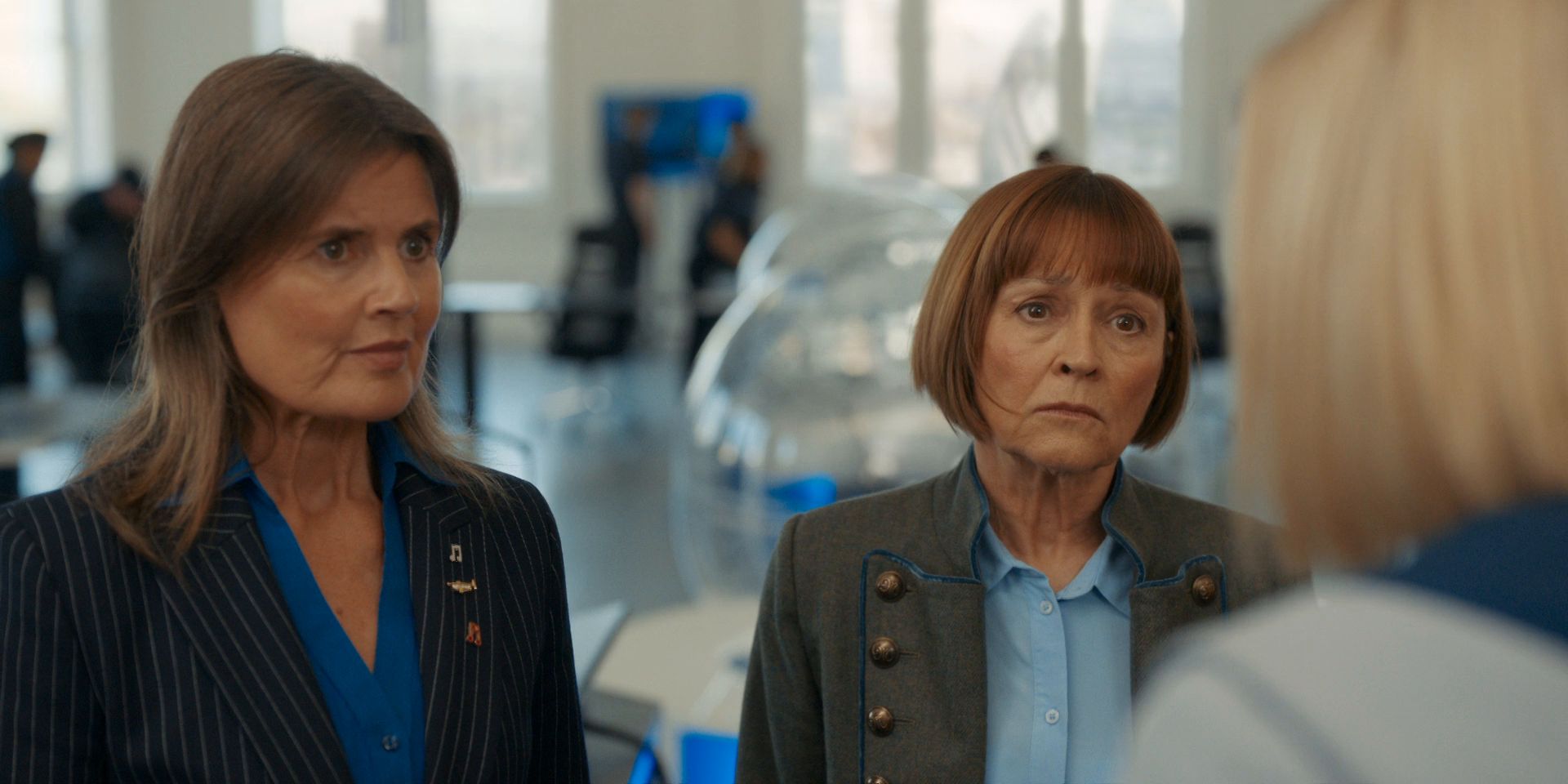
An unexpected reunion: The Doctor runs into past companions Ace (Sophie Aldred) and Tegan (Janet Fielding).

CHARACTERS:

The Doctor: Jodie Whittaker's final story, and it's a pretty good last outing for her. She is disturbed by the Master's "warning," and makes certain preparations before walking into his trap, which allows her to actively work with her friends even while she's technically incapacitated. I love the way she faces her regeneration at the end. It is neither mawkish nor protracted, but rather a look toward the future as she tells her incoming successor: "Tag, you're it."

Yaz: Sometime during the course of her travels, she has prepared a diagram and post-it notes for steering the TARDIS if the need arises. This speaks volumes about both her sense of preparation and her realism. For all of her love for (borderline worship of) the Doctor, she still realizes that her friend is not as invulnerable as she pretends. If something happens, Yaz doesn't want to end up stranded, and she has paid attention and taken steps for that eventuality. She also reacts with an absolute, forceful rejection to the idea of the Master smearing the Doctor's name, seeming to find that even more loathsome than if the Master had simply killed her.

Dan: After a particularly close brush with death, Dan re-evaluated his new lifestyle and opts to exit with his skin intact. This may have been for the best. This story is already juggling a lot with the Master, the regeneration, the returning Ace and Tegan, and giving good roles to both the Doctor and Yaz. Had Dan stuck around for the duration, he would almost certainly have been consigned (again) to the role of "spare part." At least this way, he gets a couple moments that are his own. John Bishop has been wonderful throughout his brief tenure, making the most of every scrap he's been given, and that continues to be the case here. In a way, though, that makes it all the more aggravating that we didn't get just one truly Dan-centric story some time over the past season-and-a-bit.

Tegan: Janet Fielding is one of two Classic Series regulars who return for this episode. Tegan remains as irritable as ever. She has not forgiven the Doctor for never contacting her again after she left. This is arguably unfair, as it's not as if she gave the Doctor any reason to believe that such contact would be welcome, but it is in character. Her reaction to seeing the Doctor's newest form is to sniff about how young she is. She eventually admits that she still misses the Doctor, and she gets emotional at a reference to Adric.

Ace: The other major Classic Series return comes in the form of Sophie Aldred's Ace. The original series' cancellation meant that we never saw her separation from the Doctor; other media has filled in the gaps, but knowledge of that isn't really needed. We are told enough to know that the 7th Doctor and Ace parted on even worse terms than the 5th Doctor and Tegan did. Despite this, she is openly enthusiastic at their reunion, and happily chirps that the current incarnation is "a good look." She even continues to refer to the Doctor as "Professor."

Graham: It's appropriate that one of the Thirteenth Doctor's own past companions makes an appearance. The final scenes of Revolution of the Daleks established that Graham and Ryan would continue investigating strange occurrences.  It is such an investigation that leads to Graham wandering into this story entirely on his own power. He ends up paired with Ace, and they make a surprisingly entertaining duo. Bradley Walsh works well with Sophie Aldred, and the two characters' contrasting personalities make for some enjoyable exchanges.

Kate Lethbridge-Stewart: The Power of the Doctor may just see Jemma Redgrave's best performance as Kate. What I appreciate most is how palpably frightened she of the Cybermen. When she confronts Ashad, she is shaking, knowing all too well what fate likely awaits her. She also gets to show a lighter side, with her genuine eagerness at the chance to enter the TARDIS. Her scientific background seems to be remembered in her reaction. Rather than simply express wonder at the TARDIS being bigger on the inside, she asks how it's bigger.

The Master: Sacha Dhawan's Master survived the events of The Timeless Children, though exactly how is never explained ("I'm indestructible; the whole universe knows that!"). He retains the same core of self-loathing. He doesn't want just to defeat the Doctor, or even just to take her remaining regenerations; he wants to be someone other than himself by claiming the Doctor's identity. When the Doctor and her companions thwart his plan, he pleads - as if to an uncaring universe - "Don't let me go back to being me." The irony of this plea being that there's no point in the story at which he behaves as anything other than The Master... which, if I'm honest, feels like a missed opportunity. It might have been interesting if, after taking the Doctor's identity, he had felt some "Doctorish" impulses, but the effect as portrayed isn't particularly different than if he'd snuck into the TARDIS and stolen her wardrobe.

Daleks: Are included because this is the big special celebrating the BBC's Centenary, because there was a chance that this would be the last Doctor Who story for a while, and because the New Series never misses an opportunity to overuse the Daleks. Within the confines of the story, however, they are mostly pointless. They fulfill the narrative demand of giving Ace something to do in the Final Act; but by and large, they could be removed entirely, and the story might actually be structurally cleaner for it. I guess it's nice that Ace's anti-Dalek baseball bat still works, though.

Cybermen: Unlike the Daleks, they actually seem like part and parcel of the narrative, and they work much better as a result. The Cyber-Master design looks just as silly here as it did in The Timeless Children. Thankfully, more is seen of Ashad and the regular New Series Cybermen. The scenes with the Cybermen invading UNIT develop a reasonable amount of tension, with Ashad's exchanges with Kate showing that he's still as vicious as ever. The Cybermen are a bit too easily defeated... but then, that's an issue hardly unique to this story, and the resolution to their subplot still beats "I blew them up with love!" By a lot.

Past Doctors: Chris Chibnall uses the Centenary to celebrate the Classic Series not just by bringing by Ace and Tegan, but also by bringing back Classic Series Doctors. Peter Davison and Sylvester McCoy get particularly good scenes opposite their prior companions. Jo Martin's Fugitive Doctor also receives a strong scene, which is appropriate since she's been a big part of the current era. Meanwhile, McGann, Colin Baker, and David Bradley's First Doctor show up for less than a minute each - though that's still long enough to enjoy their presence, and it's particularly nice to see Colin Baker giving such a relaxed and restrained performance. I suspect this will be their collective final bow for television Doctor Who, but the way in which this story uses the Past Doctors provides a ready, ongoing excuse for future showrunners to bring them back with no care for the actors' ages.

Band of Villains: The Master (Sacha Dhawan) makes a pact with the Daleks and the Cybermen.

THOUGHTS:

The Power of the Doctor hits the ground running with a set piece involving Cybermen attacking a bullet train in space. It never really slows down from there, as we're taken in rapid succession to: 1916 Siberia (Rasputin! And he's the Master!); UNIT HQ; a Cyber planet in Earth's orbit; and a Dalek dig site under an active volcano (did they have to exterminate Blofeld first?). We're zipped from location to location, and the high production values of this era and the large scale make this often feel less like a television special than a movie.

The benefit of this approach is that it's easy to get caught up in the rush. Writer Chris Chibnall and director Jamie Magnus Stone do a creditable job of keeping the scenes flowing nicely in and out of each other, so that it all feels like a unified narrative and not just a jumble of activity. As a celebration of 100 years of BBC history (of which Doctor Who's history is an integral part), it's also a joy to see the cameos by past Doctors and companions.

The downside? The story might be large-scale and fast-paced, but it doesn't really seem to be about much of anything. The plot mainly seems to be there to incorporate the fanservice. I've already mentioned how superfluous the Daleks seem. Add to that the Master's entire Rasputin disguise. As far as I can determine, he passes himself off as Rasputin so that he can taunt UNIT and the Doctor through altered art and then enjoy a dance number in the Winter Palace. This isn't entirely a complaint: The dance number is kind of brilliant, and none of this is even a tiny bit out of character. But on a pure plot level, it doesn't really do much.

The Thirteenth Doctor enjoys one last sunrise.

THE REGENERATION:

One aspect of this story that I cannot fault is the regeneration itself. After a brief protest that she wants more time, the Thirteenth Doctor stops and accepts what's happening - in part, I think, for Yaz's sake, but also because she recognizes the natural cycle of it. Her goodbye to Yaz, as they share ice cream atop the TARDIS while floating in space, is charming and acts as a sort of parallel to their date under the sea. Then she embraces the inevitability of the change in the light of a sunrise: the final dawn for this set of eyes, and the first for the next.

The story itself is far from my favorite New Series regeneration story. That said, I think this is my favorite New Series regeneration scene, and by a fairly substantial margin.


OVERALL:

Back in my Series Eleven Overview, I stated that Chibnall's best episodes tended to be the ones that were the most emotionally authentic, in contrast to Steven Moffat's big concepts and rapid spectacle. In that same overview, I expressed my hope that Chibnall could fix some of that season's issues with pacing and weak character interactions without throwing out those changes that had actually worked.

The Power of the Doctor mostly embraces style over substance. Yet its best moments are once again the ones that ring emotionally true: the Fifth and Seventh Doctor's brief reunions with their old companions; Thirteen standing at a very special crossroads; Kate's genuine terror of the Cybermen; and the Thirteenth Doctor's beautiful final moments. These are the scenes I will remember from this special, long after the bullet train action sequences, lethal skybeams, and dance numbers have slipped from my memory.

In the end, I enjoyed this special for what it was.  Still, it would have been nice if there had been something more substantial at the heart of it.


Overall Rating: 7/10.

Previous Story: Legend of the Sea Devils
Next Story: The Star Beast

13th Doctor Overview

Review Index

To receive new review updates, follow me:

On BlueSky:

On Threads:

Tuesday, November 15, 2022

#29: Legend of the Sea Devils.

The Sea Devils return to television! After this story, it might take them another 40 years to try again.

1 episode. Running Time: Approx. 47 minutes. Written by: Ella Road, Chris Chibnall. Directed by: Haolu Wang. Produced by: Nikki Wilson.


THE PLOT:

The TARDIS finally brings the Doctor and her friends to a beach! That beach, however, is at a Chinese fishing village in the year 1807 - a village that has just been raided by the infamous pirate known as Madam Ching (Crystal Yu)!

Ching has come for a very specific target: a stone statue of a sea monster whose base holds the key to the location of the fabled treasure of the Flor de la Mar. What she doesn't realize is that the statue is actually a prison. When she chips away at the base, she frees its captive: A Sea Devil who has been held in place for more than 200 years.

Now the Sea Devil is free - and unless the Doctor can stop him, he plans to use his technology to flood the entire planet!


CHARACTERS:

The Doctor: When she confronts the Sea Devil, she bluffs that she knows the location of the "keystone" he seeks, talking at a million miles a minute while at the same time fishing for any scraps of information he might divulge. The Sea Devil is smart enough to catch on to her game: "You talk to secure yourself time to think."

The "B" plot sees her grappling with Yaz's feelings. Yaz's interest doesn't seem entirely unrequited; if it was, moments such as showing her companion the bottom of the ocean floor while beaming that she's "not such a bad date" would smack of cruelty. Still, as she explains - and, really, as the Eleventh and Twelfth Doctors' eras repeatedly showed - her long lifespan means that any such relationship could only end in pain.

Yaz: Is a little too eager to act as "mini-Doctor," the role she effectively filled during her separation from the Doctor during the Flux. However, she isn't on the Doctor's level.  During the confrontation with the Sea Devil, she gives away information that the Doctor planned to hold in reserve.  She later attempts to replicate the Doctor's use of Sea Devil technology but can't remember which switch to use. If this era wasn't ending in just one more episode, this story would have me actively expecting her to end up on a collision course with her own limitations.

Dan: Quickly bonds with Ying Ki (Marlowe Chan-Reeves), a young man whose father became the first victim of the Sea Devil. His compassion gets the better of his judgment, though, when he follows the youth onto Madam Ching's ship, separating him from the Doctor and Yaz for most of the rest of the episode. The climax sees him battling Sea Devils with startling enthusiasm... but in between, it's back to Flux territory, with Dan mostly just an amiable presence rather than an integral part of the plot.

Madam Ching: Crystal Yu as the Historical Figure of the Week. The historical Madam Ching is a fascinating figure who rose to become head of the Guangdong Pirate Confederation, and who is sometimes credited as being the most successful pirate in history... which frankly sounds like the basis for a much more interesting and exciting story than this one. Yu does a fine job with what she's given, but she isn't given much, with the historical figure's life and background almost entirely unmentioned. Compared with this same era's treatment of historical figures such as Rosa Parks, Nikola Tesla, and Mary Seacole, this is disappointingly shallow, and the climax reduces her to little more than an extra.


THE RETURN OF THE SEA DEVILS:

The Sea Devils' design is extremely faithful to the Classic Series, only more polished. At first glance, the monsters looks terrific: menacing and strangely beautiful in a single image.

Then the lead Sea Devil talks, and the illusion is broken.

The problem is the full face mask. Compare with the (at the time) much-vilified redesign of the Silurians. That revamp left the face and mouth uncovered to allow a full range of expressions. The Sea Devils here are not granted the same luxury, and actor Craig Els is left with no ability to convey any subtlety because expressions are impossible. Also, because the mouth doesn't move well, his speech is indicated by a blinking light hanging around his chest. Which is very Classic Who... but in all the wrong ways.

As for the characterization? Well, the Doctor pays lip service to them as a peace-loving culture (though I'm frankly not sure how she arrived at that from either of their previous televised appearances). Despite that, the only speaking Sea Devil here is pure evil, sneering "Land Parasite!" at humans, keeping one man alive indefinitely just to torture him, and gloating about his planned mass extinction event. All that's missing to make him a silent movie baddie is a mustache to twirl and a scene in which he ties Yaz to some railroad tracks.

If Series One's Dalek served as a masterclass in bringing back a potentially silly monster and making it menacing and relevant to modern audiences, then I'm afraid this story represents the opposite. Their last major televised appearance was in 1984's Warriors of the Deep. After this, it wouldn't surprise me if it took another 40 years for their next return.


THOUGHTS:

Though this is not a good episode, there are good individual elements. Even if Dan is persistently underused, I really like the dynamic of the current TARDIS team. All three actors share a good-humored screen rapport. I actually believe these three enjoy traveling together, while in Series Eleven and Twelve it too often felt like the Doctor and Yaz were on one team and Ryan and Graham were on another.

For the first half or so, I mostly enjoyed this. The early scenes are fun: Yaz tricking Dan into wearing a pirate outfit (complete with hook), while the Doctor expresses exasperation with both of them; the reveal of the Sea Devil's flying pirate ship; Dan's compassion letting him get roped into an ill-advised misadventure with Ying Ki; and, most particularly, the entire sequence in which the Doctor takes Yaz 200 years into the past to locate treasure at the moment of its sinking, followed by a lovely pause (the episode's only one) at the bottom of the ocean floor.

Even in the early going, however, there are plot holes. I was immediately put off by Madam Ching operating her ship with no crew at all. A frigate isn't a private sailing boat, and the crew did not exist merely to repel boarders and to give the captain someone to flog when feeling peevish. You'd think the script would at least lampshade this with a couple lines about modifications. But... nope! She's sailing a full-sized pirate ship all on her own, and that's all there is to it.

The script has quite a bit of sloppiness. Characters reference information they shouldn't know. The Doctor and Yaz realize why the stars are in the wrong place, which would be an interesting reveal... except that they weren't present for the scene that showed the stars in the wrong place, and they had no opportunity within the episode to make that discovery for themselves! Much is also made of the Sea Devils' pet sea monster, but the creature conveniently disappears for the action climax.

The entire story feels rushed, which becomes particularly problematic near the end. First, the Doctor and Yaz escape from the Sea Devil's ship by jumping across to Madam Ching. At this point, the story should really take a moment for the characters to bond and pool information. Instead, it launches almost instantly into the final fight.

The incredibly poorly edited final fight.

Editing is somewhat jagged throughout (likely covering for issues caused by COVID restrictions), but here it becomes all but incomprehensible. I replayed bits to try to figure out how the Doctor escapes certain death in one part or how Dan knocks over Sea Devils in another part. After a few times doing this, however, I gave up and just let the images pass unchallenged; in some cases I found the answers, but it frankly wasn't worth the effort.

As if the ending hadn't been botched badly enough, the main story closes with Doctor Who's most tiresome and overused trope: a Heroic Self-Sacrifice (TM). This case feels particularly superfluous. The problem that requires a character to nobly die occurs all of a minute before the sacrifice. It may not be as poorly staged as the one in The Timeless Children, but it makes up for it by feeling entirely narratively unnecessary.


OVERALL:

Legend of the Sea Devils plays very much as if the crew shot a rough draft. This may not be far from the truth. One of the three 2022 specials was an "extra," commissioned when the BBC asked for one more episode. Given that the other two specials are the traditional Chibnall Dalek New Year's special and the epic finale, Legend of the Sea Devils seems the most likely candidate.

It might actually have been better if it hadn't been made. Eve of the Daleks left the Doctor and her team soaring into their final adventures. Legend of the Sea Devils sends them crashing back to Earth, left to stumble in a daze into their final outing.


Overall Rating: 2/10.

Previous Story: Eve of the Daleks
Next Story: The Power of the Doctor

Review Index

To receive new review updates, follow me:

On BlueSky:

On Threads:

Friday, January 7, 2022

#22 (13.1): The Halloween Apocalypse.

The Doctor has a mental link with the evil Swarm (Sam Spruell).

1 episode. Running Time: Approx. 50 minutes. Written by: Chris Chibnall. Directed by: Jamie Magnus Stone. Produced by: Nikki Wilson.


THE PLOT:

The Doctor's attempt to get information from Karvanista (Craige Els), of the dog-like Lupari species, goes predictably awry, leading to Karvanista escaping. The Doctor pursues, tracking him to present-day Liverpool... but arrives too late to stop him from kidnapping Dan Lewis (John Bishop), a seemingly ordinary human.

The Doctor and Yaz continue their pursuit, unaware that the universe itself is unraveling. Swarm (Sam Spruell), a being who has been imprisoned by The Division since the beginning of time, has escaped, and The Flux has begun...


CHARACTERS:

The Doctor: Continues to be secretive about her motives. She refuses to tell Yaz exactly why she's so intent on confronting Karvanista. When they infiltrate his ship, she sends Yaz to rescue Dan... in part to rescue the kidnapped man, but I think primarily so that she can talk to her quarry alone. When Yaz calls her on her behavior, the Doctor becomes instantly defensive, and I suspect a part of her is almost relieved when a crisis stops their argument before she has to actually share her goals.

Yaz: When Yaz meets Dan, she introduces herself as former police. To invoke Amy and Rory, she has now made the choice between "real life" and "Doctor life" - and she chose the Doctor. Which likely makes it all the more frustrating that the Doctor is still keeping secrets, something Yaz already lost patience with back in Series 12. With the TARDIS newly un-crowded, the dynamic between her and the Doctor feels much fresher and livelier, and Mandip Gill's performance here is wonderfully energetic.

Dan: Comedian John Bishop makes a strong first impression as the newest member of the TARDIS team. Introductory scenes arguably oversell the character: He's a proud Scouser who gives impromptu tours at the Museum of Liverpool despite not actually working there, who has an endearing flirtation with museum worker Diane (Nadia Albina), and who volunteers in a soup kitchen. What, no rescuing a kitten from a tree? For all this, Bishop is authentic and likable, and the scene in which he mistakes Kavanista's alien appearance for a Halloween costume is quite funny (and unlike some comedy scenes, knows to drop the gag before it wears out its welcome).

Returning Enemies: This episode briefly features both The Weeping Angels and the Sontarans. Neither enemy interacts with the Doctor, and it's obvious that they are being established for future episodes. The Weeping Angel is the centerpiece of the episode's most effective scene, as a lone angel stalks the mysterious Claire (Annabel Scholey) as she tries to make it to safety before it can catch up with her. The Sontarans receive two scenes, principally comic in tone - as has been the New Series' general treatment of them - as they relish the thought of the destruction heading their way.

Swarm: Set up as the main enemy of the season. He is introduced as a Hannibal Lecter-like character, taunting and psychologically manipulating his jailers even as he is confined. He has a history with the Doctor, presumably from when she worked for the Division, and uses a thus-far unexplained psychic link to taunt her with a past that he remembers and she does not. "There is not a tiny corner of you that remembers," he exults. "I remember every battle - which gives me the advantage." Sam Spruell does wonders with his limited screen time, his voice and bearing exuding presence. It helps that the makeup job is terrific, with him just alien enough to be unsettling without tipping over into silliness.


THOUGHTS:

The Flux begins! ...And I have only the vaguest notion of what might be going on, but at least so far it's fun to watch.

The Halloween Apocalypse is light on explanation, succeeding largely through sheer momentum. This has not traditionally been a strength of writer/showrunner Chris Chibnall's. Too often in this era, the action has screeched to a grinding halt to deliver character or plot exposition, leaving the stories to have to restart the pace instead of letting it build.

Well, that doesn't happen here. There are still good character moments, but they arise naturally during the action rather than feeling crowbarred in. Yaz confronts the Doctor about her secretiveness while they work on their pursuit of Karvanista, and they talk only for a couple minutes before being interrupted by more plot. The action is near constant, with the episode offering up no less than five different set pieces across its brisk 50-minute running time.

I wonder if it shouldn't have been a little longer. The main thread of the Doctor and Yaz pursuing Karvanista and rescuing Dan is a bit thin, and it is sometimes overwhelmed by all the "stuff" happening around it. The Division! Sontarans! Claire, who meets the Doctor out of sequence before fleeing from a Weeping Angel! And at least two other threads I'm not mentioning simply because I have no clue what's actually going on in them. The Halloween Apocalypse is the "busiest" episode of the series since the departure of Steven Moffatt, and I think an extra ten minutes might have done wonders to help all these individual bits feel like they're genuinely connected.

That said, not since Fugitive of the Judoon has a new Doctor Who episode passed so quickly for me. When the episode ended, I was actively surprised that a full 50 minutes had already elapsed. I may currently be confused about how (or whether) the pieces will end up fitting... but I wasn't bored for a second, and I'm at least cautiously optimistic that Flux might manage to deliver on its potential.


Overall Rating: 7/10.

Previous Story: Revolution of the Daleks
Next Story: War of the Sontarans

Review Index

To receive new review updates, follow me:

On BlueSky:

On Threads:

Thursday, November 25, 2021

#19 - 20 (12.9 - 12.10): The Timeless Children (2-parter).

The Master shows the Doctor the truth about her origins.

2 episodes: Ascension of the Cybermen, The Timeless Children. Running Time: Approx. 115 minutes. Written by: Chris Chibnall. Directed by: Jamie Magnus Stone. Produced by: Nikki Wilson.


THE PLOT:

In the distant future, the Cyber-Wars have resulted in the near-eradication of both humanity and the Cybermen. A handful of human survivors, led by Ravio (Julie Graham) are trying to reach a place of safety known as "The Boundary" in a dilapidated shuttle. But the shuttle has broken down - and despite Ravio's best efforts to repair it quickly, the Cybermen have found them.

The Doctor and her friends arrive just as the Cybermen attack, led by Ashad (Patrick O'Kane), the Lone Cyberman who retrieved the Cyberium from 19th Century Earth. The Doctor stands her ground long enough to distract Ashad, allowing the others to escape - except for Ryan and a young survivor named Ethan (Matt Carver), who become separated from the others. The Doctor manages to rescue them from Ashad, then steals a Cyber-shuttle to follow Ravio's escaping ship.

That ship breaks down completely near the debris marking the last great battle of the Cyber-War. Ravio, Graham, and Yaz manage to land inside a dead Cyber-ship. But Ashad is not far behind - And the ship is not as dead as it appears.

Meanwhile, the Doctor reaches "The Boundary," a phenomenon separating this universe from a pocket dimension. The divide is guarded by Ko Sharmus (Ian McElhinney), an aging veteran who has stayed behind to guide other survivors to safety. He shows the Doctor the boundary, and she is astonished at what lies beyond.

The remains of Gallifrey!  With the Master himself waiting to reveal the secret of "The Timeless Child" - the lie upon which Time Lord society was created...


CHARACTERS:

The Doctor: As The Haunting of Villa Diodati made clear, the Doctor is still haunted by Bill's Cyber-conversion. The moment she realizes that her preparations have failed and that she won't be able to just fend off the Cybermen, she pushes her companions to flee, berating herself for being "reckless" by bringing them anywhere near Cybermen. When the Master captures her in Part Two, she begs him to help her friends, appealing to their shared history. As the Master refuses, then taunts her with her hidden past, she reaches the point of physically attacking him (well, his image at least), visceral in her ferocity.

Yaz: Yas has finally started coming into her own over the second half of this season, and this proves to be another strong story for her. When the group realizes that the Doctor is trapped on the other side of the boundary, they all agree that they should rescue her. But the barrier is strange and scary, leaving them all hesitating... All except Yaz, who all but storms forward, heedless of all except the need to help the Doctor. When the Doctor insists on facing the Master at the end, Yaz is the one who protests the most strongly, insisting that "We're not letting you go!"

Graham: Spends the first half of the story in an entertaining double-act with Yaz. He and Yaz push Ravio's group to keep trying to stay alive, even when the weary survivors seem ready to give up just to end their perpetual running. As they prepare to utilize a desperate disguise to escape the Cyber-ship, both realize there is a good chance their efforts will end in death or conversion. Graham takes a moment to tell Yaz how impressed he is with her. He also enjoys an amusing flirtation with Ravio, who dubs him "strange," then clarifies that she actually likes that about him.

Ryan: Appears to have taken the Doctor's warnings about weapons a bit too much to heart, as Ko Sharmus has to convince him to take up arms against the Cybermen. "You can be a pacifist tomorrow; today, you have to survive." Ryan manages to take out one group of Cybermen - Though in his celebration, he almost gets himself captured by another group coming up behind him.

The Cybermen: "We're carrying a Cyberman that makes other Cybermen scream!" Ashad, the Lone Cyberman, returns, this time as the head of an army. The Doctor's capitulation to him at the end of the last story has left him in control of the Cyberium, and has made him more powerful than ever. He effortlessly defeats the Doctor's preparations against his attack, and she and her friends are lucky to escape with their lives. A confrontation between him and the Doctor makes clear that he despises himself for being too human - And the decidedly un-Cyberman-like anger he carries makes him more dangerous than most of the Cyber-leaders the Doctor has faced. Inevitably, he makes a deal with the Master... Though just as inevitably, that arrangement doesn't quite work out as planned.

The Master: Sacha Dhawan's Master reminds me of Anthony Ainley's early appearances in the role, before he descended into camp. Much like Ainley in Logopolis, this is a version of the character who has been battered and broken, his surface urbanity now only a thin veneer that can't hide the vicious insanity underneath. Also like the Ainley Master in Castrovalva, he won't be content with merely defeating the Doctor - He needs the Doctor to understand the intricacies, to experience the same revelation that broke him. Dhawan's screen chemistry with Jodie Whittaker is tangible, with an added sexual charge marking their confrontations.  This is a Master who is only barely in control of himself, and there's a sense of unpredictability and danger to him. I'm not going to call him the "Best! Master! Ever!" - that would be either Delgado or Gomez, depending on my mood - but so far I'd rate him a fairly close third.


THOUGHTS:

This review has taken me longer than most of my Series 12 reviews. There's a simple reason for that: After I finished Part Two, I wasn't sure what I thought. Much of this two-parter is excellent. However, there are bits that just don't work, notably the climax. It is an indisputably significant story, whether you like its revelations or not; but too much of what it reveals is delivered via long reams of exposition, leaving me to wonder if some of this information couldn't have been parceled out earlier in the season.

Ultimately, I think the easiest way to deal with this serial is to do what I almost never do with Doctor Who multi-parters: Look at the two parts individually, before judging the whole.


ASCENSION OF THE CYBERMEN

The title is a bit labored, but the episode isn't. On its own, the first half of this story ranks among the best of this season. Momentum is built almost immediately, as the Cybermen make short work of the Doctor's defenses and three of the seven survivors fall in rapid succession. There's a sense of danger, and the situation feels legitimately high-stakes in a way that The Battle of Ranskoor av Kolos failed to achieve.

Meanwhile, a side story involving a young man named Brendan (Evan McCabe) is given no direct link to the main story, yet it feels of a piece and is intriguing on its own. Initially lyrical, this side story builds a gradual sense of dread after Brendan miraculously survives a gunshot wound and a fall from a cliff. Though protesting that he was "lucky," his family suddenly eyes him... not quite with suspicion, but certainly in a way that's less than loving. When we return to Brendan near the episode's end, his story receives a shocking final note... But it never is tied into the main plot in that first episode. This is not a bad thing - It shows Chris Chibnall's confidence in his material, that he is certain the audience will wait for the next installment to tie it all together.

Ascension builds to strong endings to all three threads: The Brendan side plot, Graham and Ravio's group trapped on a ship with the Lone Cyberman, and the Doctor coming face-to-face with the Master. Pretty much every note works, guest performances and regulars alike are on strong form, and anticipation is left high for the final episode.  Judged on its own merits, I would probably rate Ascension of the Cybermen as a "9," and a "10" wouldn't be out of the question.


THE TIMELESS CHILDREN

I'm not going to say, "And then it all falls apart," because it really doesn't. But The Timeless Children simply isn't as strong as Ascension of the Cybermen, and I think the Master's presence is a big part of the reason. Though the first third of the episode builds tension as Ravio, Yaz, and Graham escape the Cyber-ship, the Cybermen plot is tied off a little too quickly and easily.  In short, it's now an inconvenience when Chibnall wants to focus on the Doctor/Master scenes, so the entire story strand is unceremoniously cleared away to make room for that.

I'm left wondering if this wouldn't have worked better as two separate stories, with the first leading into the second.  Leave Part One much as it is, but have the Doctor defeat the Cybermen at the Boundary - likely using the very same Doomsday Device (TM) that does the job at this story's climax, with her and her friends jumping through the Boundary to avoid the explosion.  The Cybermen plot is thus finished... Just in time for the Master to appear with basically the same cliffhanger that leads into Part Two.  He uses a Vortex Manipulator or some other gadget to take her away from her companions... leading into the Timeless Child story, without the leftovers of the Cybermen plot to distract.

As it stands, we have an excellent Cyberman story that lacks a satisfying conclusion, and a Master story that, revelations aside, is left feeling ever so slightly undercooked.

This isn't to say that I didn't enjoy the scenes with the Master. As I mentioned above, Dhawan and Whittaker have excellent screen chemistry. Dhawan's Master coaxes a raw quality out of Whittaker, leaving her more exposed and vulnerable than we've seen elsewhere, while he seems to become twitchy (well, twitchier) and off-balance at the mere sight of her. We see at two points in this episode that he is more than willing to die if it means "winning," and it could be argued that his entire goal here is simply to make the Doctor angry enough to put him out of his misery.

The Timeless Child flashbacks are beautifully shot and well-edited, particularly as we are shown how Brendan's tale fits into the whole. But just because it's a generally well-done info-dump, that doesn't change the fact that it is pure exposition, and quite a lot of it. Given that Can You Hear Me? involved hidden fears and memories, I can't help but wonder if some of this couldn't have been brought out in that story, which might have reduced the expositional load on this one.


THE CLIMAX

The single weakest scene in the story is, unfortunately, the climactic Doctor/Master/Cybermen confrontation.

I will say that the first part of the scene works, with the Doctor confronting the Master.  Her plan is to use the story's Doomsday Device to blow up the Master, herself, and the Cybermen all in one go. She knows that doing so will save the universe from potential devastation; the Master actively wants her to do it, because it will make her into the kind of "ends justify the means" killer that she's tried so hard not to be; and the Cybermen stand by like the robots he had earlier mocked them as, commanded by the Master not to shoot. All of this is tense, well-acted, and beautifully shot.

But of course, the show isn't about to kill the Doctor or make her into a killer, so an escape clause is required. Which means a guest characer shows up to take the device away from the Doctor and set it off, first giving her time to escape. This part is predictable, but that's not the main problem. It is genuinely badly executed.

The guest character appears at the edge of the room and takes full seconds to walk to the Doctor to take the device from her. During this time, there is nothing stopping the Master from either using his patented Shrink Ray or ordering the Cybermen to just shoot, either of which would restore the previous stalemate. Instead, the Master and all the Cybermen wait patiently until the Heroic Guest Character can get into position to perform the Heroic Self-Sacrifice. Is the Master willing to die in order to make the Doctor lose? Sure, of course he is. Is he willing to die in order to let Random Guest Character 27 go out in a blaze of glory? Er... Not so much, no.

It's not enough to ruin the episode, let alone the story, particularly as it all ends on an enjoyably bonkers cliffhanger. But it definitely knocks the score down a bit - And it probably could have been avoided, had the Cybermen and Master strands been separated into different stories, rather than squished together into a two-parter that fails to do justice to either of them.  If Part One was a triumph, then this is... not.  Were I to score The Timeless Children individually, I would probably award it a "6" - and it would mainly manage that for the performances of Whittaker and Dhawan.


THE BIG REVEAL

I have no doubt that a portion of fandom is boiling with rage at Chris Chibnall's retcon of the Doctor's origins. I'm not going to be among that number. First, Chibnall didn't really do anything that Philip Hinchcliffe and Robert Holmes hadn't tried to do with The Brain of Morbius. Hinchcliffe was moved to another show before he could make text the implication of pre-Hartnell Doctors - but the context in Morbius is clear, even if some wiggle room is left to allow for the "other faces" to be Morbius' incarnations.

What Chibnall has done is actually a rather neat reconciling of that attempted retcon with the references in The Three Doctors and Mawryn Undead to Hartnell being the First Doctor. The Morbius Doctors did exist (and more besides)... But the Doctor had no memory of them, and genuinely believed the Hartnell incarnation was the first.

I'm also fairly certain there are more revelations to come, very likely some that will muddy the waters a bit. It should certainly be noted that the Master is far from a reliable narrator, and that his stated purpose in showing the Doctor this past is to "break" her. He's probably telling the truth... But he's fairly certain to not be telling the whole truth.

Here are just a few potential questions: Why did the Master indicate in Spyfall that what was done specifically impacted both him and the Doctor; it wouldn't make sense to single out himself if he was no more linked to this than every other Time Lord. Why were all the Doctors in the previous regeneration cycle male, something so statistically improbable as to be almost indistinguishable from impossible? Perhaps the Time Lords locked the Doctor's regenerations to male ones (the only reference to female as a possibility was in The Night of the Doctor, in a regeneration offered not by the Time Lords but by the Sisterhood of Karn); as soon as that was "unlocked" in The Time of the Doctor, the Doctor becomes a woman in the second life of this new cycle - which is to say, about what you would statistically expect.

I'm not saying that those are necessarily directions I expect the show to go; the latter notes would honestly be a bit too backward-looking. The point is, there are avenues that are open to explorations, ones that don't overwrite previous lore so much as expand upon it.


OVERALL

But while I think there are legitimate dramatic possibilities in these new revelations, I still come back to this: These revelations were almost exclusively delivered via expositional infodump, and they didn't really need to be. When the Doctor discovered the possibility of a hidden past in Fugitive of the Judoon, it was achieved with a brilliant visual reveal of her digging up the buried TARDIS. Had even one standalone been jettisoned, a two-part version of Can You Hear Me? could have provided an ideal opportunity for a few more tantalizing hints and clues. Then the Master wouldn't just be delivering exposition - He would be lending context to puzzle pieces the Doctor had already discovered.

This remains a good story overall, boosted considerably by excellent performances, and I have to give Chibnall credit for risk-taking - Series 11's biggest sin, as I've previously indicated, was an almost religious adherence to playing things safe.  But I can't escape the conviction that this should have been better.  Give this story outline to Moffat or Davies, and they'd have left me slack-jawed, staring at the screen, digesting everything for weeks.  Chibnall's story is basically a good one... But most of the time I've spent mentally picking at it has involved puzzling out ways the same basic story could have been much better.


Overall Rating: 7/10.

Previous Story: The Haunting of Villa Diodati
Next Story: Revolution of the Daleks

Review Index

To receive new review updates, follow me:

On BlueSky:

On Threads:

#20: The Timeless Children.

The Master reveals the Doctor's hidden history...

1 episode. Running Time: Approx. 66 minutes. Written by: Chris Chibnall. Directed by: Jamie Magnus Stone. Produced by: Nikki Wilson.


NOTE:

I previously reviewed Ascension of the Cybermen and The Timeless Children as a single story. Given how different the focus is for each episode, and my very different overall response to each installment, I have chosen to re-review these as individual episodes before moving forward with the latest season. You can find my original review here.


THE PLOT:

Graham, Yaz, and Ravio (Julie Graham) continue to evade the Cybermen, led by the half-converted Ashad (Patrick O'Kane). Meanwhile, the Doctor has arrived at "The Boundary," a phenomenon separating this universe from a pocket dimension. The divide is guarded by Ko Sharmus (Ian McElhinney), an aging veteran who has stayed behind to guide other survivors to safety. When he shows the Doctor the divide, she is astonished at what's on the other side:

She has found the remains of Gallifrey, with the Master himself waiting eagerly to reveal his secrets! As the two Time Lords wander around the ruins of their society, the Master tells her about "The Timeless Child" - the lie upon which everything they knew was founded...


CHARACTERS:

The Doctor: Remains intensely protective of her friends. When the Master springs his inevitable trap, she appeals to whatever good may lie within him to help her friends. Unfortunately, this Master has no better nature, and he refuses with a smirk and then taunts her with her hidden past. Worn down over the course of the episode, she finally reaches the point of physically attacking him (well, his image at least).

Yaz: Has (finally) started coming into her own over the second half of this season, and this proves to be another strong story for her. When the group realizes that the Doctor is trapped on the other side of the boundary, they all agree that they should rescue her. But the barrier is strange and scary, leaving them all hesitating... except Yaz, who storms forward, heedless of all except the need to help her friend. Near the end, when the Doctor insists on facing the Master alone, Yaz is the one who protests the most: "We're not letting you go!"

Graham: Though much worse-used than in the previous episode, he does get one fine moment. As he and Yaz prepare to utilize a desperate disguise to escape the Cyber-ship, both realize there is a good chance their efforts will end in death or conversion. He takes a moment to tell Yaz how impressed he is with her in a lovely speech... which ends with a light punchline when Yaz responds.

Ryan: Appears to have taken the Doctor's warnings about weapons too much to heart, as Ko Sharmus has to convince him to take up arms against the Cybermen. "You can be a pacifist tomorrow; today, you have to survive." Ryan manages to take out one group of Cybermen... though in his celebration, he almost gets himself captured by a second group coming up behind him.

The Cybermen: Both Ashad and his Cybermen are greatly reduced. In the previous two episodes, Ashad in particular was an unstoppable threat - as relentless as he was vicious. Here, the Cyber-army is transformed into a handful of too-easily dispatched extras. Ashad survives to cross the boundary, where he makes a deal with the Master... leaving him as nothing but the Master's henchman for the remainder of the story. Oh, and the final appearance of the new race of "Cyber Lords" is just laughable; I hope this particular Cyberman variant never appears again.

The Master: Sacha Dhawan's Master reminds me of Anthony Ainley's early appearances in the role, before he descended into camp. Much like Ainley in Logopolis, this is a Master who has been battered and broken, his surface urbanity now only a thin veneer covering utter insanity. Like the Ainley Master in Castrovalva, he isn't content with merely defeating the Doctor - He needs the Doctor to experience the same revelation that broke him.

Dhawan's chemistry with Jodie Whittaker is tangible. He coaxes a raw quality out of Whittaker, leaving her more exposed and vulnerable than we've seen elsewhere. At the same time, he becomes twitchy (well, twitchier) and off-balance at the mere sight of her. Twice in the episode, he proves himself willing to die as long as he gets to "win." I'd go so far as to argue that his entire goal here is to make the Doctor angry enough to put him out of his misery. I have many problems with this episode; the dynamic between this Master and this Doctor is definitely not one of them.


OF RETCONS AND REVELATIONS:

The Timeless Children is an indisputably significant story. Whether you love its revelations or hate them, it is an episode deliberately targeted at changing everything we thought we knew: about the Time Lords, about Gallifrey, about the Doctor, and - I suspect - about the Master as well (there are clearly some revelations still to come). It is not really a conclusion to Chibnall's overall Doctor Who narrative, but rather a turning point. Which I suspect means that how Chibnall's choices are ultimately regarded will depend on what comes next.

I said much the same about Steven Moffat's decision to save Gallifrey in The Day of the Doctor - that whether I thought it was good or bad would come down to what he did with them. The answer in that case ended up being... well, Hell Bent and not much else. In this case, at least, I'm pretty sure Chibnall will actually do something with the pieces he's set up here.

The revelations have been carefully devised. Chibnall delivers a massive retcon; but by making both the Doctor and (most of) the Time Lords ignorant of this hidden history, he has avoided any direct conflict with previous episodes and managed to neatly fold together the seemingly irreconcilable stances of Hinchcliffe/Holmes's The Brain of Morbius and The Deadly Assassin and Terrance Dicks's The Three Doctors and The Five Doctors.

None of which is enough to actually make The Timeless Children a good episode...


A TWO-PARTER THAT SHOULDN'T HAVE BEEN:

The Timeless Children was made not just as the finale to Series 12, but as the second half of a two-parter, paired with Ascension of the Cybermen. I believe this was a mistake. It rapidly becomes clear that this episode has no use for the Cybermen plot. As a result, the previously formidable metal foes are brushed aside too quickly and far too easily, clearing away this distraction from the Doctor/Master material.

In my opinion, Part One should have ended with the Doctor defeating the Cybermen at the Boundary - perhaps by using the very same Doomsday Device (TM) that does the job at this story's climax, with her and her friends jumping through the Boundary to avoid the explosion. The cliffhanger could then have been the Master waiting for them in the ruins of Gallifrey... leading into this episode, now free to fully focus on the Doctor/Master confrontation.

By making it into a 2-parter, Chibnall has damaged both parts: an excellent Cyberman story is denied a satisfying conclusion; and the Master's machinations are left feeling undercooked because time that might have been used to better develop his plan is instead devoted to tying off the previous episode's story.


THE INFODUMP:

The Timeless Child flashbacks are beautifully shot and well-edited, particularly as we are shown how Brendan's tale fits into the larger whole. Sacha Dhawan's delivery of the Master's narration is often compelling, and Jodie Whittaker's reactions show how each and every bit of new information shakes the Doctor to her core.

But it still amounts to an extended infodump, and this stalls any momentum the episode might have built. I've complained before that Chris Chibnall tends to tell when he should show, and this episode is the apotheosis of this. The Timeless Children's grand revelations are delivered as pure exposition, and quite a lot of it.

This shouldn't have been necessary. Fugitive of the Judoon revealed the existence of hidden Doctors, and did so with a fantastically effective visual flourish in a story that didn't stop moving for a second. Other pieces of information could have been similarly parceled out in other episodes. To pick an obvious choice: Can You Hear Me? involved hidden fears and memories; why wasn't some of this information divulged in that story? It would have given that interesting but flawed episode further weight, and at the same time would have relieved some of the expositional burden from this finale.

As I said above, my verdict on the Timeless Child concept will depend on what is done with it. But even if Chibnall somehow manages to stick that landing, I will still find the manner in which this episode unveiled it to be both clumsy and artless.


THE CLIMAX:

Speaking of sticking the landing... My confidence in that is not helped by me finding this episode's single weakest scene to be its climax.

The first half of the scene actually works. The Doctor's plan is to use the story's Doomsday Device to save the universe by blowing up the Master, herself, and the purely robotic remnants of the Cybermen all in one go. And the Master is fully on board with this. He believes he will "win" if she becomes the kind of "ends justify the means" killer that she's tried so hard not to be. Meanwhile, the Cybermen stand by like the robots the Master's reduced them to, commanded by him not to shoot. All of this is tense, well-acted, and beautifully shot.

And then a guest character shows up to relieve the Doctor of her horrible burden, and the scene implodes. Not only does it feel like a cheat, it's genuinely badly executed.

The guest character appears at the edge of the room and takes several seconds to walk to the Doctor to take the device from her. During this time, there is nothing stopping the Master from either using his patented Shrink Ray or ordering the Cybermen to just shoot the new arrival, either of which would restore the previous stalemate. Nor is there any reason for the Master not to do so. Is he willing to die in order to make the Doctor lose? Of course. Is he willing to die in order to let Random Guest Character 27 go out in a blaze of glory? Er... I wouldn't particularly tend to think so, no.


OVERALL:

I think there are legitimate dramatic possibilities in this episode's big reveal. Even so, it was unveiled almost exclusively via expositional infodump. The story itself is harmed by the need to tie off the previous episode's Cybermen plot, and the ending confrontation dissolves into a ridiculous "Noble Self Sacrifice" cliché.

In short, for the second season in a row, Chris Chibnall has delivered a finale that doesn't quite work. Give this story outline to either Steven Moffat or Russell T. Davies, and I suspect they'd have left me slack-jawed, staring at the screen, digesting everything for weeks. In Chibnall's hands, I find myself instead picking over its flaws, trying to puzzle out how the same basic story could have been made to work much better.


Overall Rating: 4/10.

Previous Story: Ascension of the Cybermen
Next Story: Revolution of the Daleks

Review Index

To receive new review updates, follow me:

On BlueSky:

On Threads:

Tuesday, November 23, 2021

#19: Ascension of the Cybermen.

The Lone Cyberman (Patrick O'Kane) interrogates a prisoner.

1 episode. Running Time: Approx. 49 minutes. Written by: Chris Chibnall. Directed by: Jamie Magnus Stone. Produced by: Nikki Wilson.


NOTE:

I previously reviewed Ascension of the Cybermen and The Timeless Children as a single story. Given how different the focus is for each episode, and my very different overall response to each installment, I have chosen to re-review these as individual episodes before moving forward with the latest season. You can find my original review here.


THE PLOT:

In the distant future, the Cyber-Wars have resulted in the near-eradication of both humanity and the Cybermen. A handful of human survivors, led by Ravio (Julie Graham) are trying to reach a place of safety known as "The Boundary" in a dilapidated shuttle. But the shuttle has broken down - and despite Ravio's best efforts to repair it quickly, the Cybermen have found them.

The Doctor and her friends arrive just as the Cybermen attack, led by Ashad (Patrick O'Kane), the Lone Cyberman who retrieved the Cyberium from 19th Century Earth. The Doctor stands her ground long enough to distract Ashad, allowing the others to escape. However, Ryan and a young survivor named Ethan (Matt Carver) become separated from the others. The Doctor rescues them - but becomes separated from Yaz, Graham, and the other survivors in the process.

That group manages to find shelter inside a dead Cyber-ship. They appear to be safe for the moment. But Ashad is not far behind - And this ghost ship is not as dead as it appears!


CHARACTERS:

The Doctor: As The Haunting of Villa Diodati made clear, the Doctor is still haunted by Bill's Cyber-conversion. The moment she realizes that her preparations have failed and that she won't be able to just fend off the Cybermen, she pushes her companions to flee and berates herself for being "reckless" by bringing them anywhere near Cybermen. The generally more ferocious Doctor of the last couple episodes is well-suited to Jodie Whittaker's acting strengths and she really holds the screen, particularly in a holographic confrontation with Ashad in the episode's second half.

Graham/Yaz: They are strong enough together to seize a leadership role when separated from the Doctor. Between Graham's experience and Yaz's inherent optimism, they push Ravio's group to keep trying, even when the weary survivors seem ready to give up just to end their perpetual running. Graham also enjoys an amusing flirtation with Ravio, Bradley Walsh and Julie Graham showing some pretty decent screen chemistry in their too-brief moments together.

Ryan: That this TARDIS team is too large is shown by how many episodes relegate at least one companion to the role of spare part. It's Ryan's turn to wear the dunce cap, not for the first time, his importance to this installment basically just being the excuse to separate the Doctor from the others so that the derelict ship subplot can happen.

The Cybermen: "We're carrying a Cyberman that makes other Cybermen scream!" Ashad, the Lone Cyberman, returns, this time as the head of an army. The Doctor's capitulation to him has left him in control of the Cyberium, and has made him more powerful than ever. He easily defeats the preparations against his attack, and the survivors are lucky to escape with their lives. The Doctor correctly guesses that Ashad despises himself for being too human - And the decidedly un-Cyberman-like anger he carries makes him more dangerous than most of the Cyber-leaders the Doctor has faced.


THOUGHTS:

Though the math changes when it's considered in combination with the next episode, when taken on its own merits Ascension of the Cybermen ranks among the best of the season. Momentum is built almost immediately, as Ashad's Cybermen make short work of the Doctor's defenses and three of the seven survivors fall in rapid succession. There's a sense of danger, and the situation feels legitimately high-stakes in a way that The Battle of Ranskoor av Kolos failed to achieve.

Meanwhile, a side story involving a young man named Brendan (Evan McCabe) is given no direct link to the main story, yet it feels of a piece and is intriguing on its own. Initially lyrical, this side story builds a gradual sense of dread after Brendan miraculously survives a gunshot wound and a fall from a cliff. Though he protests that he was "lucky," his family suddenly eyes him... not quite with suspicion, but certainly in a way that's less than loving. When we return to him near the episode's end, his story receives a shocking final note... But it never is tied into the main plot, its significance withheld until the following installment. This is not in itself a bad thing - It shows Chris Chibnall's confidence in his material, a confidence that was too often lacking in Series 11, with him certain the audience will wait for the next installment to tie it all together.

Ascension builds to strong endings to all three threads: The Brendan side plot, Graham and Ravio's group trapped on a ship with the Lone Cyberman, and the Doctor coming face-to-face with the story's true enemy, a being even more dangerous than Ashad. Pretty much every note works, guest performances and regulars alike are on strong form, and anticipation is left high for the final episode.


Overall Rating: 9/10.

Previous Story: The Haunting of Villa Diodati
Next Story: The Timeless Children

Review Index

To receive new review updates, follow me:

On BlueSky:

On Threads:

Tuesday, February 18, 2020

#18 (12.8): The Haunting of Villa Diodati.

The Doctor investigates strange phenomena at the birth of Frankenstein.

1 episode. Running Time: Approx. 50 minutes. Written by: Maxine Alderton. Directed by: Emma Sullivan. Produced by: Alex Mercer.


THE PLOT:

Lake Geneva, 1816. Lord Byron (Jacob Collins-Levy) is hosting Dr. John Polidori (Maxim Baldry) and his friends, Percy Bysshe Shelley (Lewis Rainer), his young fiancee Mary Godwin (Lili Miller), and her sister Claire Clairmont (Nadia Parkes). Kept indoors by a storm, Byron agrees to read to the group - and Mary eagerly requests a tale of bloodcurdling horror.

The proceedings are interrupted by a knock on the door. The Doctor and her friends have arrived to witness the night that created Frankenstein. But things are not as they should be. Percy, one of the architects of the creative storm, is absent entirely, and the others now seem less interested in storytelling than in chatting and dancing - or in Byron's case, in making amorous advances toward the Doctor.

For her part, the Doctor feels a strange "vibe" coming from the villa, making it hard for her to concentrate. "I don't want to worry you," she tells her hosts, "But I'm sensing that it's sort of unrelentingly evil." Soon, the group find themselves exiting rooms only to find they have entered them again, or descending staircases only to discovery themselves at the top again. The slumbering Polidori sleepwalks through a wall, while the hand of a skeleton from Lord Byron's collection propels itself across the floor.

Is it a ghost story? Or are the Doctor and her friends experiencing another kind of haunting?


CHARACTERS:

The Doctor: "Sometimes, this team structure isn't flat. It's mountainous, with me at the summit, in the stratosphere - alone, left to choose... Watch people burn now or tomorrow. Sometimes, even I can't win." The last part of this episode sees the Doctor forced to make a choice between two evils - between one life now, or potentially billions of lives later. Ryan makes the obvious response, earning him the Doctor's fury as she soundly rejects the mathematics of choosing a death. "One death, one ripple, and history will change in a blink! ...The world you were created in won't exist, so neither will you." It's the kind of Doctor speech Peter Capaldi received regularly during his tenure, and it is a delight to see Whittaker sink her teeth in with full ferocity. Her anger, resolve, and even at times despair are all the more effective because her Doctor is at her breeziest in the story's early stages, making an effective contrast between the usual "lighter" Thirteenth Doctor and the grim figure at the story's conclusion.

Yaz: Catches Claire, who is besotted with Byron, trying to break into his study to read his letters. She reproves the young woman for "breaking and entering," but is sympathetic toward her. When Claire asks if Yaz has ever felt strongly about somebody unattainable, Yaz replies wistfully in the affirmative - The first actual, on-screen indication I've seen that her feelings for the Doctor might go deeper than simple admiration or hero worship. When the Doctor insists on confronting the episode's villain alone, Yaz protests - earning a dose of the Doctor's fire as the Doctor insists that she "won't lose anyone else!" (also the first direct on-screen evidence of my theory that Thirteen's attitude toward her companions is a direct response to the losses suffered by her previous incarnation).

Ryan: The harsher outlook we saw in It Takes You Away is glimpsed again here. When it becomes clear that saving one of the poets will risk countless lives in the future, Ryan is the one who offers up the obvious math of one life vs. many.  One-on-one, however, he remains the most likely of the group to actively support others. When Mary worries that her writing efforts pale next to those of her male companions, Ryan urges her to keep trying - advice he repeats at the episode's end. He also comes very close to stumbling into a duel with the short-fused Polidari.

Graham: Has a ghostly encounter that differs entirely from the others in the episode, leaving the Doctor actively wondering if he actually saw genuine ghosts. When Polidari challenges Ryan to a duel, we again see his protectiveness of his grandson as he announces that he forbids it. Polidari ignores the declaration entirely, but had the skeletal hand not intervenes, I doubt Graham would have simply stood by.


THOUGHTS:

A quick note about my feelings regarding this story's apparent overwriting of the 8th Doctor/Mary Shelley audios: I don't care.  I enjoyed those audios when I listened to them several years ago.  I fully expect that if I ever re-listen to them, I will still enjoy them.  Doctor Who has previously offered multiple, entirely contradictory accounts of the fall of Atlantis, and that was just on television.  The last thing I want the television writers to do is to tiptoe around the now several hundred book and audio stories; I just want them to write good shows.

This story, Maxine Alderton's Doctor Who debut, is a very good show. Based on this, I hope it is her first script of many. The dialogue is crisp, sometimes amusing, sometimes disquieting, and often quotable. The characterizations are strong for both regulars and guest cast, and the ensemble is effectively balanced, with every character getting his or her moment. This might just be the strongest characterization yet for the Thirteenth Doctor, showing off both her whimsical and serious sides to good effect.

I praised director Emma Sullivan for her atmospheric helming of Can You Hear Me?, in which I felt her directing gave a considerable boost to an interesting but rushed and underdeveloped story. Given a script that fits much better into its 50 minute slot, she performs even more strongly. The various halls and rooms, and the light and shadow illuminating them, are used to maximum visual effect, with the story being enjoyably creepy even before its midpoint turn.

The villain is one of the most memorable and threatening we have seen in a while.  There's a particularly nasty moment in which he finds a maid, hiding with an infant.  We watch the scene in long shot: Him standing over her hiding place.  She is hidden from our view, but we hear her cries mingled with the infant's wails.  He reaches down and there's a snap, after which the only remaining sound is the baby.  It's an enormously unsettling moment, all the moreso for the gruesomeness occurring just out of our vision.

It all ends with an effective lead into the two-part finale - along with a tantalizing final shot of the Doctor that could be read either as heroic or sinister - which leaves me awaiting the season's big finish. Hopefully, this finale doesn't drop the ball the way last year's did. Either way, however, this was a very strong hour of television, and one of Jodie Whittaker's best showings in the role to date.


Overall Rating: 9/10.

Previous Story: Can You Hear Me?
Next Story: Ascension of the Cybermen

Search Amazon.com for Doctor Who

Review Index

To receive new review updates, follow me:

On BlueSky:

On Threads: