Showing posts with label Maxine Alderton. Show all posts

Sunday, October 6, 2024

13th Doctor Overview.

The Thirteenth Doctor (Jodie Whittaker), with The Fam
The Thirteenth Doctor (Jodie Whittaker), with "The Fam."

I'm writing this just shy of two years from the end of the Thirteenth Doctor's era, just as I'm preparing to move on to viewing and reviewing Ncuti Gatwa's first season as the 15th Doctor. Before I move forward, I'm feeling a need to look back, because many of my thoughts about the tenure of showrunner Chris Chibnall and star Jodie Whittaker are not fully represented by my reviews of the individual episodes.

Fair warning: This is neither a hate post nor a love letter. If you're looking for relentless negativity, I suggest finding a YouTube video, probably one with googly eyes on the thumbnail that uses the word "woke" a lot. If you're looking for only positive comments, then do the same, only avoiding those particular search cues. I'm going to discuss both what worked for me (and a lot did) and my frustrations about elements that either didn't work or that I thought fell short of their potential.

As ever, this represents my own opinion, and other views are available.

The Doctor confronts a Cyberman.
The Doctor confronts a Cyberman - and Whittaker shines
with a script that lets her get properly angry for a change.

JODIE WHITTAKER AS THE DOCTOR:

The announcement of Jodie Whittaker's casting came during my burnout period, in which I was neither viewing nor reviewing Doctor Who or anything else. I will admit that the announcement caught my eye. Whittaker is an actress whose work I've generally enjoyed, and I found her to be particularly good in Chris Chibnall's Broadchurch. It took me another year to recover from my malaise, but her casting was one of the reasons I decided to return to Who when I was ready to start reviewing again.

My response to her first appearance was... well, mixed. She was fine in The Woman Who Fell to Earth, with excellent individual moments... but she also had several deliveries that struck me as either flat or just plain misjudged. It wasn't until Rosa that she won me over. Even then, Arachnids in the UK (in my opinion, her single worst performance in the role) made me doubtful all over again.

Her performance improves whenever a script avoids reducing her to "the nice Doctor." There are glimpses throughout Series 11: Her scenes with Krasko in Rosa, her interactions with both the Thijarians and Manish in Demons of the Punjab, her confrontation with King James in The Witchfinders, and her general grumpiness in Kerblam!  All of these moments saw Whittaker's performance noticeably improve.

Thankfully, that became explicit characterization in Series 12 and 13, as it became clear that this Doctor's friendly smile was a shield to protect her from getting too close to her companions. She may have labeled her first companion set "Fam," but she kept them at a distance, avoiding anything that resembled a meaningful personal question. If they pushed harder, as Yaz often did in Series 13, she became snappish and even hostile. The more these beats were played, the better both character and actor became.

Whittaker was excellent at showing the character's defensiveness, and I think she exceled in moments of frustration and anger. On the other hand, I don't think she ever quite got the handle of delivering sci-fi Technobabble. In her first season, her Technobabble scenes often reminded me of actors phonetically reciting foreign language dialogue. She got better (and the scripts wrote less of it for her), but it remained a weakness.

Her worst performances came whenever she was written as "Dr. Exposition." Her acting flattened in episodes like Praxeus, Revolution of the Daleks, and Survivors of the Flux, in which she was little more than a vessel for explanations. I got the impression she couldn't engage with reams of exposition, and I wasn't surprised when excessive exposition was one of the only complaints she voiced in interviews after her exit. 

The Doctor officiates a wedding between a Hindu and a Muslim during the Partition of India.
The Doctor officiates a wedding in Demons of the Punjab, easily my favorite episode of this era.

WHAT WORKS:

When the Chibnall era gets discussed, particularly after a couple years' distance, I see a lot of the sentiment: "Jodie was good, shame about the scripts." There is truth to that, but I think it's reductive.

There are a handful of fine scripts in these three-and-a-bit seasons. The stories from Vinay Patel and Maxine Alderton would stack up well in any era, and I hope both writers get a chance to submit for the series in the future. Chibnall's own stories include a solid new Doctor introduction in The Woman Who Fell to Earth; a terrific time-loop story in Eve of the Daleks; and, in War of the Sontarans, the best showing for the potato-headed warriors since their introduction during Jon Pertwee's tenure... though, as my review noted at the time, that doesn't clear the highest of bars; my pick for their previous second best story was the enjoyable but heavily flawed The Two Doctors.

In my Series Eleven overview, I stated some of my issues with that first season. Still, while I had quibbles with the execution, Series Eleven's attempt at a grounded and character-focused approach was something I had wanted to see from Doctor Who for a while. When the Doctor introduced herself as "just a traveler" who helps where she can, I wanted to applaud. I also love that all of Thirteen's companions are ordinary people - no dark secrets, no paradoxes, no alien plots. Just a group of average but highly decent human beings.
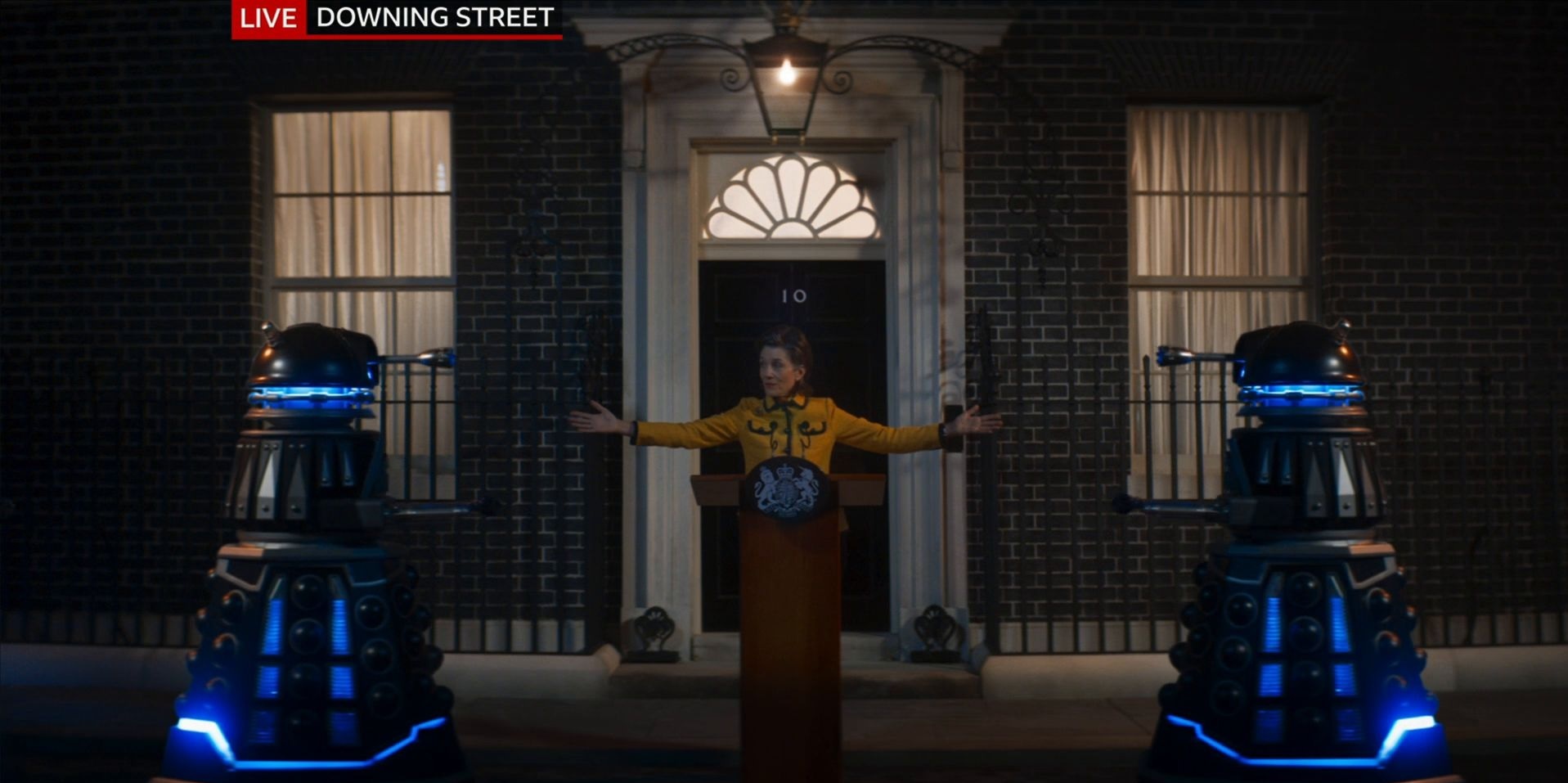
The Prime Minister introduces Daleks to the British public. It goes about as well as you'd expect.
Revolution of the Daleks. Like a lot of episodes, it's fine. Just... fine.

A LITTLE TOO CONSISTENT:

Chris Chibnall wrote a higher proportion of the scripts than his predecessors did, which results in an era that's very consistent in tone and quality. There are relatively few episodes that I think are truly bad. Even the worst don't approach the awfulness of other eras' stinkers. Gun to my head, I would choose to rewatch both Orphan 55 and Legend of the Sea Devils before I sat through either Victory of the Daleks or Fear Her again.

The flipside of this is that there are equally few standouts. The only "10/10" I awarded across three seasons was for Demons of the Punjab, while there are individual RTD and Moffat seasons that feature multiple episodes that I gave full marks. Most of the shows range from "okay" to "pretty good." That doesn't sound bad on the face of it, but a steady diet of "pretty good" becomes numbing in practice.

By the time Flux rolled around, I no longer felt excitement at the prospect of a new season. Ironically, and despite its flaws, that ended up becoming my favorite Chibnall season. But I came away from the era reflecting that the occasional ghastly dud was something I was willing to put up with, if it also meant that something truly brilliant might be around the corner.

Graham and Ryan in The Battle of Ravskor av Kolos.
Graham (Bradley Walsh) and Ryan (Tosin Cole) get Series 11's
character arc, leaving the Doctor and Yaz to just carry the plots.

CHARACTERS:

Up to this point, most of my thoughts tilt toward the positive, albeit with a side of, "This could have been better." Shifting to the regular characters, however, moves into an area that left me feeling frustrated.

I liked all three of the initial companions. As of Rosa, I thought this was a promising new set of regulars, just waiting for scripts that would bring out extra layers that would make them "pop." Sadly, at least for me, that "pop" never happened.

Some of the reasons are easy enough to determine. There's a lack of interaction, particularly among the "Fam" of Series Eleven and Twelve. Too many episodes fall into a familiar pattern of splitting them into teams - usually with the Doctor and Yaz working on the plot while Graham and Ryan received moments of character (in Series Eleven) or comedy relief (in Series Twelve).

The results tended to be good whenever an episode broke away from that pattern. Ryan and Yaz get some well-written exchanges in The Woman Who Fell to Earth and Rosa. Yaz and Graham share terrific moments in Demons of the Punjab and Ascension of the Cybermen. But Yaz is the only companion who gets significant one-on-one time with the Doctor. Even before the "Fam" leaves, it feels as if Yaz is her actual companion, with the other two just along for the ride.

Yaz also doesn't come properly into focus until Graham and Ryan leave. In those first two seasons, it often feels as if she's competing against them for screen time... and even in her supposed "spotlight" episodes, it tends to feel like she's losing that competition.

This improves with Flux and the specials, which see her interacting with new companion Dan in a way that feels a lot more authentic. It further helps that this shift happens at the same time that she starts really pushing back against the Doctor's secretiveness. At this point, the character starts to work... but by the time Flux starts, there are less than ten episodes remaining in her tenure.

The Doctor and Yaz.
Yaz falls hard for the Doctor, and it doesn't seem entirely unrequited. It also doesn't go anywhere.

BOLD IDEAS, TIMID EXECUTION:

And on to my single biggest frustration.

On paper, Chris Chibnall's ideas for Doctor Who are ambitious. These three seasons deliver: the series' first female Doctor; a massive retcon of the Doctor's origins; and the first same-sex romantic attachment between a Doctor and a companion. You can like or dislike any of these, but the ideas are unquestionably bold.

So why does it all feel so damn timid?

The first female Doctor spends too much of her first season being characterized as a blandly inoffensive "Doctor Fluffy." The Doctor, in all incarnations, has always been arrogant, more than a little judgmental, and often downright rude. In Series Eleven, she's rarely allowed to show any of these traits. She's so busy being "the nice Doctor" (right down to checking during a confrontation with a Dalek that she's nice, right?) that she too often doesn't feel properly like the Doctor.

As with other problems, this improves in her later seasons, as it becomes a major point that her surface niceness is a shield that keeps others at a distance far more effectively than the 12th Doctor's surface grumpiness ever did. But even then, she's rarely allowed to show the arrogance that the Doctor should possess.

The Doctor/Yaz relationship never actually comes to much. Yaz refers to the Doctor as "my person" in The Haunting of Villa Diodati, and her feelings for the Doctor are a character point in Flux and the first two 2022 specials... only for that to be cut off at the end of Legend of the Sea Devils when the Doctor tells her that relationships with short-lived humans end up hurting too much, something Yaz just... accepts.

Now, I've never been fond of the New Series phenomenon of Doctor/Companion romances, because they by definition can only go so far. Still, if you're going to go down that or any route, then do it! I don't think queerbaiting was the intent - but the refusal to commit to this as a direction made it come across that way. Either do a thing or don't; just half doing it will be enough to annoy those who don't like the direction while failing to satisfy those who do like it.

More than any other single element, this era's bizarre tentativeness is what holds it back. Chibnall seems to have conceived a fearless vision of Doctor Who - but instead of diving into the deep end, he keeps dipping a toe over and over before deciding the water's too cold, drying his feet off, and going back inside. Doubly frustrating for me was that I started watching this era on the heels of Broadchurch, a show from the same writer, showrunner, and actress that was emotionally fearless. His Doctor Who badly needed that same quality.

The 13th Doctor's last sunrise.
The Thirteenth Doctor's last sunrise.

OVERALL:

Given how critical the latter half of this post has been, I feel that I should emphasize that I enjoyed the 13th Doctor era on its own terms. I liked Jodie Whittaker's Doctor, particularly when she was allowed to be a little spiky and snappish later on. I loved seeing some historically based stories that were actually centered around history. I'm a Hartnell fan, and I can easily mentally transplant the original TARDIS team into stories like Demons of the Punjab and Nikola Tesla's Night of Terror.

Still, despite liking a lot more of the individual episodes than not, this is the most frustrated I've ever felt with an era of Doctor Who, including a couple that I think are qualitatively worse than this. What I said about Whittaker in Series Eleven equally applies to the era as a whole: I think there's a genuinely great take in here, if it had only been willing to commit to its own ideas.

It's been announced that Jodie Whittaker and Mandip Gill have joined Big Finish, so maybe some of their upcoming audios will redress this. Certainly, thanks in large part to COVID sending Whittaker's final season into disarray, there's a sense of an era that's only half-finished, so this was an extremely welcome announcement for me.

At its best, Big Finish has made some great Doctor Who. Fingers crossed for that, and for something of substance to be done with the 13th Doctor and Yaz, rather than them just battling Rutans and Krynoids to fill monthly slots.


Review Index

To receive new review updates, follow me:

On BlueSky:

On Threads:

Friday, January 28, 2022

#25 (13.4): Village of the Angels.

Professor Jericho (Kevin McNally) is attacked by an Angel in his television!

1 episode. Running Time: Approx. 56 minutes. Written by: Chris Chibnall, Maxine Alderton. Directed by: Jamie Magnus Stone. Produced by: Nikki Wilson.


THE PLOT:

"The Angel has the TARDIS!"

A Weeping Angel has taken control of the TARDIS. Thinking fast, the Doctor manages to expel it - but not before she and her friends are re-routed to 1967, to the quiet English village of Medderton. Strange things are happening in Medderton. The cemetery has too many gravestones. A young girl, Peggy (Poppy Polivnicki), has vanished without a trace. And Professor Jericho (Kevin McNally) is conducting psychic experiments on a young woman - Claire Brown (Annabel Scholey), the same woman the Doctor met in 21st century Liverpool.

While Yaz and Dan join the search for Peggy, the Doctor tries to learn more about Claire. But she's barely entered the Professor's house before it becomes besieged by Angels. All the Doctor can do is barricade them in first the house, then the cellar, buying time to learn exactly why Claire was targeted by the Angel in the future and what the Angels are after in the past.

But even when the Doctor gets answers, they only lead to more questions. And not everything about this situation is as it appears...


CHARACTERS:

The Doctor: As in co-writer Maxine Alderton's previous episode, there's an emphasis on the Doctor's lighter, more flippant side early on... all the better to contrast with the rest of the story, which puts her in an increasingly desperate situation. "I'm pretty good at stopping the unstoppable," she brags. But as she sets up barricades, then improvises a closed-circuit TV system to allow continuous observation of the Angels, it becomes clear that all she's doing is buying time.  She's keeping herself and her charges alive long enough to find answers - but an answer is not necessarily the same things as a solution...

Yaz/Dan: Her police training shows as she focuses on the search for the lost child even as the situation surrounding her and Dan becomes ever stranger. She insists that the Doctor will be able to "sort this, save us. She always does" in what sounds less like a prediction than a statement of faith. Dan is more or less along for the ride this time, but he remains an engaging presence even when given little to do.

Professor Jericho: Kevin McNally gives the standout performance as Jericho. Initially seeming to be a befuddled and somewhat blustery middle-aged nonentity, he emerges as a man of courage and strong will. A World War II veteran who saw the Nazi concentration camps first-hand, he is not intimidated by the Angels, even when they taunt him in his own voice. "I am not blinking!" he declares as he fixes his gaze on them, and his voice and stance convey that he not only means it, but he's somehow capable of following through.

Bel: Her search for Vinder leads her to Puzano, a world that was once the intergalactic equivalent of Venice, complete with canals. Now the canals are gone, as Flux survivor Namaca (Blake Harrison) explains, along with most of the people. When Namaca promises a potential means of escape, Bel investigates and makes a startling discovery which propels her to the next stop on her journey...

Azure: No Swarm this week, but we do get an appearance from his sister, Azure (Rochena Sandall). Azure is gathering survivors, presenting herself as someone offering salvation. She's even framed standing on a mountaintop like a prophet as she addresses the desperate remnants of humanity. We don't learn why she's collecting people, but I can't imagine it's for anything pleasant.

The Weeping Angels: That which contains the image of an Angel, is an Angel." That statement, introduced in 2010's The Time of Angels, proves central to this story.  Director Jamie Magnus Stone handles them well. There's a haunting beauty in a single Angel we see when the Doctor converses with it on a beach. Another moment, that seems taken straight from a horror movie, sees Angels' hands and faces coming out of the walls of a tunnel. Then there's the Doctor's confrontation with the full force of Angels, who remain stationary even when she turns away from them because, as Claire explains, they're cruel. They want to savor the Doctor's helplessness.


THOUGHTS:

One area in which Chris Chibnall's era has consistently done well is in its use of returning monsters. Resolution made the Daleks feel threatening again after years of being little more than the butt of jokes; War of the Sontarans fused the comical New Series treatment of them with their more formidable Classic Series origins; and Village of the Angels continues the trend by reintroducing the stone horrors in a tale that advances the season arc while also succeeding as a good, old-fashioned, atmospheric monster story.

The script tightens a vice around the Doctor while also tying the current plot to the larger arc. We learn more about The Division, and what we learn makes them seem far more dangerous than just some rogue Time Lord section. "The Division uses everything and everyone. Every species, every world, every moment. They are everywhere, present and unseen." The previous episode told us that the Flux was not an accident. Was the Division somehow behind it? Or someone trying to strike against them?

I've come to expect strong visual moments this season, and this episode does not disappoint. The quiet village is creepy both in night and day, particularly when it becomes a little too empty. An Angel emerges from a paper drawing, only to be set aflame in a genuinely disturbing image when the Doctor burns the original paper. Another Angel jumps out of a television screen. Then there's the surprising reveal of exactly what lies beyond the town's sign - a sign that we are told keeps moving closer and closer to the village itself. Finally, there's the last image before the credits roll, which is both beautiful and terrifying as we are delivered yet another excellent cliffhanger.

I didn't much care for the bickering old comedy couple, ill-tempered Gerald (Vincent Brimble) and his wife, good-hearted but ineffectual Jean (Jemma Churchill). Outside of quickly getting Yaz and Dan into the subplot searching for the lost little girl, they add nothing to the story. In an episode that otherwise features well-written and well-acted guest characters, I found these two to be teeth-grindingly unbearable.

That quibble aside, Village of the Angels is another good episode in what is shaping up to be the best season in a long time. With only two episodes left, I'm looking forward to seeing where everything leads... while at the same time, feeling a bit of nervousness as to whether the arc will be able to stick the landing.


Overall Rating: 8/10.

Previous Story: Once, Upon Time
Next Story: Survivors of the Flux

Review Index

To receive new review updates, follow me:

On BlueSky:

On Threads:

Tuesday, February 18, 2020

#18 (12.8): The Haunting of Villa Diodati.

The Doctor investigates strange phenomena at the birth of Frankenstein.

1 episode. Running Time: Approx. 50 minutes. Written by: Maxine Alderton. Directed by: Emma Sullivan. Produced by: Alex Mercer.


THE PLOT:

Lake Geneva, 1816. Lord Byron (Jacob Collins-Levy) is hosting Dr. John Polidori (Maxim Baldry) and his friends, Percy Bysshe Shelley (Lewis Rainer), his young fiancee Mary Godwin (Lili Miller), and her sister Claire Clairmont (Nadia Parkes). Kept indoors by a storm, Byron agrees to read to the group - and Mary eagerly requests a tale of bloodcurdling horror.

The proceedings are interrupted by a knock on the door. The Doctor and her friends have arrived to witness the night that created Frankenstein. But things are not as they should be. Percy, one of the architects of the creative storm, is absent entirely, and the others now seem less interested in storytelling than in chatting and dancing - or in Byron's case, in making amorous advances toward the Doctor.

For her part, the Doctor feels a strange "vibe" coming from the villa, making it hard for her to concentrate. "I don't want to worry you," she tells her hosts, "But I'm sensing that it's sort of unrelentingly evil." Soon, the group find themselves exiting rooms only to find they have entered them again, or descending staircases only to discovery themselves at the top again. The slumbering Polidori sleepwalks through a wall, while the hand of a skeleton from Lord Byron's collection propels itself across the floor.

Is it a ghost story? Or are the Doctor and her friends experiencing another kind of haunting?


CHARACTERS:

The Doctor: "Sometimes, this team structure isn't flat. It's mountainous, with me at the summit, in the stratosphere - alone, left to choose... Watch people burn now or tomorrow. Sometimes, even I can't win." The last part of this episode sees the Doctor forced to make a choice between two evils - between one life now, or potentially billions of lives later. Ryan makes the obvious response, earning him the Doctor's fury as she soundly rejects the mathematics of choosing a death. "One death, one ripple, and history will change in a blink! ...The world you were created in won't exist, so neither will you." It's the kind of Doctor speech Peter Capaldi received regularly during his tenure, and it is a delight to see Whittaker sink her teeth in with full ferocity. Her anger, resolve, and even at times despair are all the more effective because her Doctor is at her breeziest in the story's early stages, making an effective contrast between the usual "lighter" Thirteenth Doctor and the grim figure at the story's conclusion.

Yaz: Catches Claire, who is besotted with Byron, trying to break into his study to read his letters. She reproves the young woman for "breaking and entering," but is sympathetic toward her. When Claire asks if Yaz has ever felt strongly about somebody unattainable, Yaz replies wistfully in the affirmative - The first actual, on-screen indication I've seen that her feelings for the Doctor might go deeper than simple admiration or hero worship. When the Doctor insists on confronting the episode's villain alone, Yaz protests - earning a dose of the Doctor's fire as the Doctor insists that she "won't lose anyone else!" (also the first direct on-screen evidence of my theory that Thirteen's attitude toward her companions is a direct response to the losses suffered by her previous incarnation).

Ryan: The harsher outlook we saw in It Takes You Away is glimpsed again here. When it becomes clear that saving one of the poets will risk countless lives in the future, Ryan is the one who offers up the obvious math of one life vs. many.  One-on-one, however, he remains the most likely of the group to actively support others. When Mary worries that her writing efforts pale next to those of her male companions, Ryan urges her to keep trying - advice he repeats at the episode's end. He also comes very close to stumbling into a duel with the short-fused Polidari.

Graham: Has a ghostly encounter that differs entirely from the others in the episode, leaving the Doctor actively wondering if he actually saw genuine ghosts. When Polidari challenges Ryan to a duel, we again see his protectiveness of his grandson as he announces that he forbids it. Polidari ignores the declaration entirely, but had the skeletal hand not intervenes, I doubt Graham would have simply stood by.


THOUGHTS:

A quick note about my feelings regarding this story's apparent overwriting of the 8th Doctor/Mary Shelley audios: I don't care.  I enjoyed those audios when I listened to them several years ago.  I fully expect that if I ever re-listen to them, I will still enjoy them.  Doctor Who has previously offered multiple, entirely contradictory accounts of the fall of Atlantis, and that was just on television.  The last thing I want the television writers to do is to tiptoe around the now several hundred book and audio stories; I just want them to write good shows.

This story, Maxine Alderton's Doctor Who debut, is a very good show. Based on this, I hope it is her first script of many. The dialogue is crisp, sometimes amusing, sometimes disquieting, and often quotable. The characterizations are strong for both regulars and guest cast, and the ensemble is effectively balanced, with every character getting his or her moment. This might just be the strongest characterization yet for the Thirteenth Doctor, showing off both her whimsical and serious sides to good effect.

I praised director Emma Sullivan for her atmospheric helming of Can You Hear Me?, in which I felt her directing gave a considerable boost to an interesting but rushed and underdeveloped story. Given a script that fits much better into its 50 minute slot, she performs even more strongly. The various halls and rooms, and the light and shadow illuminating them, are used to maximum visual effect, with the story being enjoyably creepy even before its midpoint turn.

The villain is one of the most memorable and threatening we have seen in a while.  There's a particularly nasty moment in which he finds a maid, hiding with an infant.  We watch the scene in long shot: Him standing over her hiding place.  She is hidden from our view, but we hear her cries mingled with the infant's wails.  He reaches down and there's a snap, after which the only remaining sound is the baby.  It's an enormously unsettling moment, all the moreso for the gruesomeness occurring just out of our vision.

It all ends with an effective lead into the two-part finale - along with a tantalizing final shot of the Doctor that could be read either as heroic or sinister - which leaves me awaiting the season's big finish. Hopefully, this finale doesn't drop the ball the way last year's did. Either way, however, this was a very strong hour of television, and one of Jodie Whittaker's best showings in the role to date.


Overall Rating: 9/10.

Previous Story: Can You Hear Me?
Next Story: Ascension of the Cybermen

Search Amazon.com for Doctor Who

Review Index

To receive new review updates, follow me:

On BlueSky:

On Threads: